


AI Content Briefs Built From the Live SERP | blogr.ai
A blogr.ai AI content brief is built from the pages ranking right now for your target keyword. It records search intent, shared themes, entities, common headings, and the questions those pages leave unanswered. The brief generates automatically for each approved title, so your writer never starts from a blank page. Start the 7-day free trial and see one for yourself.
I have briefed articles by hand for years. A single brief eats a few hours of tab-hopping before anyone writes a word. Here is how the live SERP version works and what it hands you.
What an AI Content Brief Built From Live SERP Analysis Contains
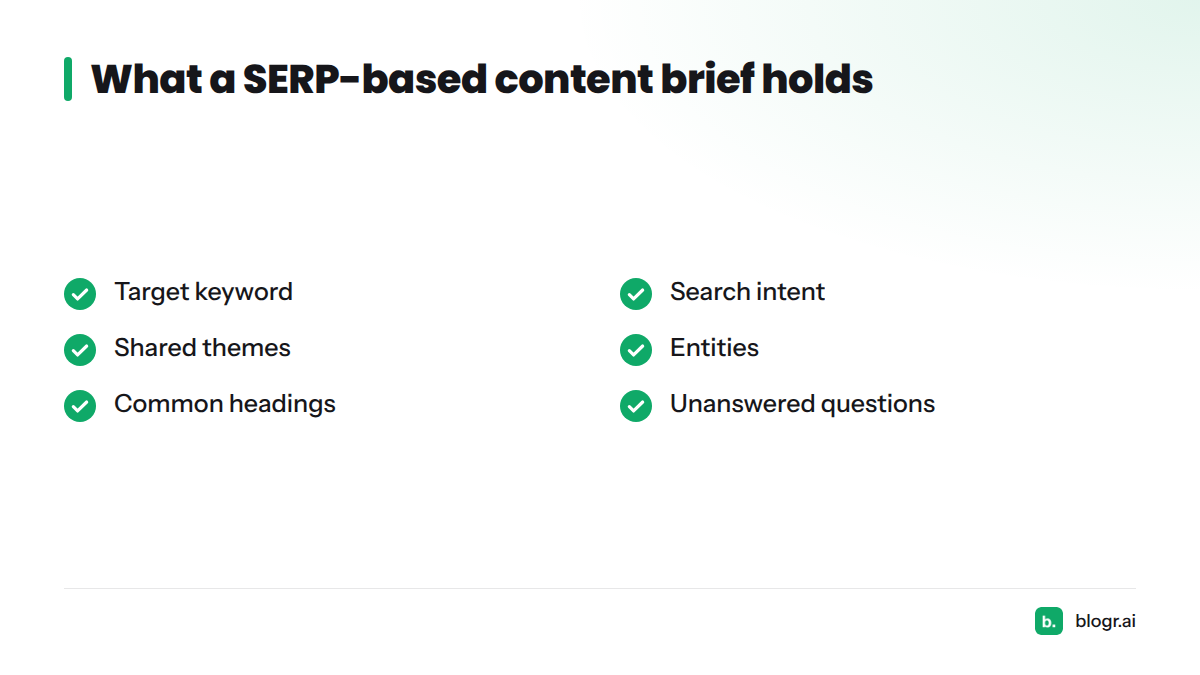
Let's start with the plain answer. A SERP-based content brief holds seven things: the target keyword, the search intent, shared themes, entities, common headings, unanswered questions, and notes for the writer. Each one comes from pages Google is rewarding today, not from a generic template.
The definition, in one sentence
An AI content brief is a structured document, generated from an analysis of the current top-ranking results, that tells a writer what a page must cover to match search intent and where it can add something new.
How a brief differs from a generic AI outline
A generic outline comes from a model's memory. A brief built from top results comes from what sits on the results page today. The table shows the gap:
| Question | Generic AI outline | Manual analyst brief | blogr.ai live SERP brief |
|---|---|---|---|
| Grounded in current results? | No | Yes | Yes |
| Shows shared themes and entities? | Rarely | If the analyst records them | Yes, every time |
| Finds unanswered questions? | No | Depends on time spent | Yes, as a dedicated step |
| Effort per article | Seconds | Hours | Automatic per approved title |
The manual brief is still the quality benchmark, and I respect it. It just doesn't scale. An AI brief generator working from live SERP analysis aims for the same grounding without the hours.
How blogr.ai Builds a Brief From the Live SERP
The method runs in five steps:
- Read the pages ranking now. The system looks at the results currently showing for the target keyword.
- Work out search intent. It decides whether searchers want to learn, compare, or buy, so the brief matches what Google already serves.
- Pull shared themes, entities, and common headings. These form the baseline every competing page covers.
- Find unanswered questions. It flags what the ranking pages skip or answer thinly.
- Assemble the brief. Everything lands in one structured document for the writer.
The flow is a straight line: approved title, live SERP, themes, entities, headings, and gaps, then the brief, then the draft.
Shared Themes Set the Baseline for Your Page
A shared theme is a subject most top pages cover. If seven of ten ranking pages explain a concept, your page needs it too. Skip it and you look incomplete next to results Google already trusts.
Covering shared themes is the floor. It gets you into the conversation. The unanswered questions, covered below, give you a reason to win it.
For a wider view of how single articles fit a whole site plan, see the topical map software that sits above these briefs.
Entities and Common Headings Show What Readers and Search Engines Expect
Entities
Entities are the specific people, products, standards, and concepts a topic revolves around. Search engines use them to work out what a page is about, and Google's Knowledge Graph is built on that idea. The brief lists the entities that recur across ranking pages, so your draft names them directly instead of circling around them.
Common headings
Common headings reveal the structure readers expect. Say most ranking pages open with a definition, move to how it works, then compare options. The brief records that pattern. You can follow it or deliberately improve on it, and either way you choose with evidence.
Content Gaps: The Questions Ranking Pages Leave Unanswered
This is the part I care about most. People Also Ask is one useful signal, but content gaps go further. A gap is a question the top pages ignore, answer vaguely, or bury.
Say ten pages explain what a content brief is, but none shows a finished one. That missing example is a gap. Fill it and your page offers something a reader can't get from the other nine. Google's guidance on creating helpful, people-first content points the same way: original value for the reader is what counts.
Sample Brief Anatomy, Field by Field
The example below is illustrative, not a client result. The keyword and entries are invented to show what each field holds.
| Field | What it holds | Why it matters |
|---|---|---|
| Target keyword | The exact query, for example "how to read a nutrition label" | Anchors the page to one clear topic |
| Search intent | Informational: readers want a step-by-step explanation | Keeps format and tone aligned with the results |
| Shared themes | Serving size, calories, daily value percentages | Baseline coverage every ranking page has |
| Entities | FDA, daily value, macronutrients, added sugars | Signals complete topical coverage |
| Common headings | "What the label shows," "Step-by-step walkthrough," "Common mistakes" | Matches the structure readers expect |
| Unanswered questions | How labels differ for restaurant menus; how to compare two products side by side | Your chance to add something new |
| Notes for the writer | Lead with a real label example; keep paragraphs short | Carries voice and format guidance into the draft |
One honest limit: a brief informs a draft. It does not guarantee rankings, and no tool can promise that.
Ready to see a real one? Start your 7-day free trial and watch a brief build for your own keyword. Prefer to brief by hand first? Browse the blogr.ai blog for guides and a template.
Each Approved Title Triggers Its Own Brief
You approve a title, and the brief starts. There's no template to fill in and no research tab to open. Because each brief reads the SERP for that specific keyword, two articles on your site never share one. The wider SEO content automation workflow covers the rest.
Where the Brief Goes Next in the Publishing Loop
The brief is the handoff between research and writing. The AI SEO writer follows it, and the finished article can publish straight to your site through CMS publishing integrations. Once it's live, the content refresh tool uses Search Console data to keep it current. To check how the result looks in Google, try the free SERP snippet preview.
For the full picture, visit the blogr.ai homepage.
FAQ
What does a blogr.ai brief include?
It includes the target keyword, search intent, shared themes, entities, common headings, unanswered questions, and notes for the writer. All of it comes from the pages ranking now.
Is the brief a copy of competitors' pages?
No. It records patterns across the results, such as themes, entities, and headings, then points to what those pages miss. The goal is a page that covers the baseline and adds something new.
Do I have to edit the brief?
No. It generates automatically for each approved title, and the writer follows it as is. You can still review it, and your own knowledge usually makes the final article better.
How is this different from a manual brief?
A manual brief takes an analyst hours of reading and note-taking. This one runs the same kind of live SERP analysis automatically for every approved title. It does not replace your judgment about what to say.
Start the 7-day free trial and get your first brief today.