


SEO Content Automation: Research to Refresh | blogr.ai
SEO content automation is software that runs the repeatable steps of publishing: finding topics, briefing, drafting, publishing and measuring. None of them needs manual effort every time. blogr.ai automates the full loop, from topical map to Search Console-driven titles, live-SERP briefs, CMS publishing and refresh recommendations, and it keeps your approval in the middle.
Most teams hit the same wall. Writing one post is fine. Researching, briefing, uploading and then checking whether the post still ranks, every single week, is where momentum dies. A one-shot AI writer fixes the drafting step and leaves everything else on your plate. Here is how a connected loop works instead.
Ready to try it? Start the 7-day free trial and watch the first titles arrive from your own search data.
SEO Content Automation: What It Covers and What blogr.ai Handles
The short definition
SEO content automation hands the repeatable work of a content program to software: topic research, planning, briefs, drafts, CMS uploads and performance checks. You decide what is worth publishing. The system does the mechanical work around that decision. The goal is steady publishing and steady updating, not a pile of unreviewed pages.
How it differs from an AI blog writer
An AI blog writer produces a draft and stops. An automated SEO content platform keeps going. It picks topics from real demand, builds the brief from pages that rank today, ships the post to your site, then watches the result and tells you what to refresh. In my view, the writer is one step and the loop is the whole job.
That is what end-to-end content automation means in practice: no hand-off where you copy a draft into a CMS or open a spreadsheet to remember what to check next.
The loop at a glance
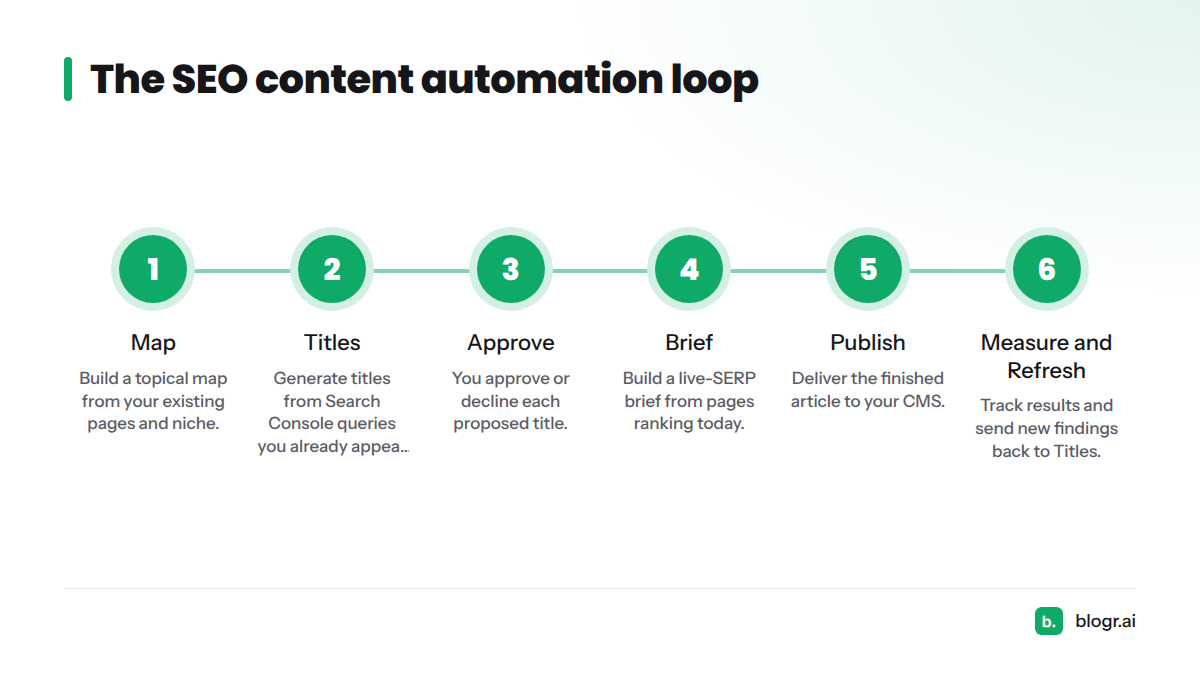
Picture a circle with six stops: Map, Titles, Approve, Brief, Publish, Measure and Refresh. The last stop sends new findings back to Titles, so the circle never ends.
| Stage | What goes in | What is automated | Where you stay in control | Output |
|---|---|---|---|---|
| 1. Map | Your existing pages and niche | Topic selection, pillars, supporting articles, gaps, internal links | You can review and shape the map | Topical map |
| 2. Titles | Search Console queries, focus topics | Title generation from queries you already appear for | You set focus topics | Proposed titles |
| 3. Approve | Proposed titles | Queueing | Approve or decline each title, or opt into autopilot | Approved titles |
| 4. Brief | Approved title | Reading ranking pages, intent, themes, entities, questions | Review before drafting | Live-SERP brief |
| 5. Publish | Finished article | Delivery to your CMS, sitemap, email with live link | Publishing pace | Live post |
| 6. Measure and refresh | Live post data | Tracking and refresh flags | You choose what to update | Refresh recommendations |
Stage 1: Build a Topical Map Before You Write Anything
Everything starts with a plan. blogr.ai reads the pages your site already has and decides which topics you can realistically own. It then lays out pillar pages with supporting articles around them. It names the gaps your competitors leave open and places internal links so new posts connect to old ones.
The order matters for topical authority. Random posts scatter your signals, while a mapped cluster concentrates them. See how the topical map software works, or test the idea first with the free topical map generator.
Stage 2: Search Console Content Automation Turns Real Queries Into Titles
Guessing at keywords is slow and often wrong. blogr.ai connects to Google Search Console and builds titles from queries your site already appears for. Google's documentation on the Performance report describes exactly this data: queries, impressions, clicks and average position.
The best raw material sits just off page one. These "striking-distance" queries already have Google's attention, so one focused article can move them. You can also set your own focus topics, and they sit beside the data-driven ones. Learn the manual version in striking distance keywords: find and fix them in GSC, or read about Search Console-driven planning.
Stage 3: Approve or Decline Every Title
This is the human step, and it is the reason the loop is safe to trust. Nothing gets written without your yes. Nothing reaches your site behind your back. You approve the titles you like and decline the rest.
If you run many sites and trust the system, you can switch to full autopilot. That is an opt-in choice, never the default. In my experience, most owners start with approval on, then loosen it once the first batch of titles proves sensible.
Stage 4: Build the Brief From the Live SERP
A template brief repeats what worked for someone else last year. A live-SERP brief reads the pages ranking right now. It works out the search intent, pulls the themes, entities and headings those pages share, and finds the questions they leave unanswered. Your article then covers what searchers expect and adds what the current results miss.
Stage 5: Automate Blog Publishing to Your CMS
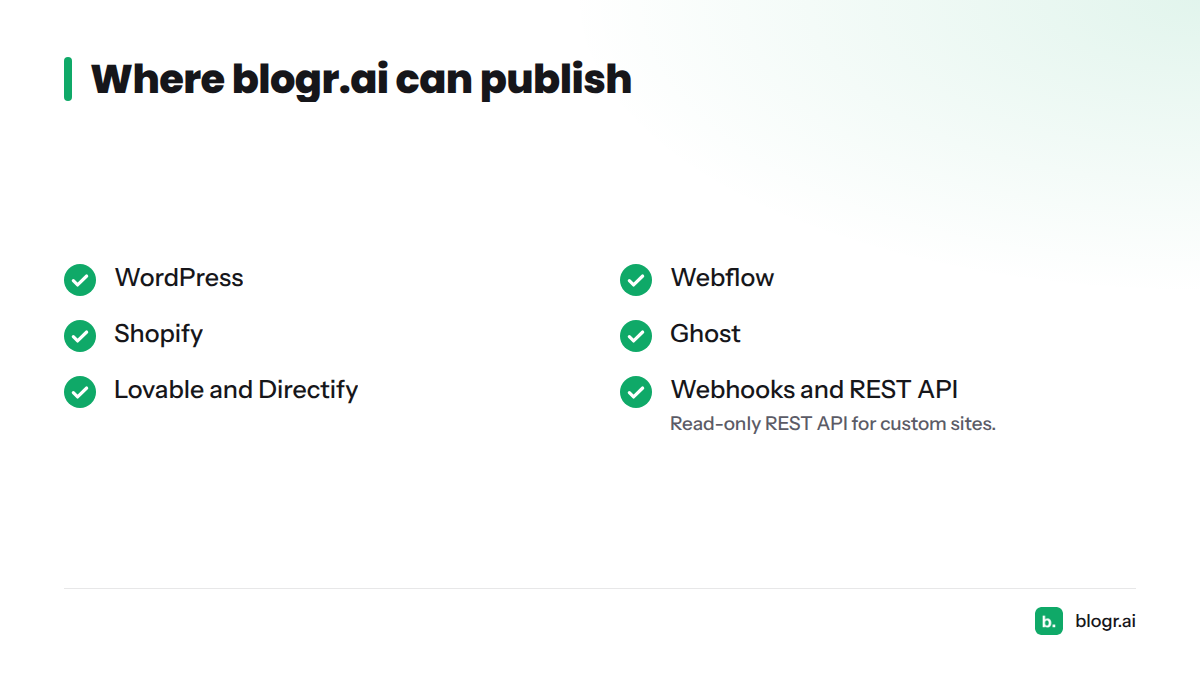
A finished article is worth little until it is live. blogr.ai ships posts to WordPress, Webflow, Shopify, Ghost, Lovable and Directify. It also supports webhooks and a read-only REST API for custom sites. After each publish, the sitemap goes back to Google and you get an email with the live link.
You control the pacing, so fifty pages never appear overnight. Browse the publishing integrations hub, or jump straight to the docs for WordPress, Webflow, Shopify, Ghost or webhooks. Building on Lovable? Here is how to add a blog to your Lovable app.
Stage 6: Measure After Publishing and Act on Refresh Recommendations
Publishing is the midpoint, not the finish. blogr.ai tracks position, impressions, clicks, CTR and new queries for every post. Then it sorts your pages into plain groups:
- Pages worth widening because new queries are appearing.
- Pages that earn impressions without clicks and need a better title or snippet.
- Pages sitting near page one that deserve a push.
- Aging posts whose rankings are slipping.
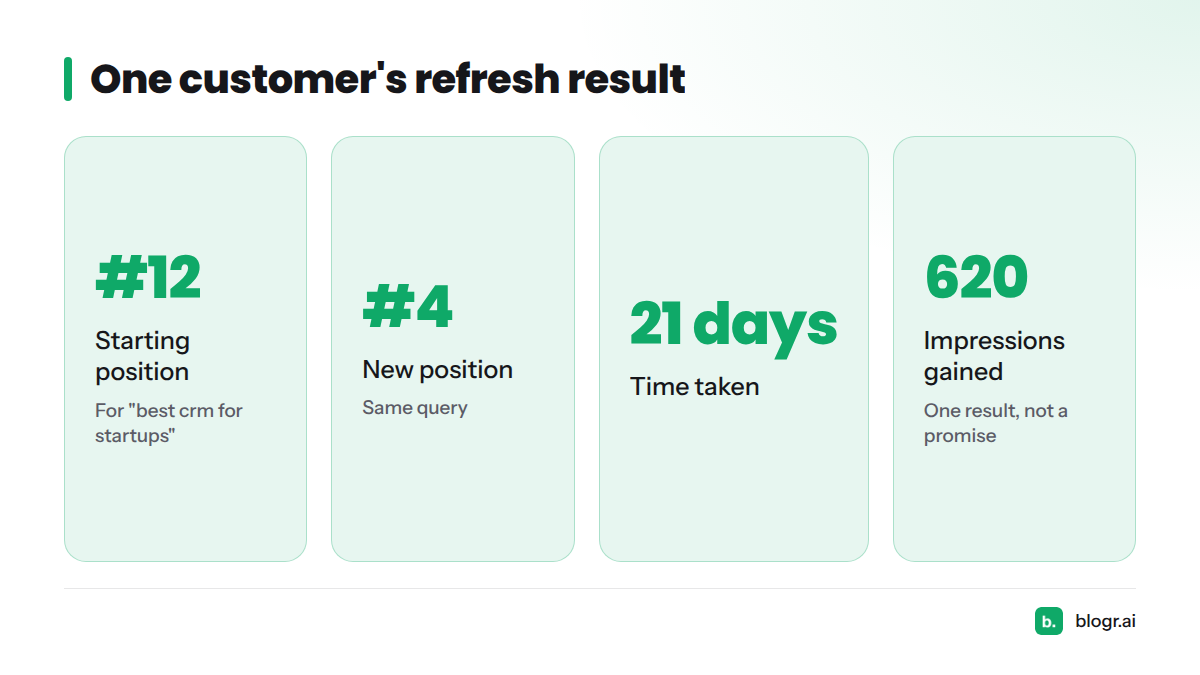
Here is one real data point. A customer's article moved from position #12 to #4 for "best crm for startups" in 21 days and picked up 620 impressions. That is one result, not a promise, but it shows what a targeted update can do. To go deeper on the manual side, read about spotting ranking decay before traffic disappears, why you rank but get no clicks, and the weekly content refresh loop.
How Each Stage Feeds the Next
The stages are not separate tools. Each output becomes the next input:
- The topical map decides which topics are worth owning.
- Search Console data turns those topics into titles you can actually win.
- Your approval turns titles into work orders.
- The live-SERP brief turns each work order into a plan.
- Auto-publish turns the plan into a live post.
- Measurement turns the live post into data.
- Refresh findings and new queries become new titles, and they re-enter the approval queue at stage 3.
That last step closes the circle. Your content library keeps learning from your own search results, and you keep the final say.
Who Gets the Most From the Loop
- SaaS teams: turn product-led topics into steady comparison and how-to coverage.
- Ecommerce stores: publish buying guides beside your product pages.
- Local businesses: cover service-area questions without hiring a writer.
- Agencies: run many client sites with one approval workflow.
- Publishers: keep older posts fresh as they age.
- Solo founders: get a consistent blog without an SEO team. This guide to on-page SEO for founders shows what you can skip.
- Multi-site owners: use autopilot where you trust the output.
Beginners can start safely: keep approval on, let the system propose, and decide yourself. Experienced SEOs will like that every stage stays inspectable, so nothing is a black box.
Next steps: start the 7-day free trial, or compare blogr.ai plans first.
FAQ
What is SEO content automation?
SEO content automation is software that handles the repeatable steps of publishing: finding topics, briefing, drafting, publishing and measuring. A complete system also feeds results back into new topics, so the process repeats without starting from scratch.
How is blogr.ai different from an AI blog writer?
An AI writer makes one draft. blogr.ai runs the loop around it: topical map, Search Console titles, approval, live-SERP brief, CMS publishing, and measurement with refresh recommendations.
Does blogr.ai publish without my approval?
No, not by default. Every title needs your approval before anyone writes it, and nothing is published behind your back. Full autopilot exists, but you must choose it.
Which CMSs can it publish to?
WordPress, Webflow, Shopify, Ghost, Lovable and Directify, plus webhooks and a read-only REST API for custom sites. See the integrations hub for setup docs.
Sources
- Performance report (Search), Google Search Console Help, Google
- Search engine optimization, Wikipedia
Related: refresh recommendations for aging posts, briefs built from the live SERP