


What Is PageRank? Definition and How It Works

PageRank is Google's original link-analysis algorithm. It scores a web page by the number and importance of the pages linking to it, treating each link as a vote of confidence. Votes from important pages count for more. Larry Page and Sergey Brin created it at Stanford University.
That is the short answer. Below is the plain-English version, plus an honest read on what Google PageRank means for SEO in 2026.
What Is PageRank? A Short Definition
PageRank in one line: a score that estimates how important a page is, based on which pages link to it and how important those pages are.
Think of a reference list. A paper cited by many respected papers earns trust, and a web page works the same way. The idea comes from citation analysis, applied to the web instead of academic journals.
What Is PageRank in SEO?
When people ask "what is PageRank in SEO," they usually mean the value a link passes from one page to another. SEOs call that value link equity or link juice. Both labels are informal, and neither is an official Google metric. For more related vocabulary, see our SEO glossary.
Where PageRank Came From
Larry Page and Sergey Brin developed the idea while at Stanford University. Two primary documents describe it:
- The Anatomy of a Large-Scale Hypertextual Web Search Engine, by Brin and Page, describes the early Google system.
- The PageRank Citation Ranking: Bringing Order to the Web, by Page, Brin, Motwani and Winograd, is a Stanford InfoLab technical report that lays out the method.
So yes, Google's founders invented it, and Stanford is where it began. The name is also a small pun: it ranks web pages, and it carries Larry Page's surname.
The sequence ran like this:
- Stanford research produces the PageRank method.
- The Brin and Page paper describes it inside a working search engine.
- Google launches with PageRank as a central ranking idea.
- Google Toolbar PageRank shows a public 0 to 10 score.
- Google retires that public toolbar score.
I left dates off this list on purpose. I only print dates I can tie to a live primary source, and the two papers above are the ones to read for the origin story.
How the PageRank Algorithm Scores a Page
The PageRank algorithm works in three steps:
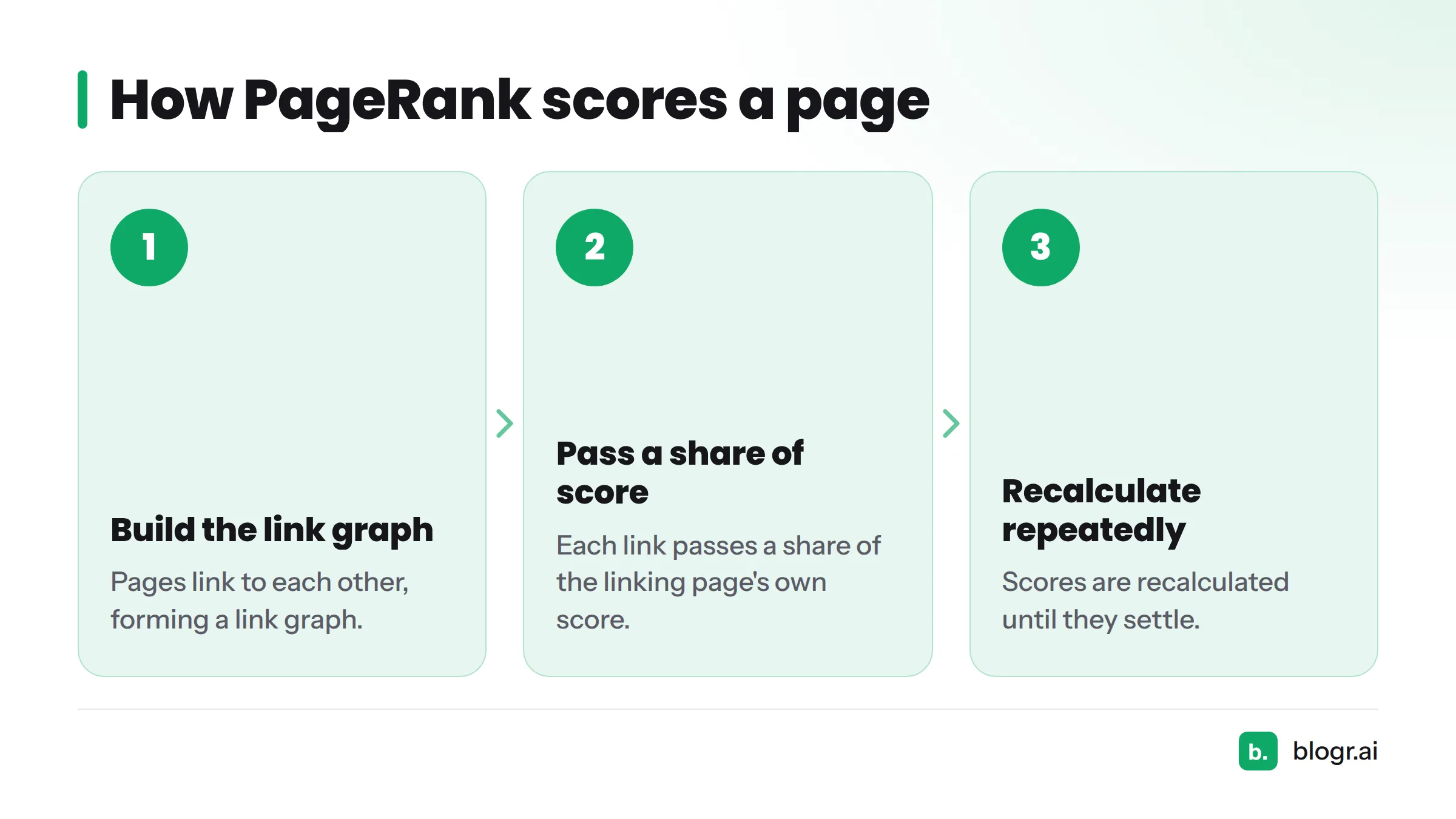
- Pages link to each other, forming a link graph.
- Each link passes a share of the linking page's own score.
- The system recalculates scores repeatedly until they settle.
Here is a small example. Picture four pages: A, B, C and D. B, C and D all link to A, and A links back only to B. A collects the most votes, so A scores high. B scores well too, because a high-scoring page links to it. D has no inbound links, so it scores lowest. The example is illustrative and uses no real-site scores.
| Concept | Plain meaning |
|---|---|
| Link graph | The map of which pages link to which |
| Links as votes | Each link counts as a vote for the page it points to |
| Weighted votes | A vote from an important page counts for more |
| Random surfer model | An imagined person who clicks links at random and sometimes jumps to a new page |
| Damping factor | The chance the surfer keeps clicking instead of jumping; the original paper discusses a value of 0.85 |
| Iteration | Repeating the math until scores stop changing |
If you want the math behind these PageRank algorithms, the Stanford CS54N handout on the PageRank algorithm walks through it. Developers who want code can try graph libraries such as NetworkX.
For a visual walk-through, this short video covers the idea well.
What PageRank Means for Google Rankings Today
Let's be direct: this page does not describe how Google ranks pages today. Google has not published how much weight links carry now, and I won't guess.
What we can say is limited and factual:
- Google Toolbar PageRank, the public 0 to 10 score, no longer exists.
- PageRank was one signal in the original system, not the whole algorithm.
- Google's own How Search works documentation describes links as a way it discovers pages.
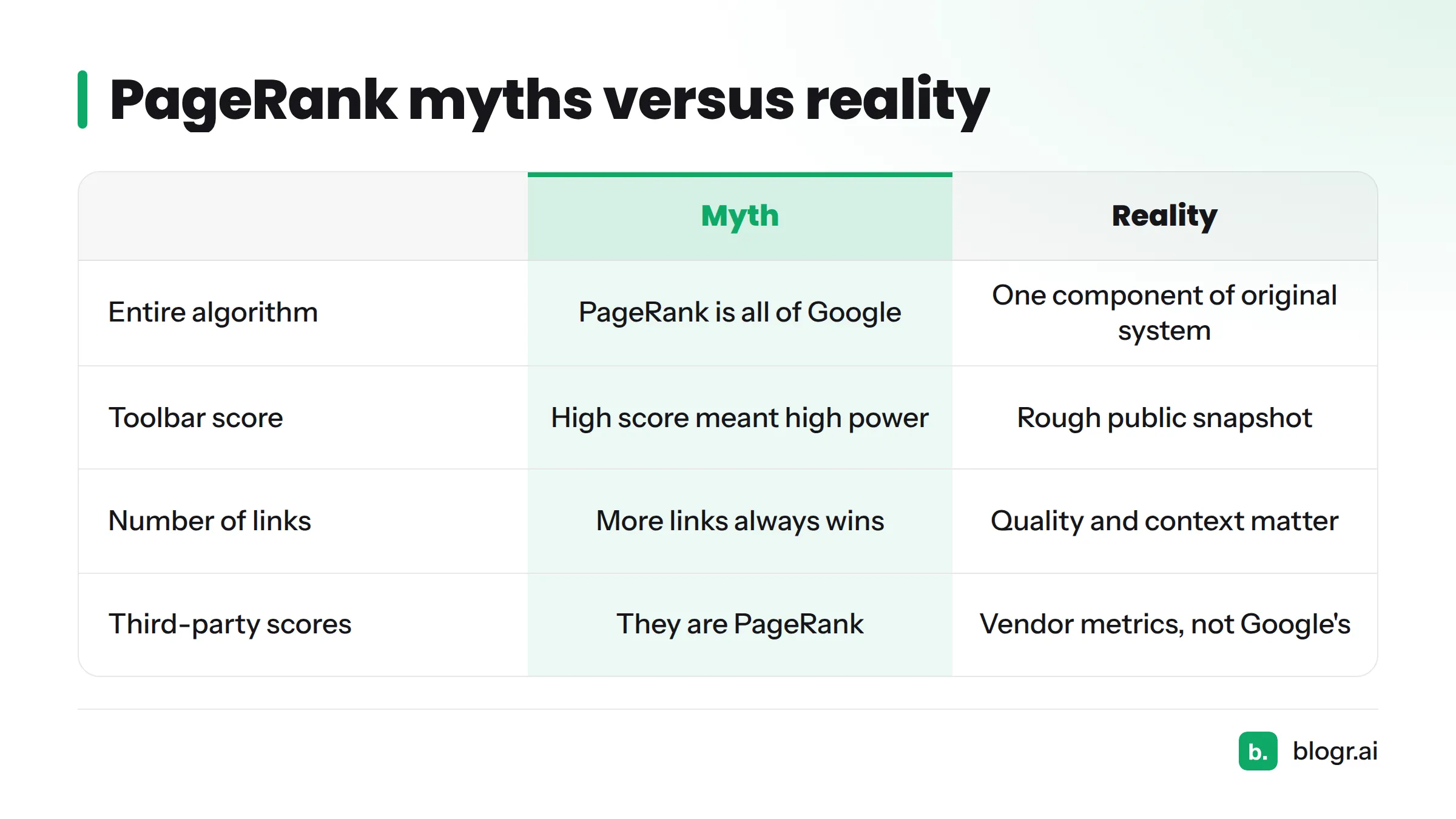
Misconceptions about PageRank Google still circulate, so here is how they stack up against what the sources support:
| Myth | Reality |
|---|---|
| PageRank is Google's entire algorithm | It was one component of the original system |
| A high toolbar score meant high ranking power | The toolbar score was a rough public snapshot |
| More links always wins | Link quality and context matter; the original idea weighted votes |
| Third-party authority scores are PageRank | Those are vendor metrics, not Google's |
How Internal Links Pass Authority to New Posts
This section is my opinion, based on working with content sites. It is not a claim about how Google ranks pages.
A new post starts with zero inbound links. Crawlers find pages by following links, so a post nobody links to can sit undiscovered. A few internal links from related, already-crawled pages give the crawler a way in. The anchor text also tells it what the new page covers.
That is the practical echo of the PageRank idea: links shape discovery and context. They guarantee nothing about indexing or rankings. For how to place those links, read our internal linking strategy guide when it publishes. To plan which posts should link to each other across a cluster, use topical map planning.
Related Link Terms
- Backlink: a link from another site to yours.
- Internal link: a link between two pages on the same site.
- Link equity: the informal idea of value passed through links.
- Link graph: the network of pages and the links between them.
Next steps: our off-page SEO page covers link building, and our search engine definition page covers how engines work. You can also browse more terms at blogr.ai.
Ready to connect your content? Map your cluster first, then plan internal links with topical map planning.
FAQ
Is PageRank still used by Google? Google has not said how it uses PageRank today, and it retired the public toolbar score. Treat any claim of certainty with caution.
Did Google invent PageRank? Yes. Larry Page and Sergey Brin developed it at Stanford University, and it later became part of Google's search engine.
What is PageRank used for? It scores pages by link importance. The same method also applies to any network, which is why graph tools and course materials teach it.
Who owns Google's original search algorithm? Stanford developed the method, and Google is the company built around it. For ownership details, check the original papers and Google's own statements.
Sources
- The Anatomy of a Large-Scale Hypertextual Web Search Engine, Sergey Brin and Larry Page, Stanford University
- The PageRank Citation Ranking: Bringing Order to the Web, Stanford InfoLab
- The Google PageRank Algorithm, Stanford CS54N handout
- How Search works, Google Search Central
- Citation analysis, Wikipedia