


What Is a Keyword in SEO? Simple Definition

A keyword in SEO is the word or phrase that sums up what a person types into a search engine, and what a page is about. "Running shoes" is a keyword. So is "how to clean running shoes." Keywords connect what searchers want with the pages that can answer them.
Quick definition: A keyword is a word or phrase that labels a topic people search for. In programming, a keyword is a reserved word in a language. In school reading, it is an important word that points to a passage's main idea. This page covers the SEO meaning.
Let's start with the plain version, then move to the part most glossaries skip.
What Is a Keyword? A Plain-English Definition
If you have ever typed "what is keyword," "what is keywords" or "what is keyword mean" while staring at a blog tool or an ads dashboard, you are in good company. The term sounds technical, but the idea is simple. Picture a keyword as the label on a drawer. Searchers open the drawer by typing words, and your page sits inside it.
People also search "what is keywording," which usually means the work of choosing and assigning keywords to pages. And "what is keywords in SEO" gets the same answer as the question above: SEO keywords are the topic labels you build pages around.
A simple keyword definition and example
Say a runner types "best running shoes for flat feet" into Google. A shoe retailer writing a buyer's guide would call that phrase its keyword. The guide exists to answer that need, and the phrase names it. You will also see this called a search term or search phrase. Our SEO glossary defines the neighboring terms in the same plain style.
Single words, phrases and acronyms
A keyword can be one word ("shoes"), several words ("waterproof trail running shoes") or an acronym ("SEO"). Length doesn't matter. What matters is that the words describe something a person looks for.
Keywords vs. Search Queries: Why the Difference Matters
This is where beginners get tripped up. A search query is the exact string someone typed. A keyword is the topic label that groups many similar queries. Google's own Search Console performance report documentation uses the word "queries" for what searchers entered, which is why that report is the place to see them.
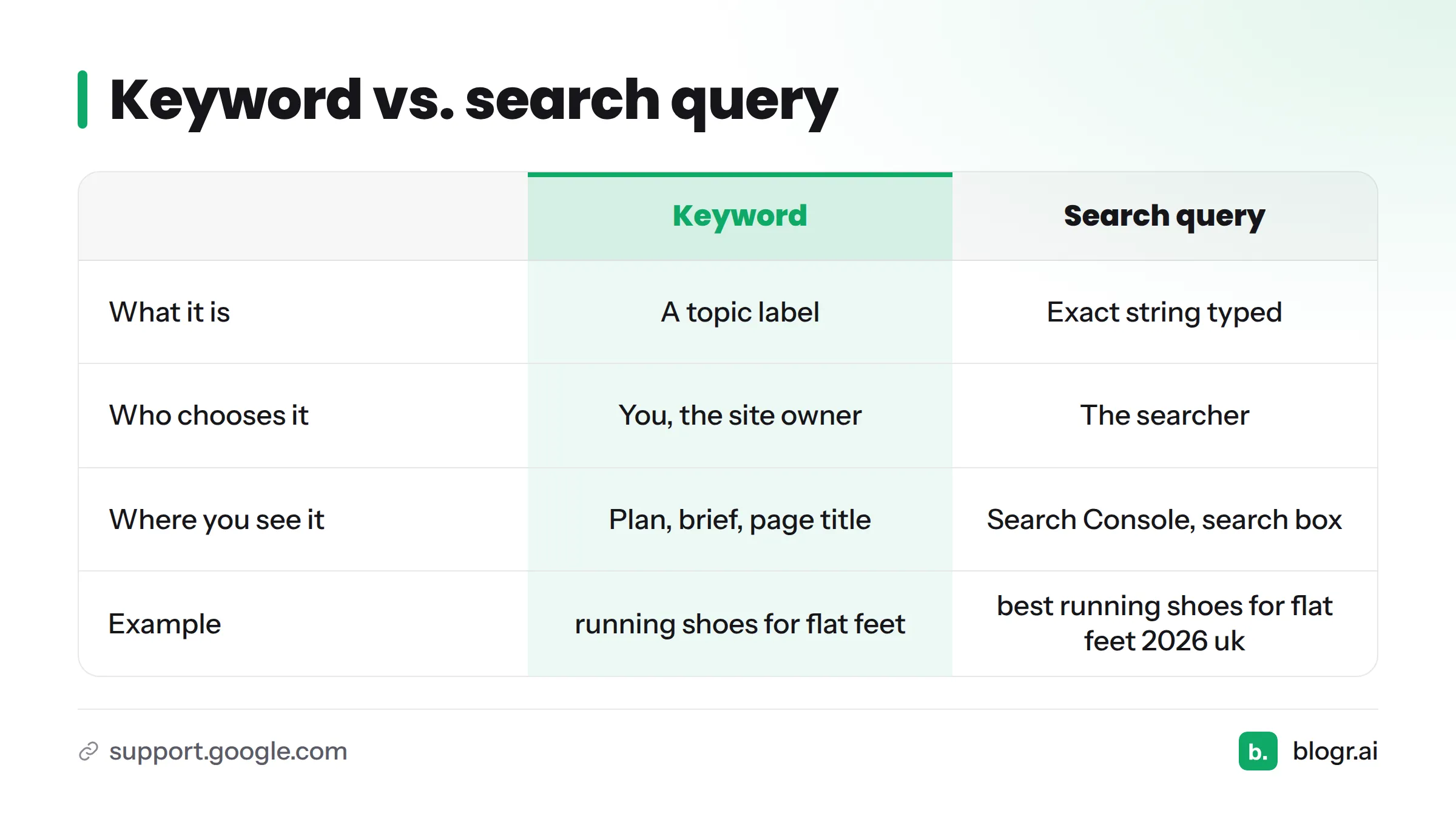
| Keyword | Search query | |
|---|---|---|
| What it is | A topic label | The exact string typed |
| Who chooses it | You, the site owner | The searcher |
| Where you see it | Your plan, brief or page title | Search Console, search box |
| Example | running shoes for flat feet | best running shoes for flat feet 2026 uk |
Here is a quick test. If a real person typed it, it is a search query. If you picked it to describe a page, it is a keyword. Placement rules, such as keyword density, belong in their own guide.
SEO Keywords by Length: Short-Tail to Long-Tail
Keywords sit on a spectrum from broad to specific. The examples below are illustrations, not data.
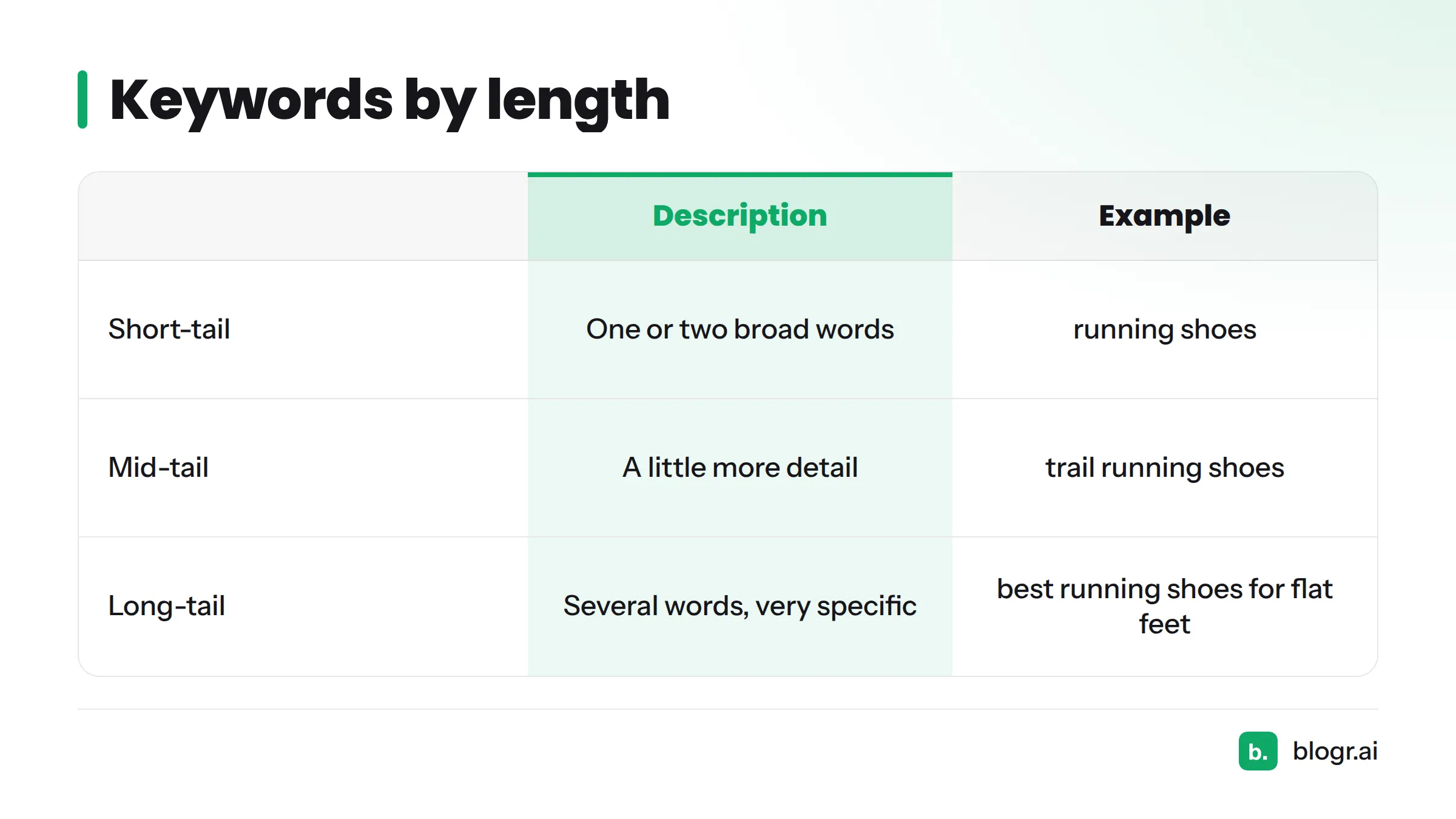
| Type | What it looks like | Illustrative example |
|---|---|---|
| Short-tail (head term) | One or two broad words | running shoes |
| Mid-tail | A little more detail | trail running shoes |
| Long-tail keyword | Several words, very specific | best running shoes for flat feet |
Broad terms cover a lot of ground. A long-tail keyword states a clearer need. Neither wins automatically, and choosing between them is a separate decision that depends on your site and your goal.
SEO Keywords by Search Intent
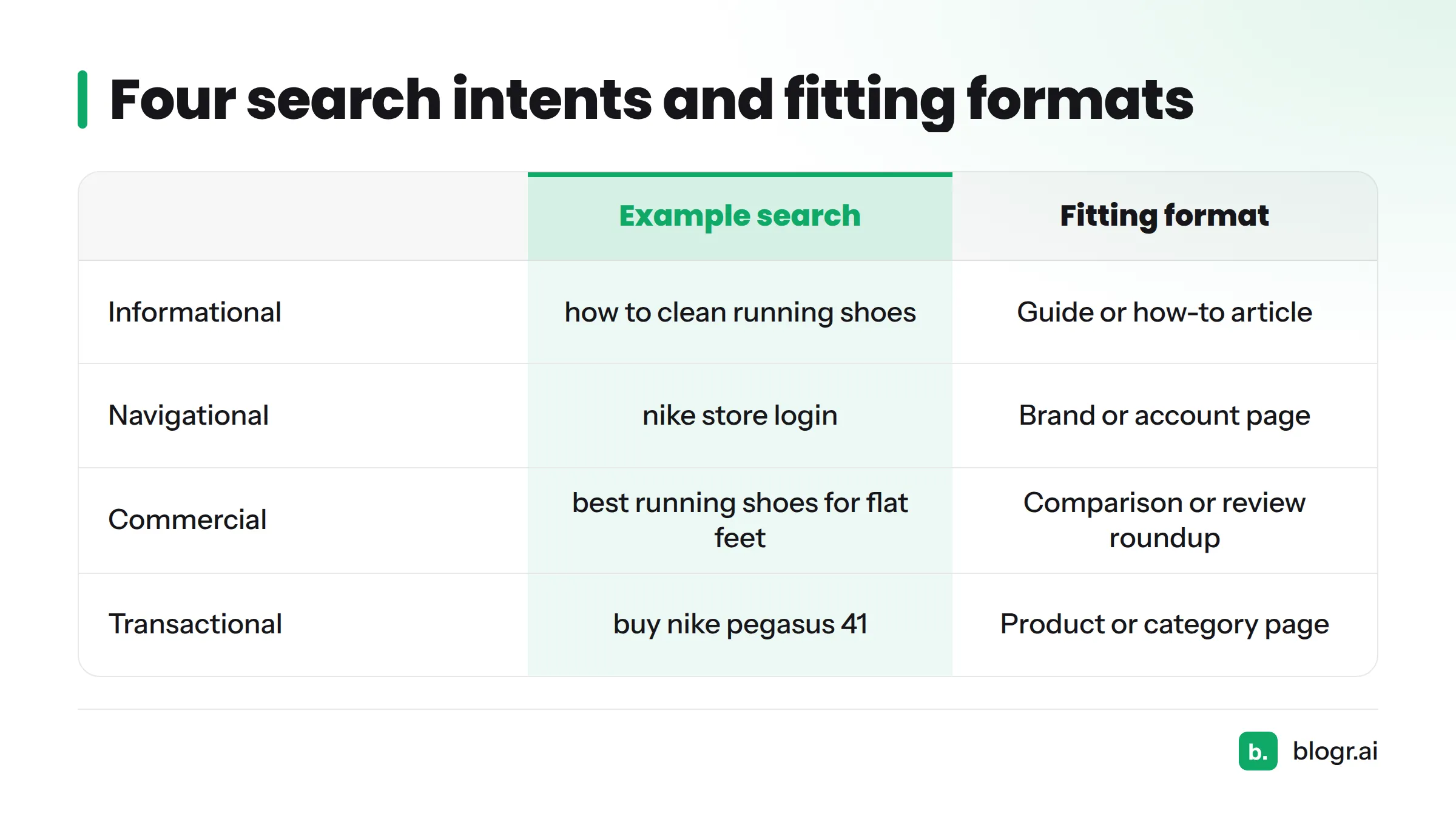
Search intent is the goal behind the words. Four types cover most searches:
- Informational: the person wants to learn.
- Navigational: the person wants a specific site or page.
- Commercial: the person is comparing options.
- Transactional: the person is ready to act or buy.
| Intent | Illustrative example | Content format that fits |
|---|---|---|
| Informational | how to clean running shoes | Guide or how-to article |
| Navigational | nike store login | Brand or account page |
| Commercial | best running shoes for flat feet | Comparison or review roundup |
| Transactional | buy nike pegasus 41 | Product or category page |
Search Intent Decides Whether a Keyword Works
The same words can carry different intent. "Running shoes" alone might mean someone wants to shop, learn what to look for, or find a store. A keyword only becomes useful once you know the search intent behind it.
Read the SERP to confirm intent. Search the phrase yourself. If the first page shows product grids, shoppers are buying. If it shows guides, people are learning. Match the format you see.
AI answer surfaces such as Google AI Overviews still begin from what a searcher typed and what they likely mean, so intent stays central.
What Search Console Shows About Real Keywords
Here is the part I find most useful. When I look at connected sites in Google Search Console, a pattern repeats: the queries a page appears for often differ from the keyword its owner had in mind. A page written for "running shoes for flat feet" may collect impressions for questions about arch support, insoles or pronation that the writer never planned around.
The performance report lists each query with impressions (times you appeared), clicks and average position. Queries sitting just off page one deserve a close look, because small edits can lift them. Our guide to striking distance keywords shows how to spot them. For research steps, read finding keywords in Search Console. The Search Console SEO tool turns that data into suggested actions.
Keyword FAQ
What is the definition of a keyword?
A keyword is a word or phrase that describes a topic people search for and that a page is built to answer.
What is the difference between a keyword and a search query?
A search query is the exact text a person typed. A keyword is the topic label that groups many queries.
What are keywords called?
You will hear search term, search phrase, key phrase and seed keyword. Broad ones are called head terms.
What is a keyword in reading?
In reading, a keyword is an important word in a passage that points to its main idea.
What does keyword mean for kids?
For kids, a keyword is a word you type into a search box to find what you want, such as "volcano facts."
Is a focus keyword the same as a keyword?
A focus keyword is the main keyword you choose for one page. A page can attract many other keywords too.
Are long-tail keywords better?
Not by default. A long-tail keyword is more specific, while short-tail terms are broader. Which fits depends on your goal.
Next Step: Group Your Keywords
Got a list of keywords and no idea how they fit together? Try the Free Keyword Clustering Tool from blogr.ai to group them by topic in minutes.