

What Is a Web Crawler? Definition for SEO
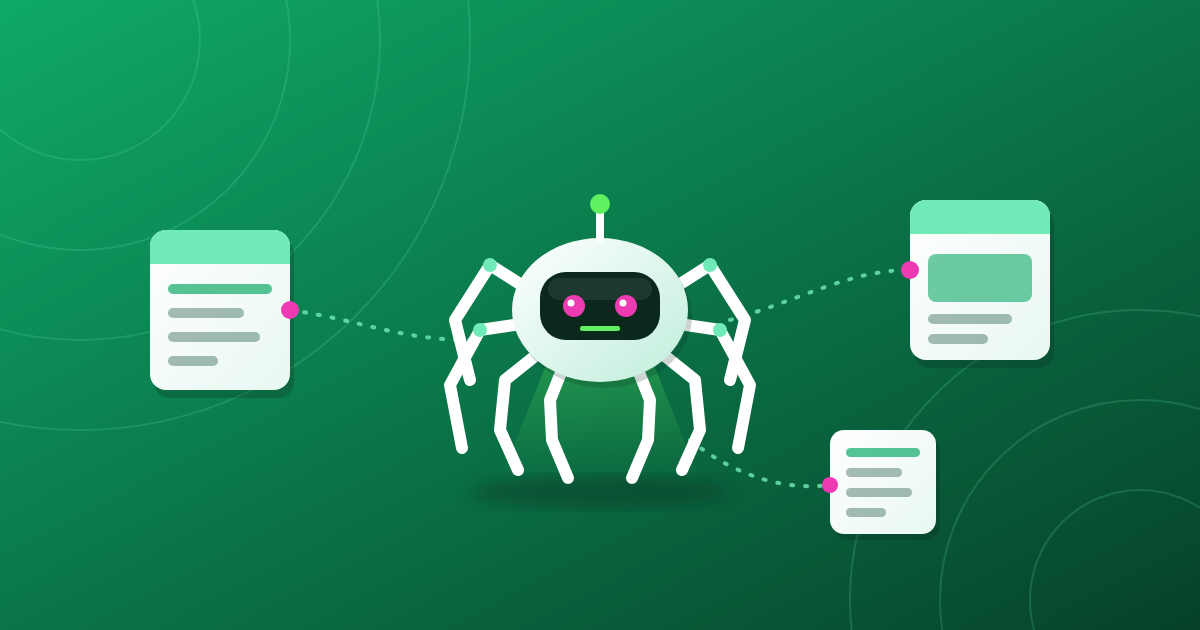
A web crawler (also called a web spider or crawler bot) is an automated program that fetches web pages and follows their links to find more pages. Search engines run crawlers such as Googlebot to collect content so it can be considered for their index.
Quick answer: A web crawler discovers and fetches pages for a search engine. It does not decide what gets indexed or how pages rank.
What Is a Web Crawler?
If you have ever wondered what a web crawler is, picture software that visits a URL, downloads the page, and reads the links inside it. Google describes this stage as crawling, where it finds and fetches pages before anything is indexed.
You will meet several names for the same thing: spider, spiderbot, search engine bot, website crawler. All of them mean a program that hops from link to link.
One boundary matters. Crawling is discovery. Whether a page enters a search index, and where it ranks, are separate steps. The SEO glossary covers those terms if you want the definitions side by side.
How Web Crawlers Work
Think of a crawler as a very fast reader holding a to-do list. Here is the loop:
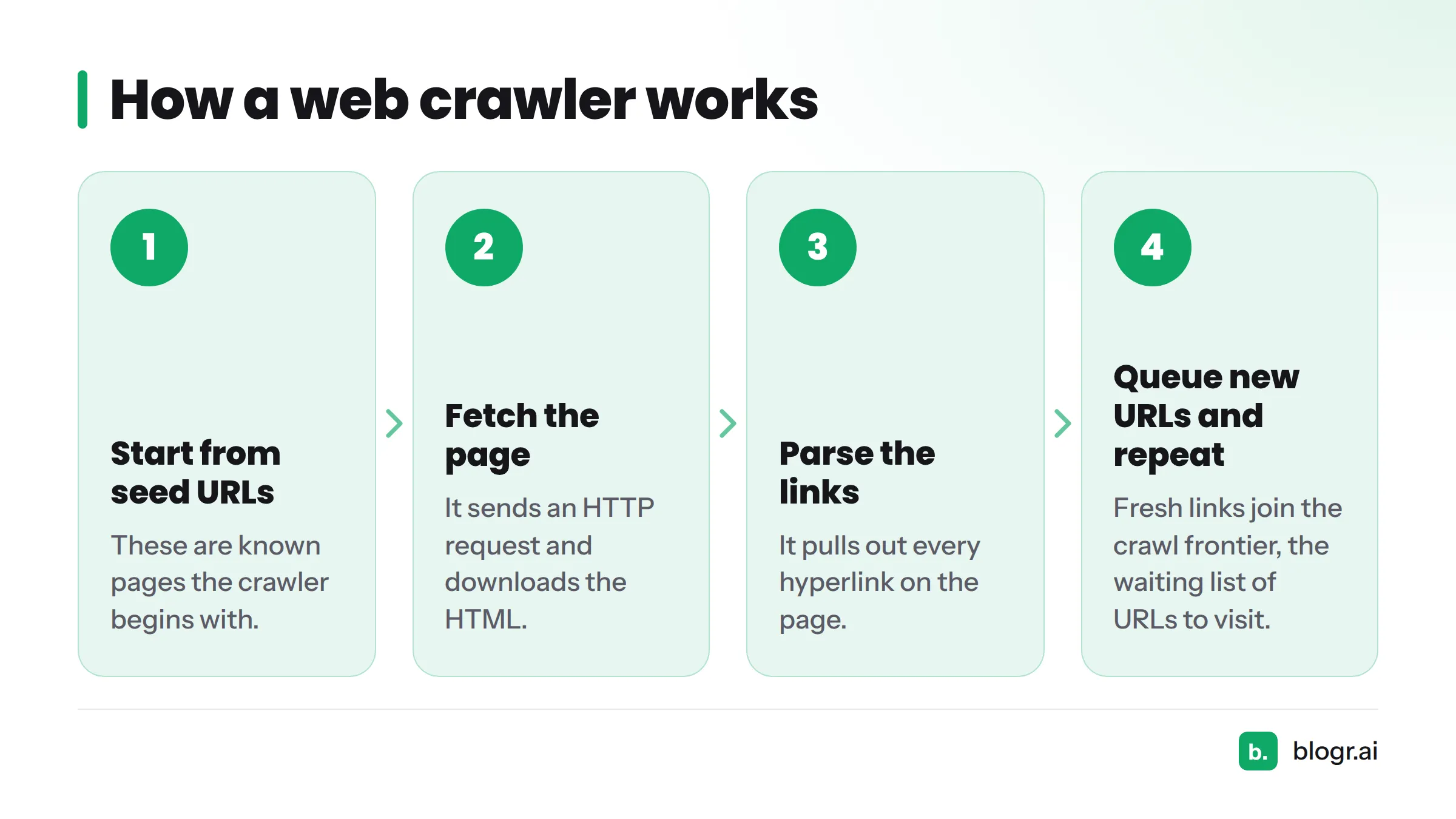
- Start from seed URLs. These are known pages the crawler begins with.
- Fetch the page. It sends an HTTP request and downloads the HTML.
- Parse the links. It pulls out every hyperlink on the page.
- Queue new URLs and repeat. Fresh links join the crawl frontier, the waiting list of URLs to visit.
Well-behaved crawlers check robots.txt before they fetch anything. Google explains that a robots.txt file tells crawlers which URLs they can access. It manages crawling, not whether a URL shows up in results. The format is standardized as the Robots Exclusion Protocol in RFC 9309.
URL Discovery: Sitemaps and Internal Links
Crawlers find URLs two main ways: they follow links, and they read an XML sitemap. Google notes that a sitemap is a file that tells search engines about the pages on your site. Treat it as a hint, not a command.
Internal links do the quiet work. A page linked from your homepage or a related post gets found faster than an orphan page that nothing points to. Links also pass authority, the idea behind PageRank. Canonical URLs help too, because they tell crawlers which duplicate version you prefer.
What we see as publishers: when automated blogging pushes a new post live, the post usually reaches Google through two doors, the sitemap entry and a link from an existing page. Some posts get picked up quickly. Others wait. Timing varies, and nothing guarantees it.
Why Crawling in SEO Comes First
A page that never gets crawled cannot be indexed. Crawling is step one.
Crawl budget is the amount of crawling Google will do on your site. Google says crawl budget management matters mostly for very large or fast-changing sites. Most small sites can skip the worry.
Here is how the three stages split up:
| Stage | What happens | Question it answers |
|---|---|---|
| Crawling | A bot discovers and fetches the page | Can the engine find it? |
| Indexing | The engine processes and stores the page | Is it eligible to appear? |
| Ranking | The engine orders results for a query | Where does it show up? |
"Discovered - Currently Not Indexed": What It Means
Google Search Console sometimes labels a URL "Discovered - currently not indexed." Google's Page indexing report help says this means Google knows the URL but has not crawled it yet.
In our experience, new posts can sit in that status for a while, especially on newer sites. Think of it as a waiting room, not a verdict. To read these reports with confidence, see how to read Google Search Console data.
Common Web Crawler Examples
| Crawler | Operator | Purpose |
|---|---|---|
| Googlebot | Crawls pages for Google Search (Google crawler overview) | |
| Bingbot | Microsoft | Crawls pages for Bing (Bing Webmaster guidelines) |
| AI crawlers | AI companies | Collect content for AI products; each publishes its own rules |
| SEO audit crawlers | Tool vendors | Scan your own site for technical issues |
Is ChatGPT a web crawler? Not by itself. OpenAI documents separate bots, such as GPTBot, that crawl the web and can be controlled through robots.txt.
FAQ
What is crawling in SEO?
It is the process where a search engine bot discovers and fetches your pages by following links and reading sitemaps.
Is a web crawler the same as a web scraper?
No. A crawler discovers pages. A scraper extracts specific data from them. One tool can do both.
How do crawlers find new pages?
Mainly through links from known pages and URLs listed in an XML sitemap.
Does robots.txt remove a page from Google?
No. It controls crawling. Use other methods to keep a page out of results.
Next steps: want to see which of your pages Google has crawled and indexed? Run the free Search Console audit from blogr.ai.
Sources
- How Google Search works, Google Search Central
- Introduction to robots.txt, Google Search Central
- RFC 9309: Robots Exclusion Protocol, IETF
- Sitemaps overview, Google Search Central
- Crawl budget management for large sites, Google Search Central
- Page indexing report, Search Console Help
- Overview of Google crawlers, Google Search Central
- Bing Webmaster Guidelines, Microsoft Bing
- Overview of OpenAI crawlers, OpenAI