


Blog Examples for Students: 8 Formats to Model
Good blog examples for students to model fall into eight formats: reflective journal posts, book or article reviews, how-to explainers, research summaries, opinion posts, case studies, listicles, and interviews. Each follows a repeatable structure you can rebuild in your own words. Below, every format gets a short skeleton and an editor's note. Want a ready-made layout first? Grab the blog template for students.
I review blog drafts for a living at blogr.ai, and student drafts tend to fail in the same few places. The headline promises one thing, the post delivers another, and the main point shows up in paragraph four. The skeletons below are illustrative patterns I built from that review work. They are not drawn from named student submissions. Last updated for 2026.
What Makes a Good Student Blog Example to Model
A good example is one you can take apart. If you can point to the headline, the hook, the main point, the evidence, and the ending, you can rebuild that structure around your own topic. Let's break it down.
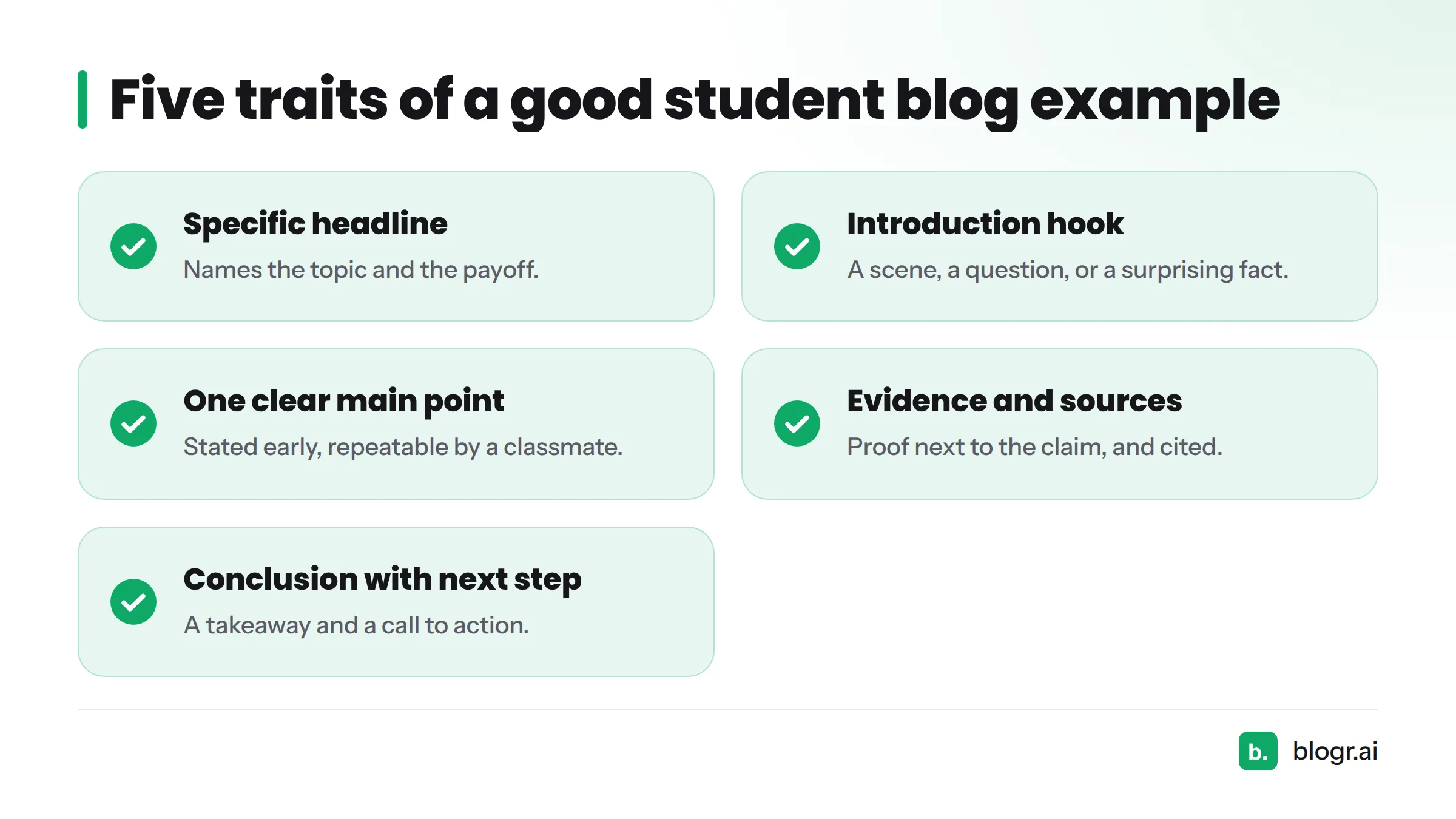
Five traits to look for
- A specific headline. It names the topic and the payoff, such as "What a Failed Lab Taught Me About Planning."
- An introduction hook. One or two sentences that give the reader a reason to continue: a scene, a question, or a surprising fact.
- One clear thesis or main point. State it early, in a sentence a classmate could repeat.
- Evidence and sources. Put proof next to the claim it supports, and cite it.
- A conclusion with a next step. End with a takeaway and a call to action, such as a question for readers or a resource to try.
How a blog post differs from an essay
An essay can build slowly toward its argument. A blog post leads with the point. It uses a conversational voice, short paragraphs of two to four sentences, and subheadings so a reader can scan. The standards of honesty and sourcing stay the same, so your instructor will still expect credit for borrowed ideas. The Purdue Online Writing Lab is a reliable place to check how citations work.
What an editor checks first in a draft: Does the headline promise something the post delivers? Can I find the main point in the first 100 words? Does a source or an example follow every claim? Those three checks catch most weak drafts.
The eight formats at a glance
| Format | Purpose | Typical length | Evidence level | Best for |
|---|---|---|---|---|
| Reflective learning journal | Show what you learned | 500 to 800 words | Low (your own experience) | Reflective writing assignments |
| Book or article review | Judge a text | 600 to 900 words | Medium (quotes) | Reading responses |
| How-to explainer | Teach a process | 600 to 1,000 words | Medium | Skills and lab topics |
| Research summary | Translate a study | 700 to 1,000 words | High (cited source) | Science and social science classes |
| Opinion and argument | Defend a position | 600 to 900 words | Medium to high | Debate and civics topics |
| Case study or project write-up | Report what you did | 700 to 1,100 words | Medium | Capstones and group projects |
| Listicle | Organize ideas in items | 500 to 900 words | Low to medium | Beginners, quick topics |
| Interview or profile | Share a person's story | 600 to 1,000 words | Medium (quotes) | Career and community units |
Length ranges are my editorial rules of thumb. Your blog rubric always wins, so check it first. For formats beyond the classroom, see these blog post examples across formats.
1. Reflective Learning Journal Post
The reflective blog post is the most common class blog assignment, and the easiest to get wrong.
What it looks like (a skeleton)
- Headline pattern: "What [specific event] Taught Me About [skill or idea]"
- Hook: Open on one concrete moment, such as the minute your experiment failed.
- Main point: The lesson, stated in one sentence.
- Evidence: Two or three details from the moment, plus a course concept or reading that explains it.
- Close: What you will do differently, and a question for readers.
Why it works: editor's note
The post pairs a specific moment with a lesson. The common weakness is diary-style summary ("First we did this, then we did that"). Cut the recap and keep the one scene that changed your thinking.
2. Book or Article Review Post
What it looks like (a skeleton)
- Headline pattern: "[Title] Review: Worth Reading for [audience]?"
- Hook: Your verdict in one line.
- Main point: What the author argues, in plain words.
- Evidence: Two short quotes with page numbers or links, each followed by your reaction.
- Close: Who should read it, plus one weakness.
Why it works: editor's note
The verdict arrives early, so readers know where you stand. Quotes carry citations, and the judgment stays balanced. Drafts often praise everything in a review post. Name one real limitation.
3. How-To Explainer Post
What it looks like (a skeleton)
- Headline pattern: "How to [result] in [number] Steps"
- Hook: The problem a beginner faces.
- Main point: The promise: after these steps, the reader can do X.
- Evidence: Numbered steps and one worked example.
- Close: A common mistake and a next task to try.
Why it works: editor's note
A good explainer post names a defined audience ("first-year chemistry students") and shows one example, not five. Drafts slip when a step hides two actions. Split them.
4. Research Summary Post
What it looks like (a skeleton)
- Headline pattern: "What a Study on [topic] Found About [outcome]"
- Hook: The finding in plain language.
- Main point: Why the finding matters to your reader.
- Evidence: The study's authors, journal, year, method in one sentence, and a full citation.
- Close: Limitations and what you still want to know.
Why it works: editor's note
The plain-language finding comes first, and the source follows right away. Always state a limitation, such as a small sample. Ask your instructor which style to use: APA Style, MLA, or Chicago.
5. Opinion and Argument Post
Yes, you can write an opinion post for a class blog if the assignment allows a position.
What it looks like (a skeleton)
- Headline pattern: "Why [position] Deserves a Second Look"
- Hook: A common belief you want to challenge.
- Main point: Your position in one sentence.
- Evidence: Two supporting facts with sources, then the strongest counterpoint and your reply.
- Close: A call to action for readers.
Why it works: editor's note
A stated position and an honest counterpoint make the argument credible. Weak drafts attack a straw version of the other side. Quote the best version instead.
6. Case Study or Project Write-Up
What it looks like (a skeleton)
- Headline pattern: "How We [achieved result] on [project]"
- Hook: The problem and the stakes.
- Main point: What you built or tested, and the outcome.
- Evidence: Process steps, data or screenshots described in words, results.
- Close: What you would change next time.
Why it works: editor's note
Problem, process, result, and a reflection make a complete arc. Drafts often skip the problem and jump to the process. Readers need the why first.
7. Listicle Post
What it looks like (a skeleton)
- Headline pattern: "[Number] [Things] Every [audience] Should Know About [topic]"
- Hook: Why the list matters now.
- Main point: The one idea tying the items together.
- Evidence: Items that share the same structure: a name, a sentence of explanation, a source or example.
- Close: Ask readers to add their own item.
Why it works: editor's note
Choose the number for a reason, not for effect. Seven items you can support beat ten you padded. For more patterns, see these listicle examples and how to write one.
8. Interview or Profile Post
What it looks like (a skeleton)
- Headline pattern: "[Name] on [specific lesson or career path]"
- Hook: A striking quote.
- Main point: The angle: why this person, why now.
- Evidence: Three or four quotes placed in context, with your short framing for each.
- Close: The takeaway and where readers can learn more.
Why it works: editor's note
A purposeful angle keeps an interview from becoming a transcript. Get permission before you publish, attribute every quote, and read the person's words back to them for accuracy.
How to Model an Example Without Copying It
Modeling means learning the shape of a post, not borrowing its sentences. Passing off someone's words as yours is plagiarism, and the concept is explained on Wikipedia's academic integrity page.
Borrow the structure, not the sentences
| Borrow | Change |
|---|---|
| Headline pattern | The topic and wording |
| Order of sections | Your examples and details |
| Where the main point sits | Your actual claim |
| Placement of citations | Your sources |
| Length and paragraph size | Your voice and word choice |
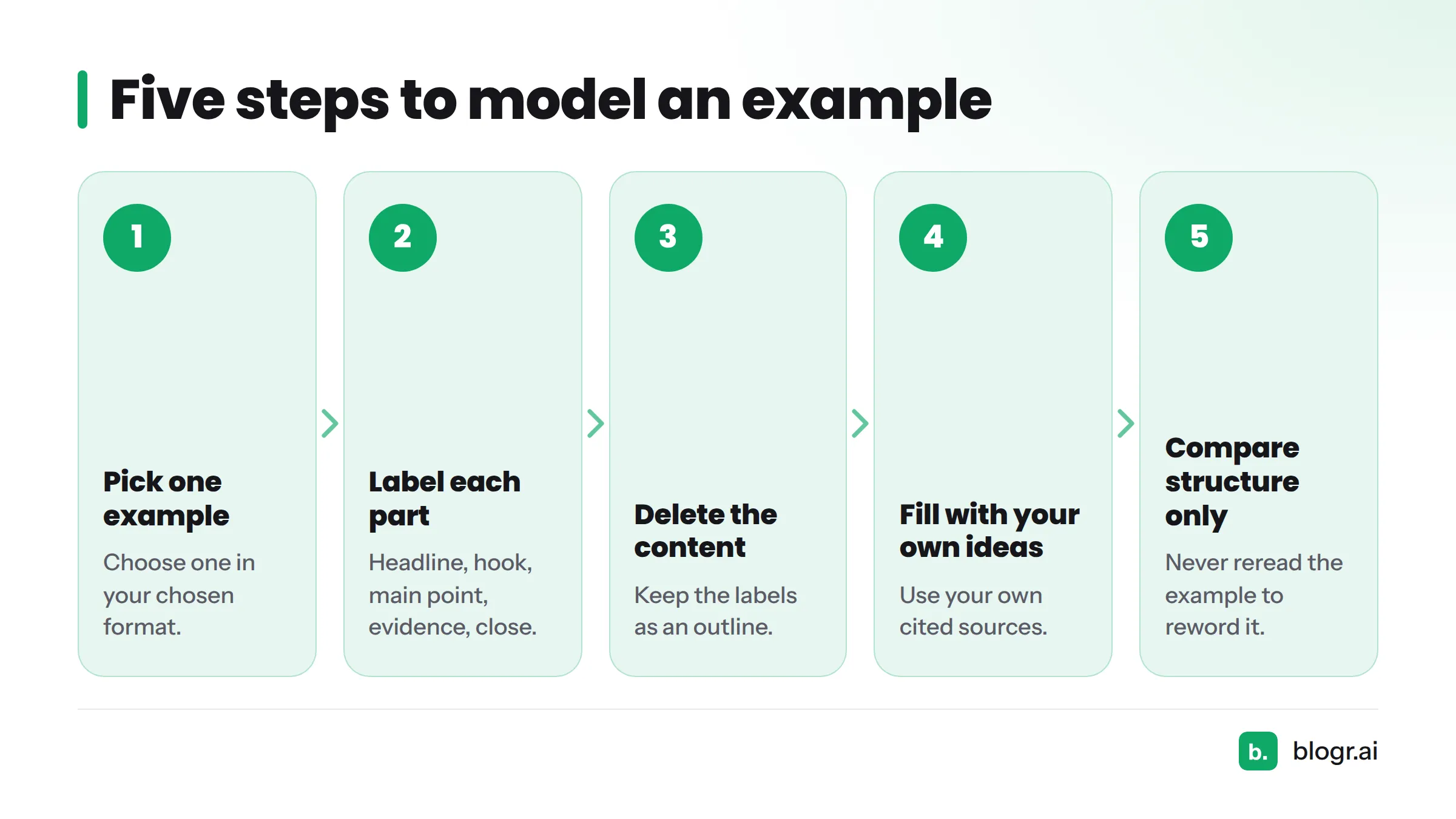
Here is a five-step method:
- Pick one example in your chosen format.
- Label each part: headline, hook, main point, evidence, close.
- Delete the content and keep the labels as an outline.
- Fill each slot with your own ideas and cited sources.
- Reread the example only to compare structure, never to reword it.
If you want one complete post to study, read a full annotated sample blog.
Send your draft for feedback before you submit
A fresh reader catches what you cannot. Ask a classmate or tutor to run this one-pass checklist:
- Can they state your main point after reading only the headline and first paragraph?
- Does every claim have a source or example beside it?
- Do subheadings tell the story on their own?
- Does the ending give a next step?
Format-picker checklist
| If your assignment says... | Pick this format |
|---|---|
| "Reflect on," "what did you learn" | Reflective learning journal |
| "Respond to a reading," "evaluate" | Book or article review |
| "Teach," "demonstrate," "guide" | How-to explainer |
| "Summarize a study," "report findings" | Research summary |
| "Argue," "take a position" | Opinion and argument |
| "Document your project" | Case study |
| "Share tips," "list resources" | Listicle |
| "Talk to someone," "community voice" | Interview or profile |
First-time blogger? Start with the how-to explainer or the listicle. Their structure is the most forgiving. Some courses use a separate blog assignment template, so ask your instructor and check the blog rubric for length, tone, and citation rules.
Troubleshooting common draft problems
- Reads like an essay: Shorten paragraphs, add subheadings, and lead with the point.
- No main point: Write one sentence that starts "This post argues..." and move it to the top.
- Thin evidence: Add one source per major claim, cited in the style your course uses.
- Weak headline: Add the topic and the payoff, and cut vague words like "thoughts" and "things."
Frequently Asked Questions
What are good blog examples for students to model in a class assignment?
Reflective journal posts, reviews, how-to explainers, research summaries, opinion posts, case studies, listicles, and interviews. Each has a repeatable structure.
How should I write a blog?
Follow five steps: pick a format, write a specific headline and hook, state your main point, support it with cited sources, and close with a next step.
How long should a student blog post be?
Most class posts run 500 to 1,000 words. Your rubric sets the real limit, so follow it.
Do I need citations in a blog assignment?
Usually yes, when you use someone else's ideas, data, or quotes. Ask which style your instructor wants: APA, MLA, or Chicago.
Can a 14-year-old start a blog?
Often, yes, but platforms set their own age rules. Check the terms of the site you choose and ask a parent or teacher for permission. Class blogging platforms such as Edublogs are built for school use, and Edutopia covers blogging in the classroom.
Are blogs still relevant in 2026?
Yes. For students, they remain a low-pressure way to practice clear writing and build a visible portfolio. University student blogs, such as those run by MIT Admissions and the University of London, show the format is still in active use.
What platforms can students use for a class blog?
Blogger, Edublogs, WordPress.com, and Medium are common options. Your instructor may require a specific one.
Next Steps
Pick a format from the table, label an example, and fill in your own content. Then download the student blog template to turn the skeleton into a finished draft.