


Listicle Examples and How to Write One With AI

A strong listicle example promises a finite, scannable list, states how its entries were chosen, gives every entry the same useful structure, and answers something the existing results leave out. To write one with AI, build a brief from the live SERP, generate a draft, then edit for accuracy and depth. The outlines below are constructed for this page, so treat them as illustrative skeletons, not famous real-world lists.
I look at list queries all day, and the same pattern keeps showing up. The lists that earn their spot are not the longest. They are the ones with a clear reason behind every line. Let's break down what that looks like.
What Is a Listicle, and What Makes One Strong?
Start with the basics, then the traits that separate a good list from a pile of links.
A one-line definition
A listicle is an article built around a list of items, each with a short heading and a brief explanation. A strong one states its selection criteria, uses a sensible number of entries, and gives every entry the same structure. Merriam-Webster defines the word as an article consisting of a series of items presented as a list. You will also hear it called a list post, a roundup post, or a numbered list article. The wording changes. The job does not.
The five traits of a strong listicle format
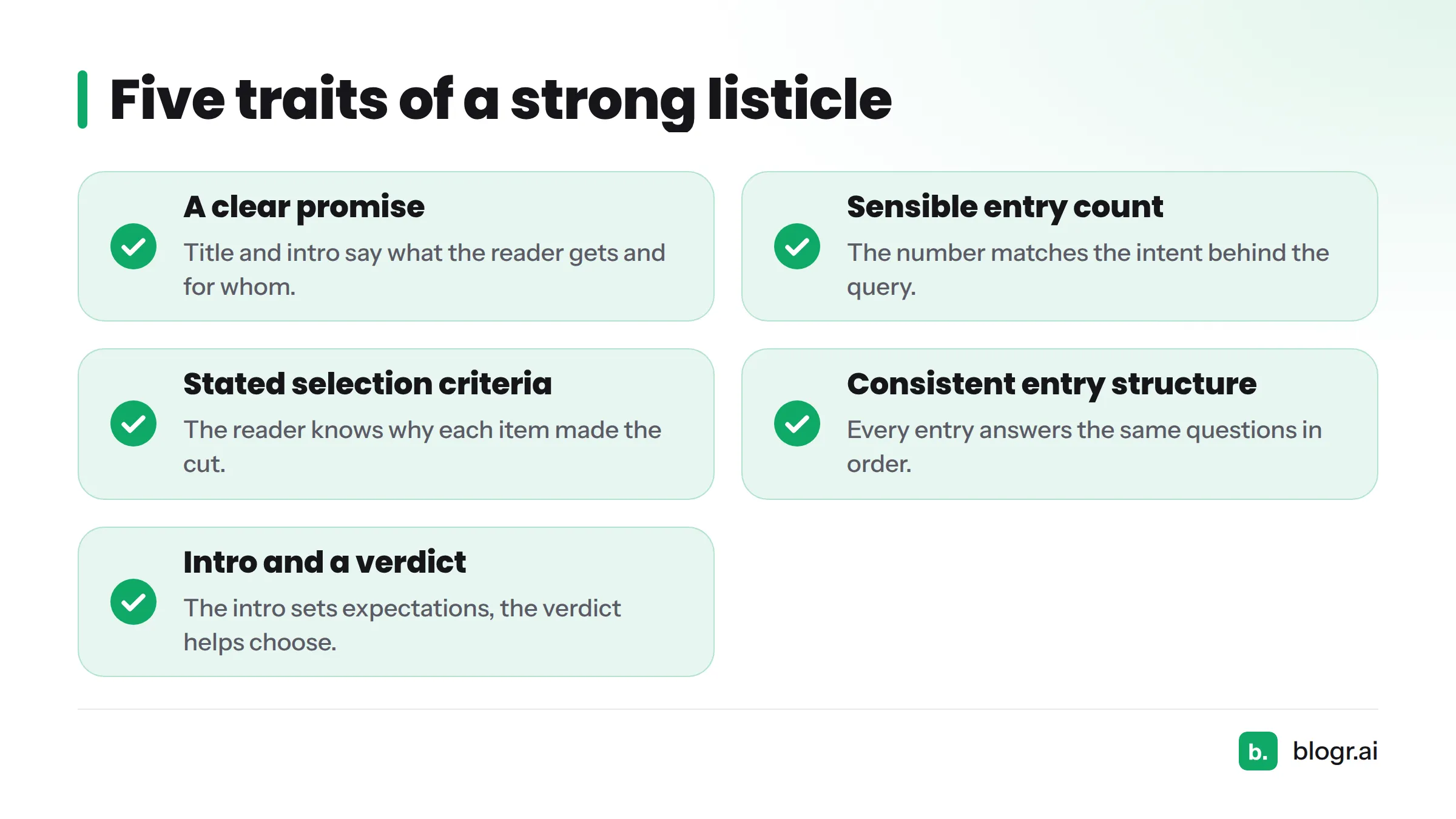
These are the five traits I check first when I review any list:
- A clear promise. The title and intro say what the reader gets and for whom.
- A sensible entry count. The number matches the intent behind the query, not a lucky number.
- Stated selection criteria. The reader knows why each item made the cut.
- A consistent per-entry structure. Every entry answers the same questions in the same order.
- An intro and a verdict. The intro sets expectations. The verdict helps the reader choose.
Picture the anatomy from top to bottom: a promise-led title, a short intro with criteria, a run of identically built entries, then a closing verdict. If one of those layers is missing, the list feels thin even when it is long.
Listicle Example 1: The Tight, Criteria-Led List
Illustrative outline, constructed for this page.
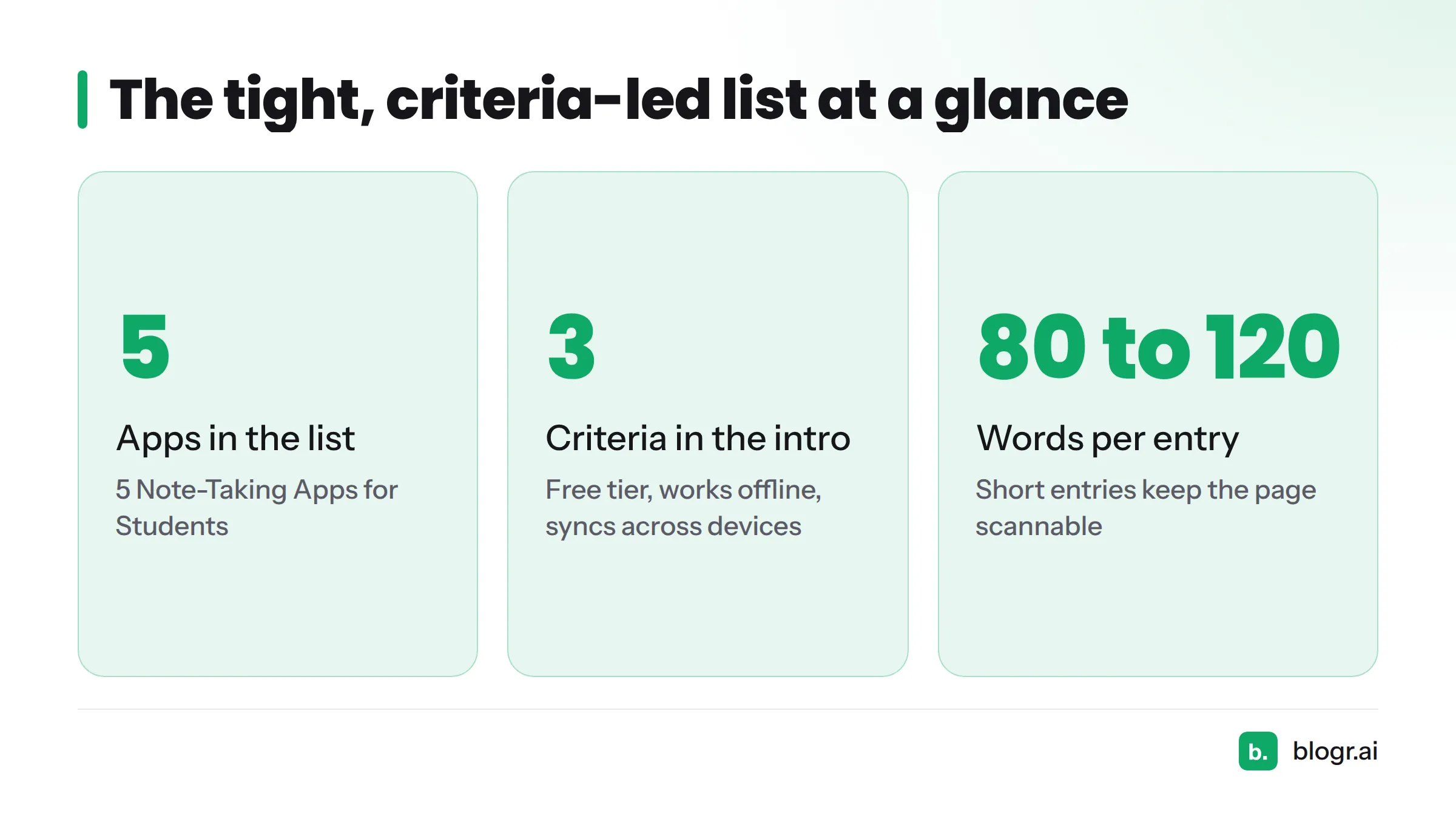
Imagine a short best-of list: "5 Note-Taking Apps for Students." The intro states three criteria in one sentence: free tier, works offline, syncs across phone and laptop. Each entry runs about 80 to 120 words. The verdict names one pick for each type of student.
Why it works
The reader sees the rules before the results, and that builds trust fast. Short entries keep the page scannable. The verdict saves the reader from doing the final comparison alone.
What to copy
Copy this: Put your criteria in the first 100 words, keep every entry the same length, and end with a verdict that maps picks to reader types.
This archetype suits "best X for Y" queries where the reader wants a quick shortlist. It is the simplest best-of list article structure to execute well, so beginners should start here. To see the pattern applied to a real category, look at a ranked listicle of AI SEO writers.
Listicle Example 2: The Long-Form Roundup With Per-Entry Depth
Illustrative outline, constructed for this page.
Now picture "15 Project Management Tools for Small Agencies." Each entry carries what the tool is, who it suits, one caveat, and a piece of evidence, such as a feature you tested or a limit you hit. Entries run 150 to 250 words. This is a comparison post in list form.
A repeatable listicle template keeps any entry from drifting:
| Field | Purpose | Example |
|---|---|---|
| Heading | Names the item and its angle | "Tool name: best for client approvals" |
| One-line verdict | Gives the point before the detail | "Strong for approvals, weak for time tracking." |
| Evidence | Proves you looked closely | "Approval links worked without a login." |
| Who it is for | Helps the reader self-select | "Agencies with 5 to 20 clients" |
| Caveat | Builds trust through honesty | "Reports need a paid plan." |
Why it works
Depth per entry lets the reader decide without opening ten more tabs. The caveat line does the most work. It makes the page read as if someone who used the product wrote it.
Where it goes wrong
Padding. Writers hit a round number like 15, then fill the last five slots with weak items, and each filler entry dilutes the good ones. Cut to the count you can defend.
Listicle Example 3: The Problem-Solution List That Answers Unanswered Questions
Illustrative outline, constructed for this page.
Take "7 Reasons Your New Blog Gets No Traffic (and the Fix for Each)." Every entry names a problem the reader has, then gives the fix. At least one entry covers a question the other results skip, such as "your posts target queries your site has no authority for yet."
Why it works
The reader arrives with a pain, not a product search, and a problem-solution layout mirrors how they think. The skipped-question entry gives the page a reason to exist beyond repeating what already ranks. Google's own guidance on helpful, people-first content asks whether a page offers original value. This is a direct way to add some.
What to copy
Write the problem as the heading, the fix as the first sentence under it, and the proof after. Want more layouts to study? Our guide to more blog post examples by format covers them with annotations.
What Live SERP Analysis Shows About Entry Count, Criteria and Gaps
This section is my commentary from checking list queries by hand, not measured data. Run the query yourself before you trust my read.
Entry count follows intent, not a fixed number
A "best for" query tends to reward a short, decisive list. A broad "tools for" query tends to reward a longer roundup. A "why isn't X working" query suits a handful of well-explained fixes. Look at the lists already ranking for your query, and note how many entries they carry and how deep each one goes. Then pick the count you can fill with real substance.
Criteria separate a list from a pile of links
If a page never says why an item is included, the reader cannot tell a pick from a paid placement. One plain sentence of criteria fixes that. Three to five criteria is usually enough.
The unanswered-questions check
Open the top results for your query and write down every question the reader would still have after reading them. Maybe price context is missing, or caveats, or advice for beginners, or any comparison between entries. Each gap is a candidate entry, a sub-section, or a verdict line. The live SERP briefs feature automates this scan, but you can do it by hand with a notebook and ten minutes.
Here is how the three example types compare:
| Type | Typical entry count | Depth per entry | Best intent |
|---|---|---|---|
| Tight, criteria-led | 5 to 8 | Short | "Best X for Y" shortlist |
| Long-form roundup | 10 to 20 | Medium to deep | Broad comparison research |
| Problem-solution | 5 to 9 | Medium | "Why isn't X working" |
Which type fits your query? Ask three questions in order:
- Is the reader choosing between options? Use the tight list or the roundup.
- Do they want a shortlist or a full survey? Shortlist means tight. Survey means roundup.
- Do they have a problem, not a purchase? Use the problem-solution list.
How to Write a Listicle With AI: Brief, Draft, Edit
You can write a listicle with an AI SEO writer in three steps. I keep this overview light on purpose, because the full process for a complete post belongs in a separate guide on how to write an SEO blog post.
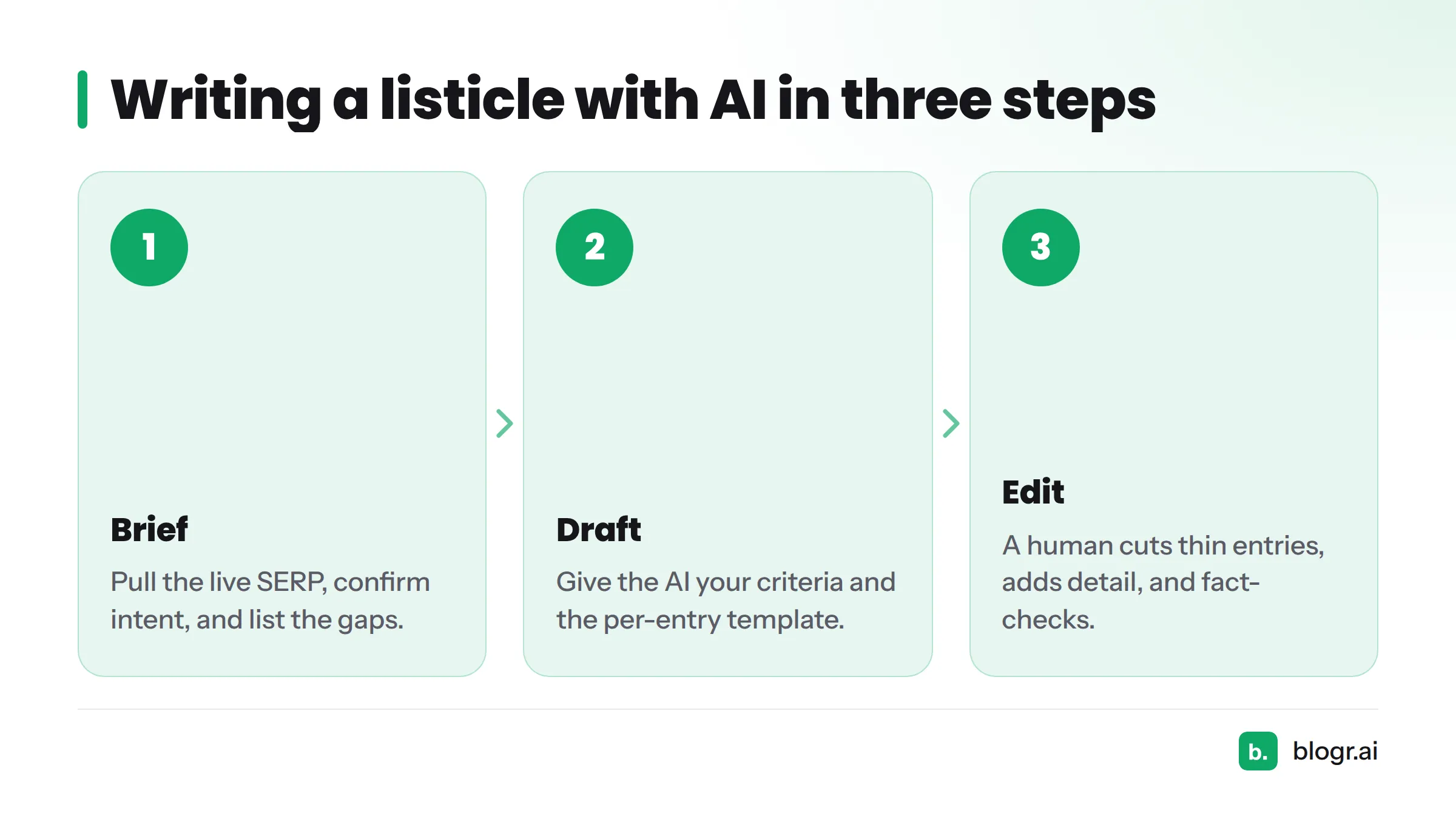
- Brief. Pull the live SERP, confirm the intent, note which entries every result shares, and list the gaps.
- Draft. Give the AI-generated draft your criteria and the per-entry template.
- Edit. A human cuts thin entries, adds first-hand detail, and fact-checks every claim.
Brief: start from what ranks
A good brief for a list names the query, the intent, the entry count range, the criteria, and the gaps you found. AI content briefs built from the live SERP collect all of that in one place, so the draft starts from evidence instead of a guess.
Draft: feed it structure
Large language models write fluent filler when you give them nothing to work with. Hand over the criteria, the entry template from the table above, and the gap list. If the first pass comes back generic, ask for one entry at a time. An AI listicle generator works best with constraints like these.
Edit: where the quality is made
Most people rush this step. Read every entry and ask what a reader could not get from the top three results. For the line-level work, see 8 edits that humanize AI content. No tool can guarantee a ranking, and an unedited draft is the likeliest way to publish a thin page.
Thin-entry fixes checklist:
- Does the entry name who it is for?
- Does it include one caveat?
- Does it include one detail only someone who used the item would know?
- Is every factual claim checked against a source?
- Could the entry be deleted without the list losing anything? If yes, delete it.
- Is the entry the same length and shape as its neighbors?
For a wider look at tooling, read how to choose AI writing tools for SEO. For a full annotated post, see this sample blog post.
Seven Structure Lessons to Copy Into Your Next Listicle
Pin this recap next to your draft:
- Make a clear promise in the title and the first paragraph.
- Choose the entry count from the query's intent, not a lucky number.
- State three to five selection criteria before the first entry.
- Give every entry the same template: verdict, evidence, audience, caveat.
- Include at least one entry or note that answers a question the top results skip.
- Close with a verdict that maps picks to reader types.
- Cut any entry you cannot defend with a specific detail.
Once the list is finished, you can mark it up for search engines. schema.org's ItemList is the structured data type built for ordered lists. Headline writing for list posts deserves its own treatment, so I will leave SEO headlines for a dedicated guide.
A one-page outline helps here. Copy the five trait names and the five template fields from this article into a blank document, and you have a reusable starting point.
Next steps: draft a listicle with the blogr.ai AI SEO writer and test it with the 7-day free trial on the pricing page. You can also start from the blogr.ai homepage to see how the platform turns a brief into a draft you then edit.
FAQ
What is a listicle?
A listicle is an article built around a list of items, each with a short heading and a brief explanation. The word blends "list" and "article." Merriam-Webster's definition describes it as an article consisting of a series of items presented as a list.
What is an example of a listicle?
"5 Note-Taking Apps for Students" is a simple example. It has a stated set of criteria, five short entries built the same way, and a closing verdict. The outlines in this article show three versions of that idea.
Why are listicles so popular?
Readers can scan them quickly and know what they will get before they commit. A fixed structure also lets them jump straight to the one entry they need. That scannability is the practical reason the format lasts.
How many items should a listicle have?
Match the count to the intent. Shortlist queries suit roughly 5 to 8 entries. Broad survey queries suit 10 to 20. Choose the number you can fill with specific, defensible detail, and cut the rest.
Can AI write a good listicle?
AI can produce a solid first draft when you give it a brief, criteria, and an entry template. The quality still depends on human editing and fact-checking. No tool can promise a ranking, so treat the draft as raw material.