


What Is Programmatic SEO? A 2026 Practitioner Guide
Every few months, a founder tells me they want "ten thousand pages by Friday." Sometimes that plan works. More often, the pages sit in Google Search Console as "Crawled, currently not indexed" and never earn a single impression. The template rarely explains the difference. The data behind it does.
Here is the short version: programmatic SEO builds many search-targeted pages from one template and one dataset. This guide shows how that works, why some page sets earn impressions while others stall, and how to decide whether it fits your site. Last updated for 2026.
What Is Programmatic SEO? The 60-Word Answer
Programmatic SEO is the practice of generating many search-targeted pages from a reusable page template and a structured data source, so each page targets a specific long-tail query. Done well, every page carries unique, useful data. Done badly, it produces thin content that search engines skip, ignore, or demote.
Programmatic SEO meaning and pSEO in plain terms
"pSEO" is the common shorthand, and if you have ever asked "what is pSEO," this is the whole idea. Picture a spreadsheet with 300 rows, one per city, tool, or product. A template pulls each row's values into a consistent page layout. You get 300 pages without writing 300 articles by hand.
The idea is not new. Large directories, marketplaces, and comparison sites have built pages this way for years. What changed is that small teams can now do it with a CMS, a spreadsheet, and a few custom fields.
Programmatic SEO vs traditional SEO
| Traditional (editorial) SEO | Programmatic SEO | |
|---|---|---|
| Unit of work | One researched article | One template plus one dataset |
| Best for | Topics needing opinion, depth, and story | Repeatable queries with real structured data |
| Main risk | Slow output | Thin or duplicate pages at scale |
Technical SEO sits underneath both. It covers crawling, indexing, and site structure. Programmatic work leans on it harder, because thousands of new URLs test your crawl paths fast.
Not the same as programmatic advertising. Programmatic advertising buys ad placements automatically through real-time auctions. Programmatic SEO creates organic pages. They share a word and nothing else.
How Programmatic SEO Works: Templates, Data, and Publishing
Let's break it down into five steps:
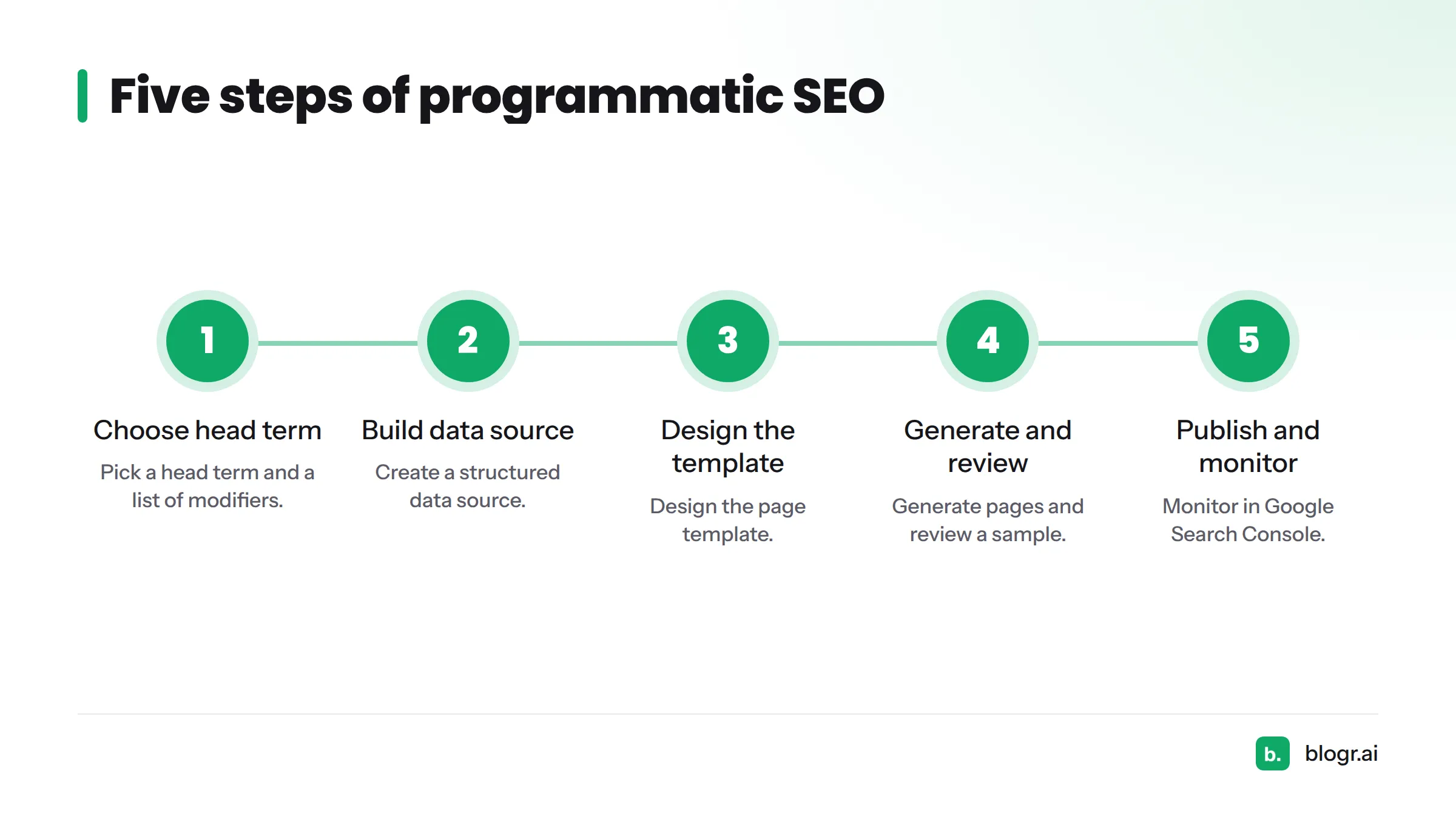
- Choose a head term and a list of modifiers.
- Build a structured data source.
- Design the page template.
- Generate pages and review a sample.
- Publish, then monitor in Google Search Console.
That sequence is the backbone of any programmatic SEO strategy. Skip the data step and the rest collapses.
The head term and modifier pattern
A head term is the repeating part of the query. Modifiers are the parts that change. Neutral examples: "{service} in {city}", "{tool} alternatives", "{currency} to {currency} converter". One head term plus a list of modifiers gives you a page set.
Shopify's own guide offers a handy sanity check: a pattern usually needs at least three variables before it feels like real data rather than a keyword swap (Shopify). I agree with the spirit of that rule. Before you template anything, decide how you will group related queries. A free keyword clustering tool can show you which modifiers deserve their own page and which belong together.
The structured data source
Your data can live in Google Sheets, Airtable, a database, an API, or first-party records from your own product. First-party data usually wins because competitors cannot copy it. Scraped or lightly rewritten public data is the weakest option.
The programmatic SEO template and dynamic fields
A good programmatic SEO template holds fixed sections plus dynamic placeholders. In WordPress or Webflow, these map to CMS custom fields. Static site generators such as Hugo do the same job from data files. Template based SEO pages need, at minimum:
- A title and H1 built from the head term and modifier
- A body block that changes meaningfully with the data
- Real facts, comparisons, or figures unique to that row
- Links to the hub page and to related siblings
Publishing, indexing, and internal linking
Use a hub-and-spoke structure. A hub page lists the whole set, and each spoke links back to it and to a few relatives. That prevents orphan pages, which crawlers may never find. Submit an XML sitemap, then watch indexing. A topical map helps you plan which hub each spoke belongs to before you generate anything.
The flow to remember: data source, template, pages, sitemap, Google Search Console.
Why Some Templated Page Sets Earn Impressions and Others Stall
Here is my practitioner view. In the page sets I review through Search Console, one pattern repeats. Sets with genuine per-page uniqueness get indexed and collect impressions. Sets that only swap a keyword into a shared body stall. These are qualitative observations, not a controlled study, so treat them as a diagnostic guide.
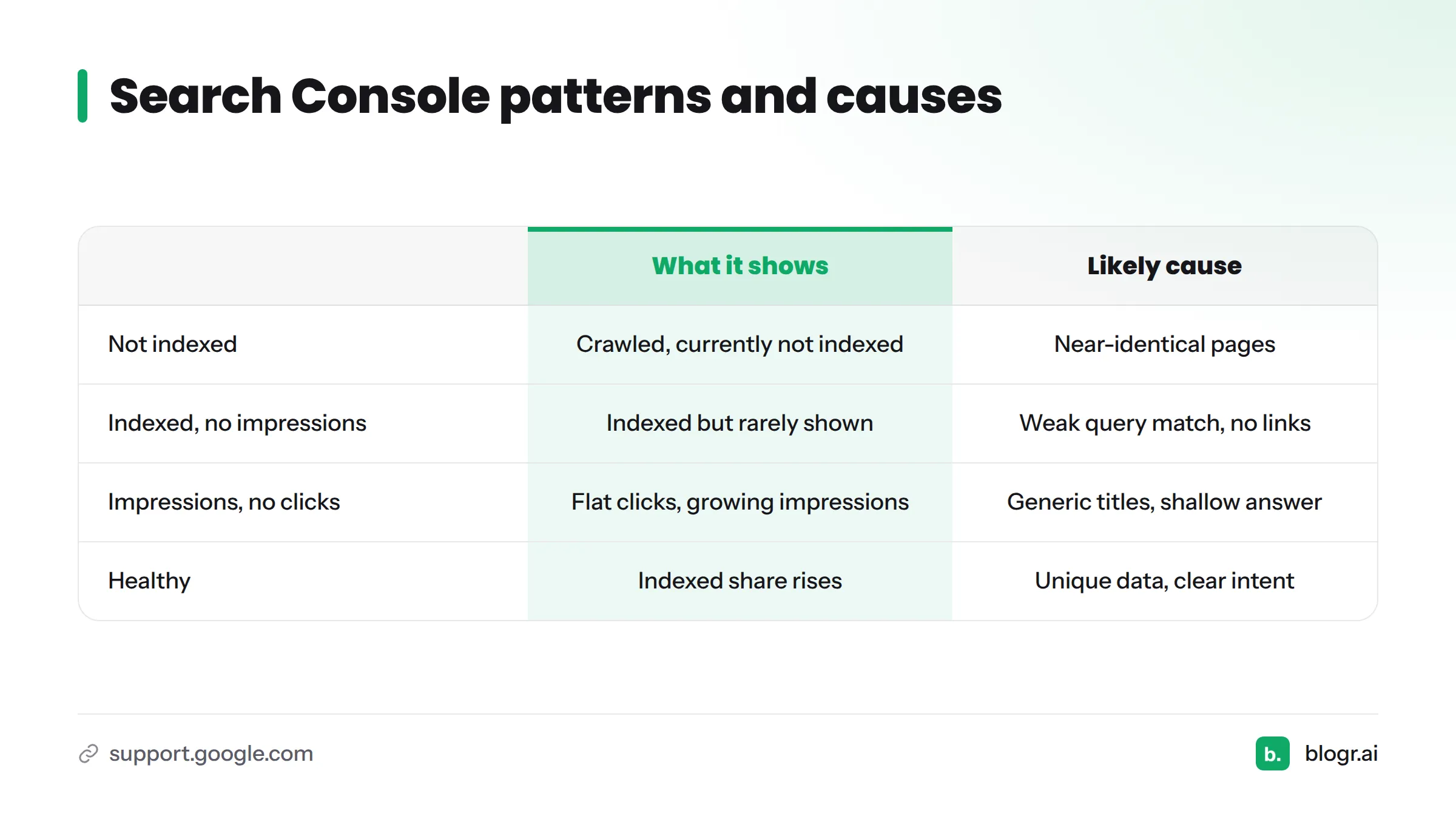
Search Console patterns to watch for
| Pattern | What Search Console shows | Likely cause |
|---|---|---|
| Not indexed | Many URLs listed as "Crawled, currently not indexed" | Pages look near-identical; low unique value |
| Indexed, no impressions | URLs indexed but rarely shown | Weak match to real queries, or no internal links |
| Impressions, no clicks | Growing impressions, flat clicks | Generic titles; answer is too shallow to win the click |
| Healthy | Indexed share rises, impressions grow per template | Unique data per page, clear intent match |
Google documents these statuses in its Page indexing report help. For a walkthrough of the reports themselves, see this guide to reading Search Console data. If pages rank but nobody clicks, this fix-it guide applies directly.
The uniqueness test
Run this before you publish. Open any two pages from the set and cover the keyword in each title.
- Can a reader still tell the pages apart by their content?
- Does each page answer the query with facts the other page lacks?
- Would the page still help a reader if no other page in the set existed?
Two "no" answers mean you have a swap, not a page. Fix the data, not the wording.
If swapping the keyword is the only difference between pages, expect a stall.
Reading impressions and indexing signals
Group URLs by template in the Performance report, using a page filter on the shared URL path. Compare the indexed share and impressions per template, not per URL. Individual pages are noisy, while the template shows the trend. If you are still learning the query side, start with finding keywords in Search Console.
When Programmatic SEO Fits and When It Does Not
Good fits share three traits:
- A repeatable query pattern with real search demand
- Structured data you own or can enrich
- One shared intent across pages, so people want the same kind of answer
Poor fits look different. You have fewer than a few dozen possible pages, no unique data beyond the keyword itself, or a topic that needs editorial depth, opinion, or lived experience.
| Signal | Fit | No fit |
|---|---|---|
| Query pattern | Repeats with clear modifiers | One-off topics |
| Data | First-party or enriched | Only the keyword changes |
| Intent | Same across pages | Varies by page |
| Page value | Useful alone | Only useful as filler |
If the answer is "no fit," write editorial content instead. Plenty of programmatic SEO examples are worth studying once you know what to look for, and most of them share strong data.
Programmatic SEO Risks at Scale
Programmatic SEO risks come in two groups: what search engines may judge your pages to be, and what the work costs you to run.
Thin and duplicate content
Thin pages offer little original value. Duplicates repeat what other pages already say. A templated set can trigger both at once, which is why the uniqueness test matters.
Doorway pages
Google's spam policies describe doorway abuse as sites or pages created to rank for specific queries while funneling users to the same destination, with little value of their own (Google Search Central spam policies). City-swap pages for a service you deliver identically everywhere are the classic risk.
Scaled content abuse
The same policy page defines scaled content abuse as producing many pages primarily to manipulate rankings rather than help users, however they are made. The method is not the issue. Purpose and value are. For depth, read where programmatic pages cross into scaled content abuse.
Operational risks
- Crawl budget: Thousands of weak URLs can dilute crawling of your good ones.
- Stale data: Outdated figures erode trust fast.
- Maintenance: Every template change touches every page.
Expert callout: Release in batches (drip publishing) and use noindex on variants with weak data until they earn enough substance. Your indexed set stays clean while you improve the rest.
A Short Readiness Check Before You Start
Score one point per "yes":
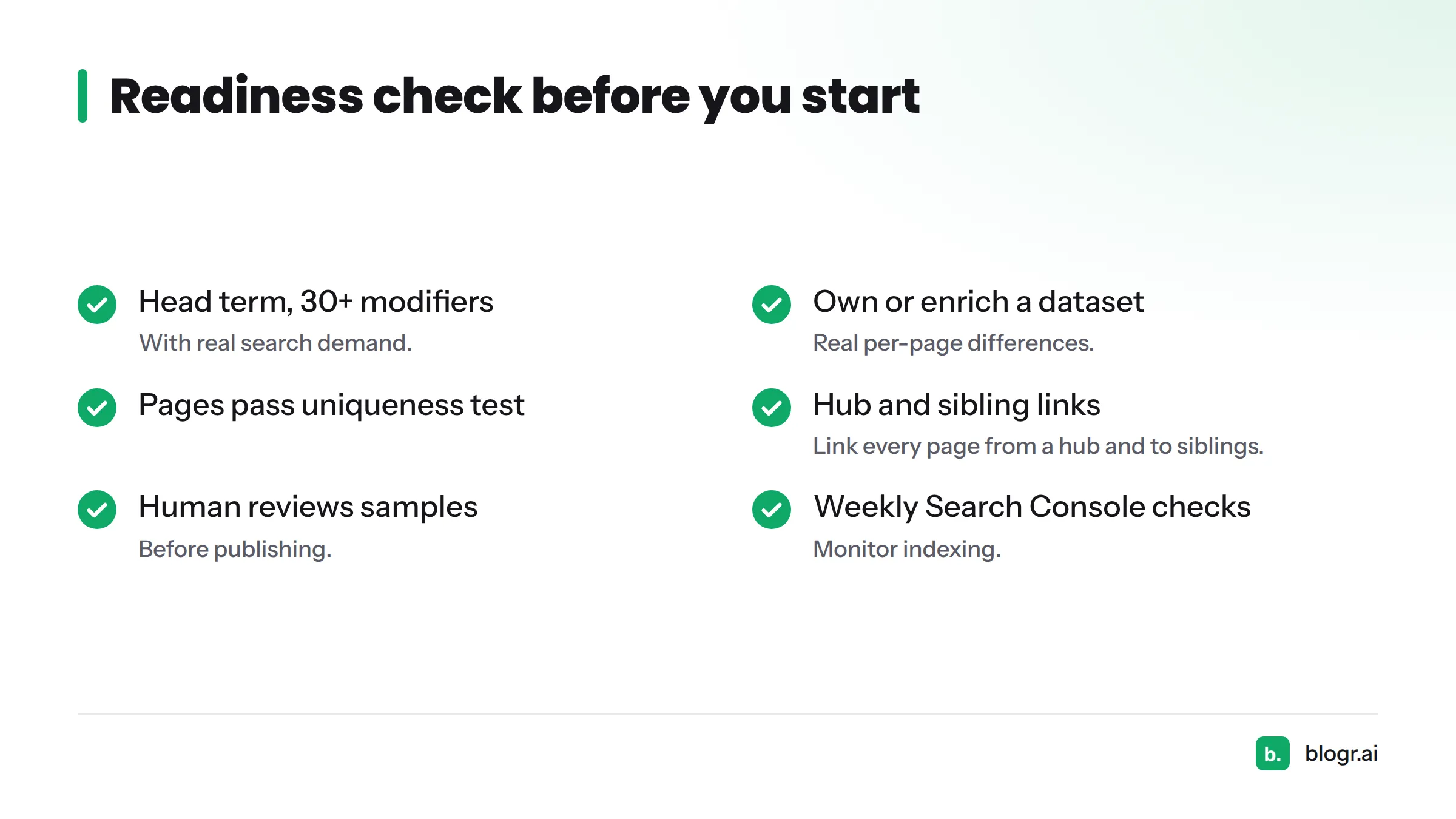
- I can name a head term and at least 30 modifiers with search demand.
- I own or can enrich a dataset with real per-page differences.
- The pages would pass the uniqueness test.
- Searchers share one intent across the set.
- I can link every page from a hub and to siblings.
- I can refresh the data on a schedule.
- A person will review samples before publishing.
- I can monitor indexing in Search Console weekly.
Scoring rule: 7 to 8 is a go. 5 to 6 means fix the gaps first. Under 5, skip it and write editorial content.
Start small: pilot 20 to 50 pages
Generate 20 to 50 pages. Have a human read at least a fifth of them. Publish in two or three batches, then wait for indexing and impressions per template before scaling. If the pilot stalls, diagnose it with the table above, improve the data, and try again.
Does it still work in 2026? Yes, for sets with real data. AI Overviews answer simple lookups directly, so shallow pages lose even more ground than before.
Next Steps
If your readiness score is low because you lack unique data, template pages are the wrong tool. Editorial scale is the safer path: researched articles, produced in volume, approved by you before they go live. That is the kind of bulk article generation with approval that blogr.ai is built for. Look at the SEO content automation workflow, then try the 7-day free trial. To find quick wins first, see striking distance keywords in GSC.
FAQ
What is programmatic SEO in simple terms?
It means building many pages from one template and one dataset, each aimed at a specific long-tail search. A spreadsheet row becomes a page. It works when each page carries unique, helpful information and fails when pages differ only by a swapped keyword.
Is programmatic SEO still worth it in 2026?
Yes, when you have real structured data and a repeatable query pattern. It is a poor bet for keyword-swap pages. AI Overviews now answer shallow lookups, so pages must offer something a summary cannot: specific, current, original data.
Does programmatic SEO work for small sites?
It can, if the site owns useful data. A small site with a distinctive dataset can beat a bigger one with generic pages. Start with a 20 to 50 page pilot, monitor indexing in Search Console, and expand only when impressions grow.
Is programmatic SEO against Google's guidelines?
No, the method is not banned. Google's spam policies target scaled content abuse and doorway pages, meaning pages made mainly to manipulate rankings with little user value. Templates with genuinely useful, unique data per page are acceptable.
How many pages do I need for programmatic SEO?
There is no official number. The approach pays off when a query pattern yields dozens to thousands of valid pages. If you can only justify a handful, write them by hand. Quality per page matters more than total count.
What is the difference between programmatic SEO and programmatic advertising?
Programmatic SEO generates organic web pages to rank in search. Programmatic advertising uses automated auctions to buy paid ad placements. The channels and goals differ, and only the vocabulary overlaps.