


Keyword Clustering: How to Group Keywords by Intent

Keyword clustering groups search terms that share the same intent and return largely the same Google results, so one page can target them together. To cluster keywords so each group maps to one page: export and clean your list, group by intent, check SERP overlap, apply a threshold, name each cluster, then assign it a single page.
Quick answer in 4 lines
- Clean the list, then sort keywords by intent.
- Count shared ranking URLs in the top 10 for each keyword pair.
- Merge pairs at about 3 or more shared URLs. Split pairs at 0 to 1.
- Give every cluster one main keyword and one page.
I run this process on messy exports every week. It takes an afternoon in a spreadsheet, and it keeps you from writing two pages that fight each other. Let's break it down.
Step 1: Export and Clean Your Keyword List
Bad input gives bad clusters. Spend 20 minutes here and the rest goes fast.
Export the CSV
Pull keywords from wherever you have them: a keyword tool, a brainstorm, or your own query data. If you already rank for some terms, a Search Console export is the best starting point because it shows real queries. Search Console Help: Get your performance data (Google) explains how to export performance data, and our guide on how to find keywords in Search Console walks through the report itself.
Keep four columns:
- Keyword
- Monthly search volume (or impressions if you use Search Console)
- Ranking URL, if you already rank
- A blank "intent" column you will fill in Step 2
Clean it
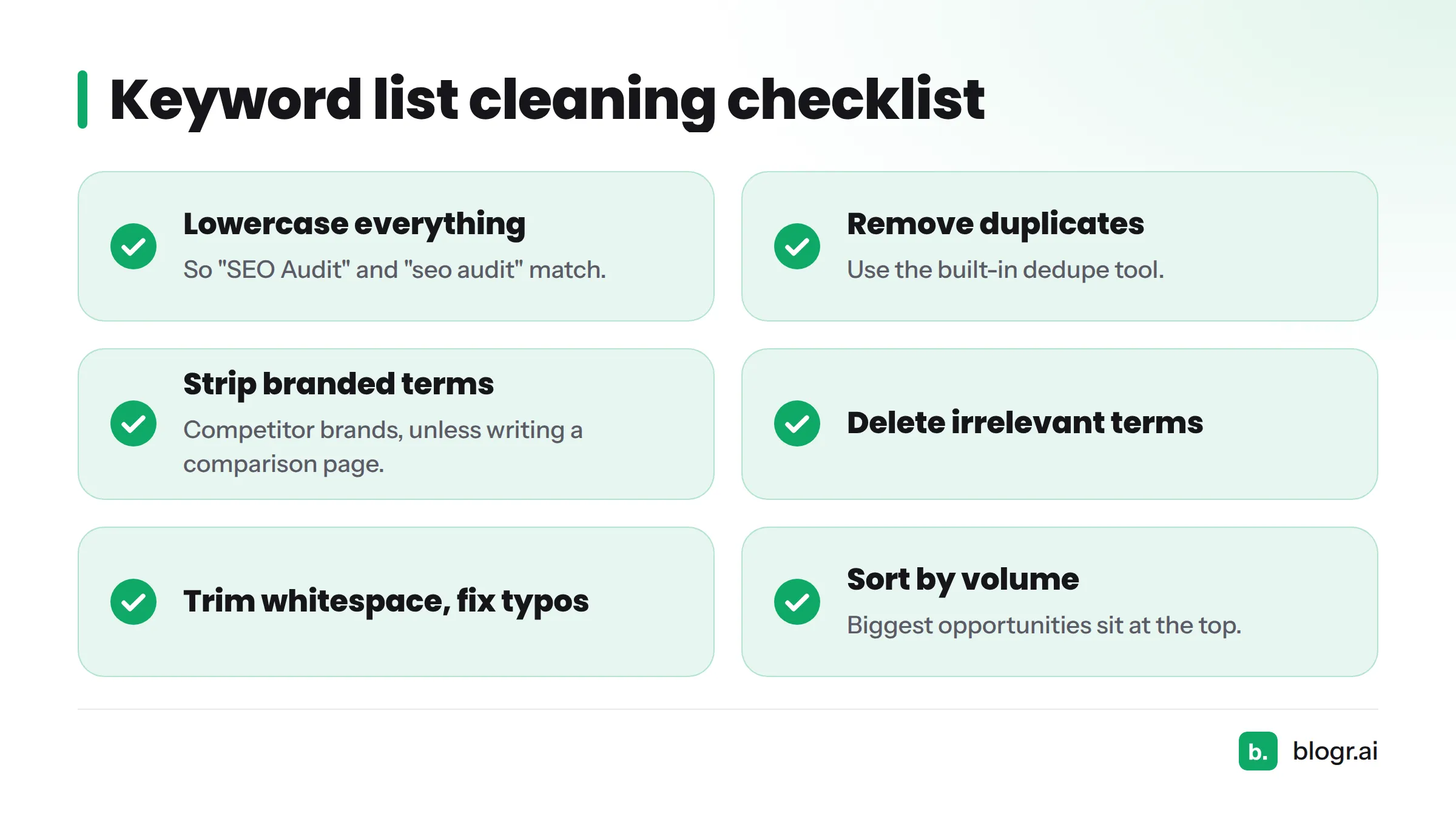
Open the file in Google Sheets or Excel and run through this checklist:
- Lowercase everything so "SEO Audit" and "seo audit" match.
- Remove duplicates with the built-in dedupe tool.
- Strip branded terms that belong to competitors, unless you are writing a comparison page.
- Delete irrelevant terms you would never write a page about.
- Trim whitespace and fix obvious typos.
- Sort by volume so your biggest opportunities sit at the top.
A 2,000-row export usually shrinks by 15 to 30 percent after this pass. That range comes from my own work, not from a benchmark.
Step 2: Group Keywords by Search Intent
Search intent is the job the searcher wants done. Google's guidance on creating helpful, reliable, people-first content (Google Search Central) tells creators to match what a person came to find. Two keywords with different jobs should rarely share a page. That is the logic behind learning to cluster keywords by intent before you touch any SERP data.
Informational vs commercial vs transactional intent
| Intent | What the searcher wants | Example keywords |
|---|---|---|
| Informational | To learn or understand | what is keyword clustering, how to cluster keywords |
| Commercial | To compare options before choosing | best keyword clustering tools, keyword clustering software compared |
| Transactional | To act or buy now | keyword clustering tool free trial, buy keyword research software |
A quick test: add "how", "best" or "buy" to the keyword in your head. The one that reads naturally usually gives you the label.
Make a first-pass grouping
Fill the intent column, then sort by intent and scan for shared themes. Put "how to group keywords" and "keyword grouping method" together. Keep "keyword clustering tool" in its own pile because its intent is commercial. Treat this pass as a hypothesis. The next step tests it against what Google actually shows.
Step 3: Check SERP Overlap Between Keyword Pairs
Your intuition about meaning can be wrong. The live results settle it.
What shared ranking URLs tell you
When two different queries return many of the same URLs, Google treats them as the same need, and one page can satisfy both. When the results share nothing, Google sees two different needs, and you need two pages. This is the idea behind SERP overlap clustering, as opposed to lemma-based clustering, which only compares words.
How to count overlap
- Search keyword A and copy the top 10 organic URLs into a column.
- Do the same for keyword B.
- Count the URLs that appear in both lists. That count is your overlap score.
- Ignore ads, video carousels and People Also Ask boxes. SERP features distort the count.
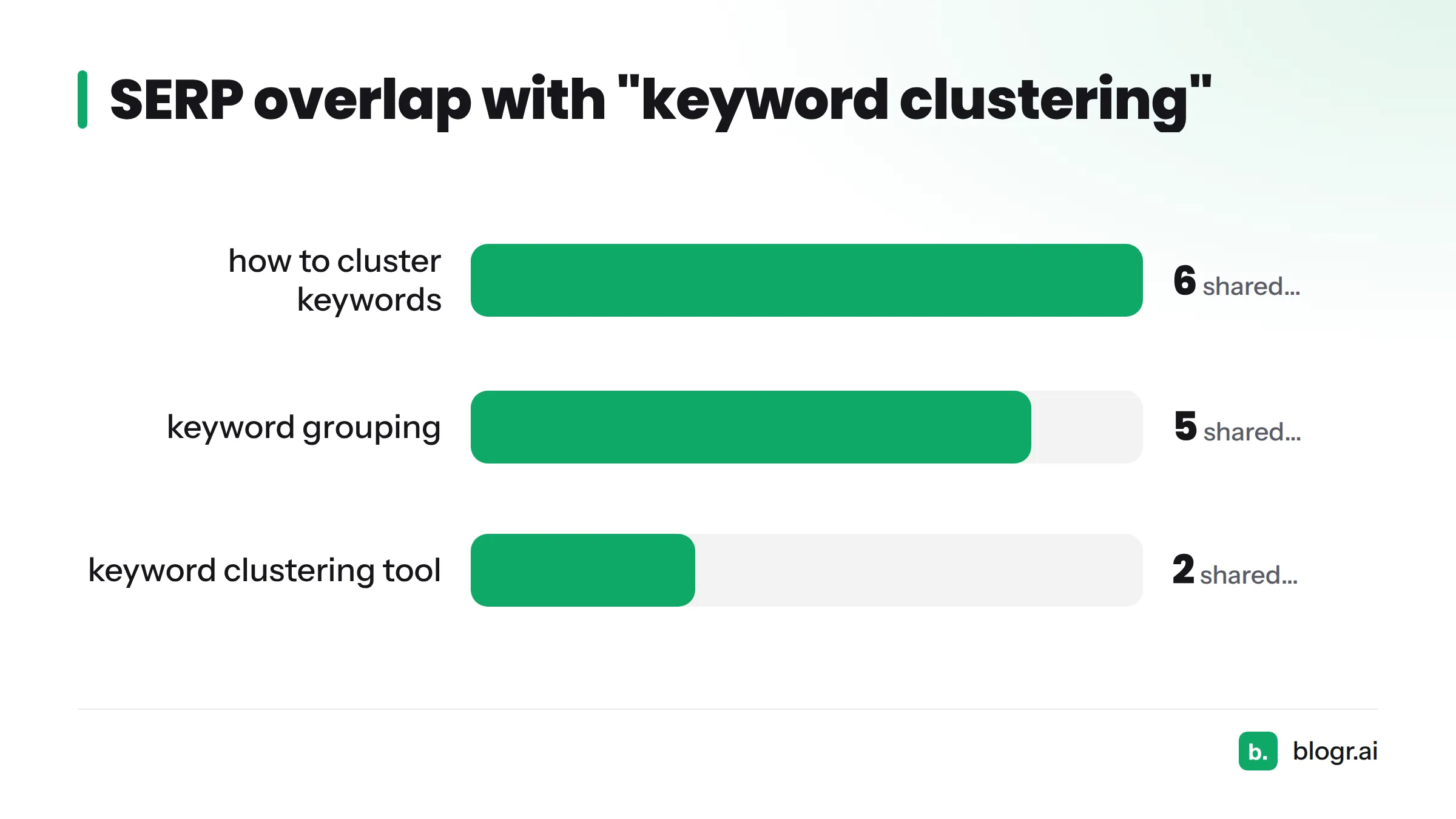
Here is a pairwise overlap matrix for four sample keywords, scored out of 10:
| keyword clustering | how to cluster keywords | keyword grouping | keyword clustering tool | |
|---|---|---|---|---|
| keyword clustering | 10 | 6 | 5 | 2 |
| how to cluster keywords | 6 | 10 | 4 | 1 |
| keyword grouping | 5 | 4 | 10 | 1 |
| keyword clustering tool | 2 | 1 | 1 | 10 |
These scores are illustrative. Run your own SERPs, since results shift by country and over time.
Step 4: Set an Overlap Threshold, Then Merge or Split
A practical starting threshold
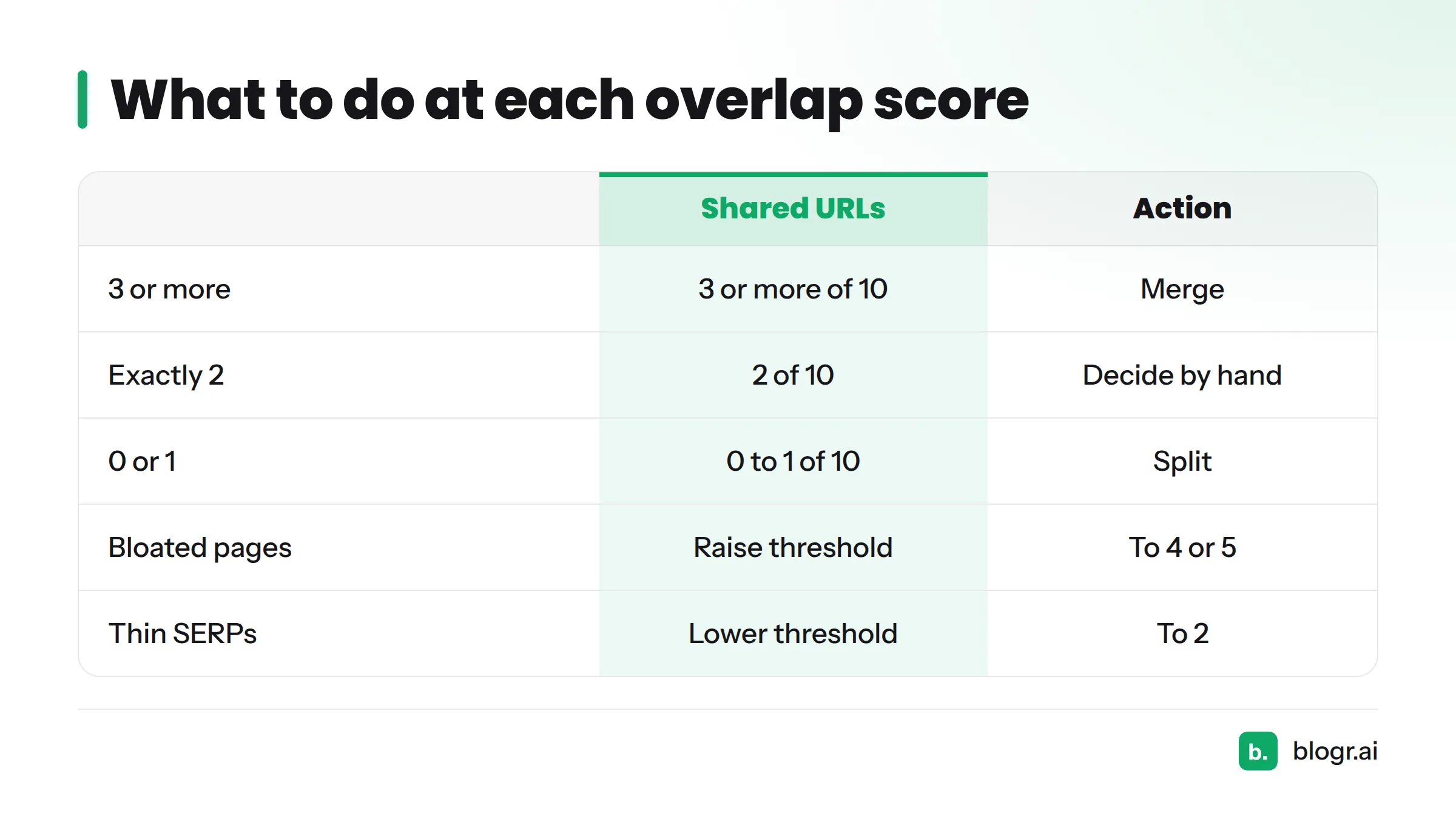
Start with 3 shared URLs out of the top 10. At 3 or more, merge. At 0 or 1, split. At 2, look at intent and decide by hand.
Why 3? Two shared URLs can be a coincidence, such as one giant authority site ranking for everything. Three or more suggests Google judges the pages by the same standard.
Tune it like this:
- Raise it to 4 or 5 if your merged pages feel bloated or off-focus.
- Lower it to 2 if your niche has thin SERPs and you end up with dozens of tiny pages.
Treat the number as a starting point, not a law.
Merge, split or leave alone
Use this decision tree for each pair:
- Overlap of 3 or more and the same intent label? Merge into one cluster.
- Overlap of 3 or more but different intent labels? Look at the top results. If they all share one format, merge. If the formats are mixed, split.
- Overlap of 0 to 1 and the same intent label? Split. Same topic, different SERP, different page.
- Overlap of exactly 2? Leave it alone for now and review it in Step 7.
Apply this to the matrix above. "keyword clustering" and "how to cluster keywords" share 6, so they merge. "keyword grouping" shares 5 with the head term, so it joins them. "keyword clustering tool" shares only 2 and has commercial intent, so it gets its own page.
Step 5: Name Each Cluster and Pick Its Main Keyword
Main keyword vs supporting keywords
The main keyword is the one term that best describes the page. The rest become supporting keywords that you work into headings and body copy.
Choose the main keyword using two checks, in order:
- Best intent match. Does the term describe what the top-ranking pages actually deliver?
- Highest volume among the terms that pass check one.
Volume alone misleads. A big-volume term with a slightly different intent will pull you off target.
Naming conventions
Name each cluster after its main keyword, in plain lowercase. Add a short prefix for the intent, such as "info:" or "comm:". Your spreadsheet filter will thank you later.
Step 6: Map Each Cluster to One Page
One page per cluster is the rule that prevents internal competition. It is also what makes keyword clusters for SEO useful rather than decorative.
New page vs existing page
For each cluster, check whether you already rank with a page that fits the intent.
- A page exists and matches the intent: assign the cluster to it and plan an update.
- A page exists but the intent is wrong: build a new page. Do not bend the old one.
- No page exists: create one.
Here is a sample cluster-to-page map:
| Cluster | Main keyword | Supporting keywords | Intent | Target page |
|---|---|---|---|---|
| info: keyword clustering | keyword clustering | how to cluster keywords, keyword grouping | Informational | New guide |
| comm: clustering tools | keyword clustering tool | best keyword clustering software | Commercial | Existing tools page |
| info: keyword cannibalization | keyword cannibalization | what is cannibalization in SEO | Informational | New explainer |
Once clusters are mapped, you can turn keyword groups into topic clusters and see where clustering fits in a topical map. If you want software to keep that structure organized, topical map software that clusters topics does it for you.
Step 7: Review Clusters Manually and Record the Result
Automation finds patterns. You catch the exceptions.
Manual review checklist
- Does each cluster have one clear intent?
- Would a reader land on the page and find every supporting keyword answered?
- Are any two clusters so close that one page would cover both?
- Did every "2 shared URLs" pair get a final decision?
- Are tiny-volume keywords parked under a bigger cluster instead of getting thin pages?
- Does one domain dominate the SERP and inflate overlap? If so, discount that URL.
- Is the SERP volatile? Re-check in a week before you commit.
Record the cluster map and revisit it
Save the map as a dated sheet. Add columns for target page, status and the date you checked the SERPs. Re-cluster every quarter, or when you add a large batch of new keywords. SERPs change, and your clusters should too.
When Two Queries Deserve One Page (and When They Don't)
Two keywords should share a page when the same URLs rank for both and the intent matches. They deserve separate pages when the results differ, even if the words look nearly identical.
Same SERP, same page
"Group keywords by intent" and "cluster keywords by search intent" overlap heavily. Different words, same need. One page.
Same topic, different intent, different pages
"Keyword clustering" and "keyword clustering tool" share a topic but not a job. One reader wants to learn. The other wants to compare products. Splitting them lets each page match its own SERP.
Worked example: a sample list clustered end to end
Start with eight raw keywords for a small SEO blog.
Before:
| Keyword | Volume | Intent |
|---|---|---|
| keyword clustering | 480 | Informational |
| how to cluster keywords | 210 | Informational |
| keyword grouping | 90 | Informational |
| keyword clustering tool | 320 | Commercial |
| best keyword clustering software | 140 | Commercial |
| keyword cannibalization | 600 | Informational |
| fix keyword cannibalization | 170 | Informational |
| keyword research template | 260 | Informational |
The volumes are sample figures for the exercise. After Steps 3 and 4 with the 3-URL threshold:
After:
| Cluster | Main keyword | Supporting | Overlap logic | Page |
|---|---|---|---|---|
| keyword clustering | keyword clustering | how to cluster keywords, keyword grouping | 4 to 6 shared URLs | Guide |
| clustering tools | keyword clustering tool | best keyword clustering software | 5 shared URLs | Tools page |
| cannibalization | keyword cannibalization | fix keyword cannibalization | 4 shared URLs | Explainer |
| research template | keyword research template | none | 0 to 1 with all others | Template page |
Eight keywords became four pages, each with a clear job.
How blogr.ai briefs apply the same logic
blogr.ai briefs are built from the live SERP. They read the pages currently ranking and compare shared themes, entities and headings. The same logic tells you whether two queries want the same page. If the top results cover the same subtopics and name the same entities, one page can serve both. If they diverge, you need two. Your spreadsheet does the same job by hand, using shared ranking URLs.
Next Steps: Cluster Your Keyword List Now
Doing this by hand is a good way to learn the method. Once your list hits a few hundred rows, you will want help. You can cluster your keyword list with the free tool, then apply Steps 5 to 7 to the result. If you are new to blogr.ai, start at the blogr.ai homepage to see how briefs, topical maps and clustering connect.
FAQ
What is keyword clustering?
Keyword clustering is grouping search terms that share the same intent and return mostly the same results, so a single page can target them. It replaces the old habit of one page per keyword.
What is a keyword cluster example?
"Keyword clustering," "how to cluster keywords" and "keyword grouping" form one cluster. They share an informational intent and many ranking URLs. "Keyword clustering tool" belongs to a different cluster because searchers want to compare software.
How many keywords belong in one cluster?
There is no fixed number. Let the SERP decide. Many clusters hold 3 to 10 keywords, but a cluster of one is fine when the SERP is unique to that query.
Should I cluster by intent or by SERP overlap?
Use both. Intent gives you a fast first pass. SERP overlap confirms it with evidence. Intent alone misses cases where Google treats near-identical phrases differently.
How do I cluster keywords in a spreadsheet?
Follow Steps 1 to 4: clean the export, add an intent column, paste the top 10 URLs for each keyword, and count shared URLs for each pair. A COUNTIF formula speeds up the counting.
Does clustering prevent cannibalization?
It lowers the risk because each cluster gets one page, so your pages stop targeting the same query. It does not fix existing overlap. To find that, learn how to spot keyword cannibalization in Search Console.