


SEO Content Case Studies: Measured Results | blogr.ai

SEO content case studies should show measured outcomes, not marketing claims. Automated SEO content can move rankings, but results vary by site, competition and page age. The blogr.ai case studies below use connected-site Google Search Console data, and one case is published today: an article that moved from #12 to #4 in 21 days.
What Results Does Automated SEO Content Produce?
It depends. Your niche, the number of competitors in the search results and the age of the page all change the outcome. Anyone who promises a fixed result is selling, not measuring.
What we can offer is first-party evidence rather than an industry average. Every entry here comes from a site connected to the Search Console-driven SEO tool we built. That also makes these AI SEO results easier to check than a round-number claim with no source.
One published case today. A single case is evidence, not a benchmark.
How We Measure Every Case Study
Each entry has to meet the same standard before it goes live.
Data source
Numbers come from connected-site Google Search Console data. That is first-party data, pulled from the site owner's own account.
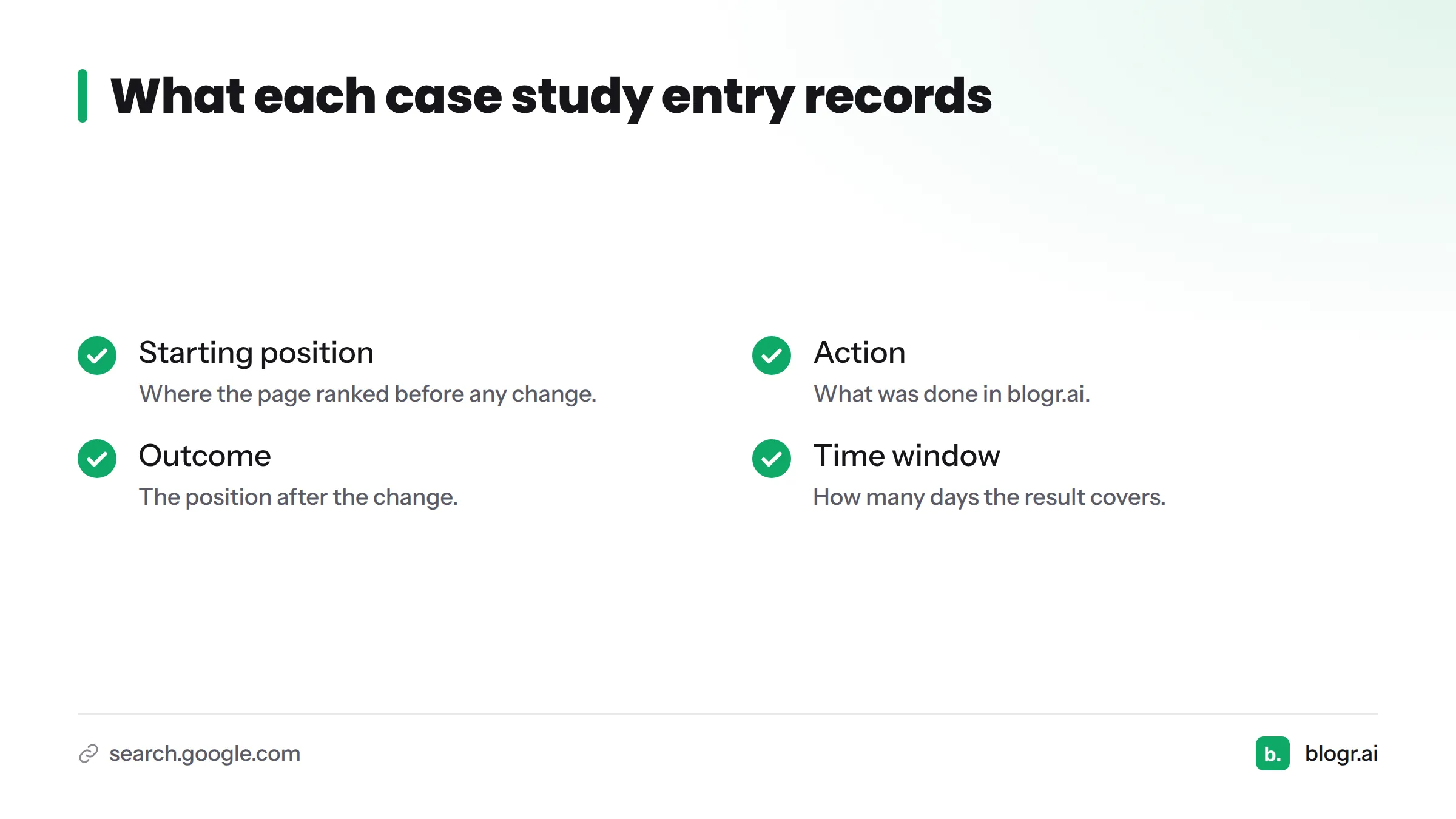
What each entry records
- Starting position: where the page ranked before any change.
- Action: what was done in blogr.ai.
- Outcome: the position after the change.
- Time window: how many days the result covers.
What we leave out
Unverified figures and anonymous claims stay out. If we can't tie a number to a connected account, we don't publish it.
Quick definitions
Google's Performance report documentation defines the metrics used here. In plain English:
- Impressions: how often your page appeared in search results.
- Clicks: how often someone clicked through to it.
- Average position: the average spot your page held for a query. Because it is an average, it moves around.
- Striking-distance keywords: queries sitting just off page one. Our guide to striking-distance keywords covers the method.
For more term explanations, see the SEO glossary.
Case Study Index: Situation, Action, Outcome
| Case | Situation | Action in blogr.ai | Outcome | Time window |
|---|---|---|---|---|
| CRM article ranking jump | Ranked #12 | Content updated in blogr.ai (summary only) | Ranked #4 | 21 days |
There are no placeholder rows. If a case isn't published, it isn't in the table.
Featured Case: A CRM Article Moves From #12 to #4 in 21 Days
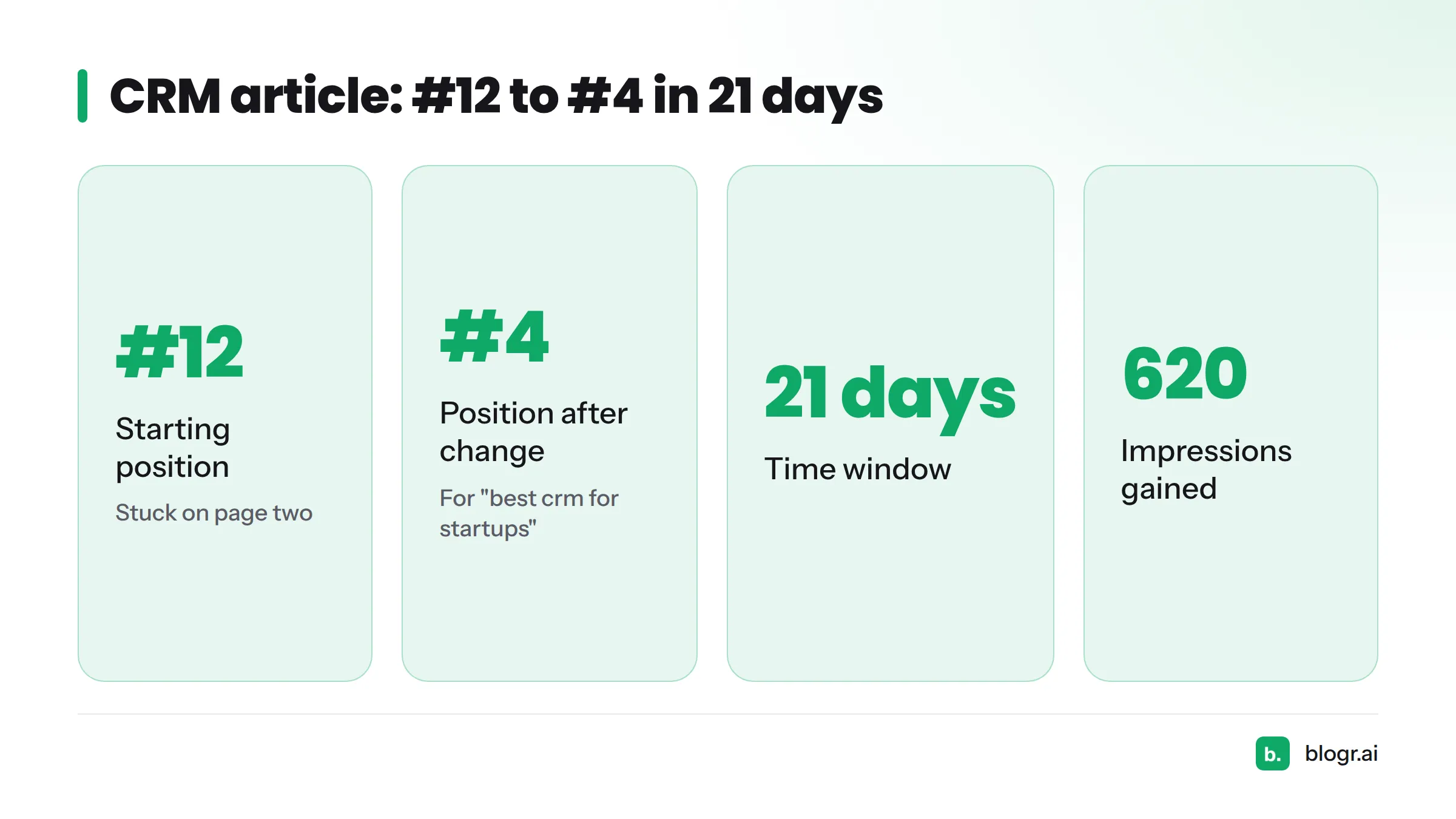
This ranking improvement case study starts with a CRM article stuck on page two at #12. Within 21 days it reached #4 for "best crm for startups" and picked up 620 impressions. The full story lives on its own page: how one article moved from #12 to #4 in 21 days.
How to Read These Results, and Their Limits
Let's break it down.
One case is not a typical result
One win can't tell you what your site will do. Treat it as a worked example, not a forecast. Correlation is not causation in SEO, and other factors can shift rankings at the same time.
Position, impressions and clicks each tell you something different
Position shows where you rank. Impressions show visibility. Clicks show whether people chose your page. A page can gain position and still earn few clicks, which is a separate problem covered in why you rank but get no clicks. Our guide on reading Search Console data goes further.
Time windows and page age change the picture
A 21-day window on an existing page is not the same as a brand-new page's first month. Always ask which one you are looking at.
Five questions to ask of any SEO case study
- Where did the data come from?
- What was the starting position?
- What time window does the result cover?
- What else changed during that window?
- Is this one result or a pattern?
Those questions work on any organic traffic case study, ours included.
What These Case Studies Don't Cover Yet
Only one case is published, so there is no coverage yet of other industries, site sizes or content types. I would rather show a short, honest list than pad it.
Next Steps: See Your Own Numbers
Connect Search Console and start the 7-day free trial to see where your pages sit today. You can also read how content refresh works, browse use cases, or visit the blogr.ai homepage.
FAQ
Are these case studies based on real data?
Yes. Each entry draws on connected-site Google Search Console data, with starting position, action and time window stated.
How quickly do SEO content results show up?
It varies. The published case covers 21 days, but that is one result, not a promise. Competition and page age change the timeline.
Can I submit my own site as a case study?
Customers must give permission before we publish results. If you want to be considered, connect your site and get in touch once you have measurable results.