


AI SEO Content Automation Software by Job | blogr.ai
AI SEO content automation software does more than draft articles. It finds topics in real search demand, plans them, writes them, publishes to your CMS, and measures what happened afterward. blogr.ai runs all of that as one loop driven by Google Search Console, and nothing gets written until you approve the title. Pick the job below that matches your problem, then start the 7-day trial.
I run organic growth for my own products, and this page comes from that hands-on work. Most pages in this category are feature tours. You don't need a tour. You need to know which SEO job you have today and which part of the software handles it. Let's break it down.
What AI SEO content automation software is, and which jobs it takes off your plate
An end-to-end SEO content software platform runs the repeatable steps of organic content work from start to finish: choosing topics from search demand, briefing, writing, publishing to your CMS, and measuring the outcome. The goal is a steady, reviewable flow of pages that can rank. A single draft is not the goal.
The data behind that flow matters. Google Search Console reports the queries, impressions, clicks, and average position your site already earns. Those numbers show the software what your site is close to winning.
Automation software vs. an AI writing assistant
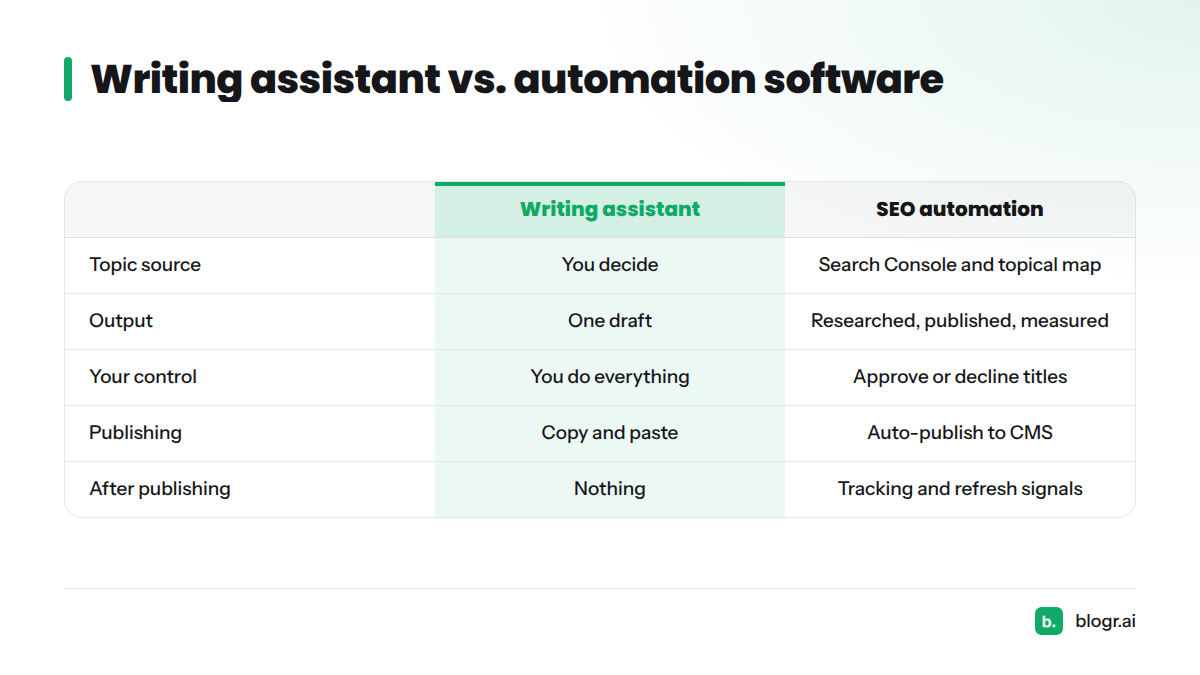
A writing assistant hands you a draft and stops. An AI SEO automation tool owns the loop around the draft.
| AI writing assistant | AI SEO content automation software | |
|---|---|---|
| Where topics come from | You decide | Search Console queries and a topical map |
| Output | One draft | Researched, published, measured articles |
| Your control | You do everything | You approve or decline each title |
| Publishing | Copy and paste | Auto-publish to your CMS |
| After publishing | Nothing | Position and click tracking, refresh signals |
The five jobs at a glance
You can automate SEO content jobs in five areas:
- Recover lost organic traffic
- Push page-two keywords to page one
- Publish blog content on a steady schedule
- Refresh aging content automatically
- Manage SEO content across multiple sites
Each one gets its own section below, along with the loop stage that performs it.
How the blogr.ai loop works, from Search Console to post-publish measurement
Here is the whole loop in five steps:
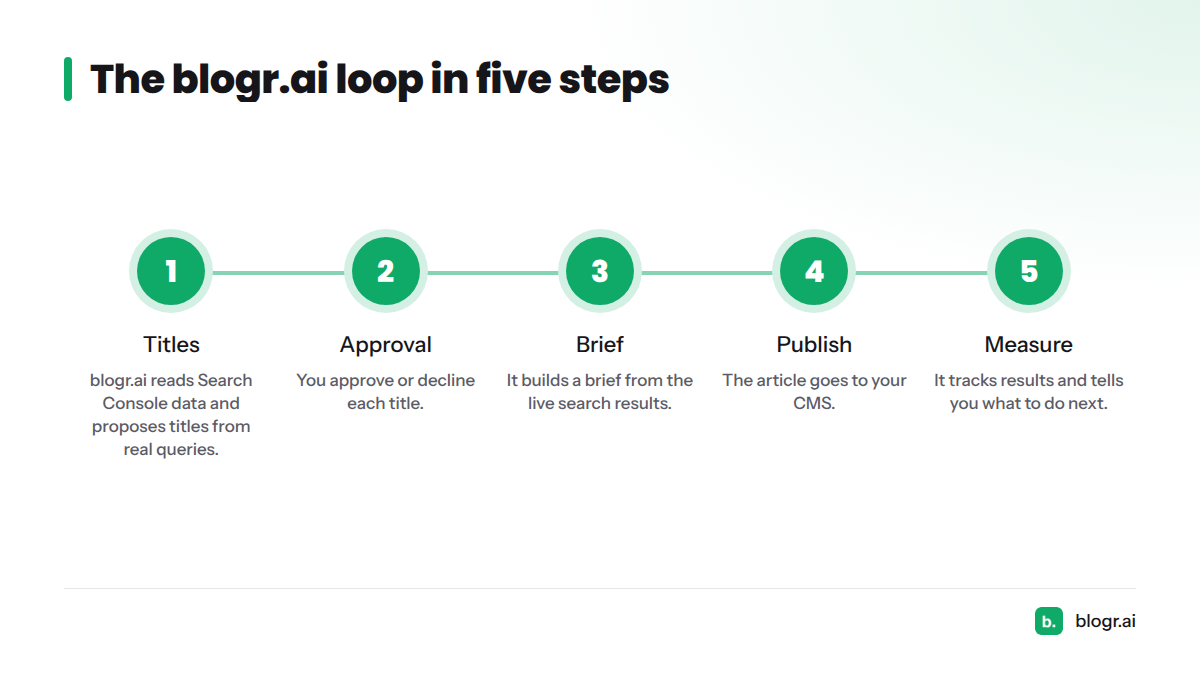
- Titles: blogr.ai reads your Search Console data and proposes titles from real queries.
- Approval: you approve or decline each title.
- Brief: it builds a brief from the live search results.
- Publish: the article goes to your CMS.
- Measure: it tracks results and tells you what to do next.
The full SEO content automation loop goes deeper. This is the short version.
Titles from real queries, then your approve-or-decline
Titles come from Search Console data and a topical map, not guesswork. Nothing is written until you say yes. Teams that want zero involvement can switch on autopilot, but that choice is yours.
A live-SERP brief, then the article
Once you approve a title, the system builds a brief from the live SERP. It checks what currently ranks, then writes to beat it in your brand voice. As an AI SEO writer, it works from what those ranking pages cover and what they leave out, instead of filling a fixed template.
Auto-publish, then measurement and what to do next
Articles publish through CMS integrations such as WordPress, Webflow, Shopify, and Ghost. After that, impressions, clicks, and position feed back into the loop. That feedback powers the next four jobs.
Recover lost organic traffic
Loop stage: post-publish measurement. Best for: sites whose clicks fell and nobody knows why.
The software compares current performance with past performance and flags pages that are slipping. You can spot the early signs in ranking decay in Search Console. What you get is a short list of pages to fix, not a vague feeling that traffic is down.
Push page-two keywords to page one
Loop stage: Search Console-driven titles and refresh. Best for: sites that already have impressions.
Striking-distance keywords are queries where you rank just past the first page. They tend to be the cheapest wins, because Google already associates your site with the topic.
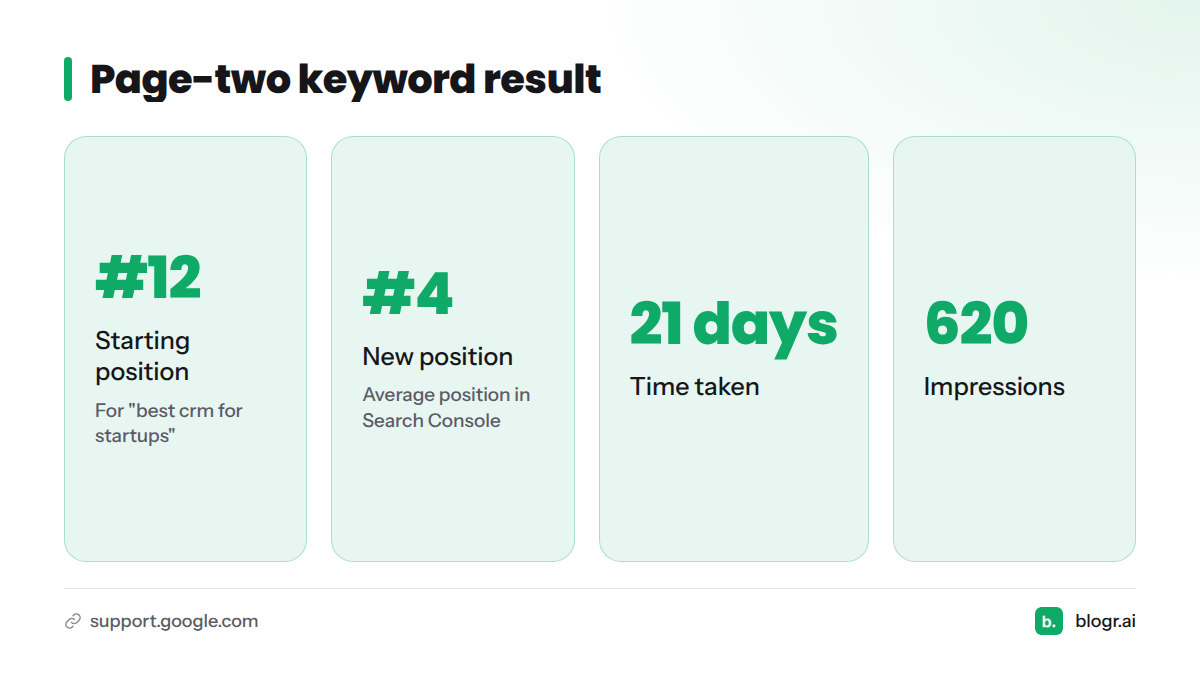
Here is a real result. One customer article moved from position #12 to #4 for "best crm for startups" in 21 days, on 620 impressions. Position here means the average ranking Google reports in Search Console, as defined in Google's Search Console documentation. One result guarantees nothing, but it shows the pattern: a page already near the top responds to a targeted push.
Publish blog content on a steady schedule
Loop stage: auto-publish. Best for: new sites and busy founders.
Consistency is where most blogs die. The software queues approved articles and drips them out over weeks, so your site publishes on a cadence while you work on the product. It never dumps fifty pages at once, and the queue holds only what you approved. Founders without an SEO team will find on-page SEO basics for founders a useful companion.
Refresh aging content automatically
Loop stage: post-publish measurement. Best for: blogs with a back catalog.
Old posts decay. The content refresh tool reads performance data and recommends which posts to update and why, so you stop guessing. For the method, read how to update old blog posts and the weekly content refresh loop.
Manage SEO content across multiple sites
Loop stage: the whole loop, repeated per site. Best for: agencies and operators with several properties.
Each site gets its own Search Console connection, topical map, approval queue, and CMS destination. You review everything in one place. Agencies can see how that works in SEO agency software for client sites.
Which job should you start with?
Match your situation to a starting point:
- You have Search Console impressions: start with page-two keywords or a refresh.
- Your traffic dropped: start with recovering lost organic traffic.
- Your site is new: start with publishing on a steady schedule.
- You run many sites: start with multi-site management.
Still unsure? The free Search Console audit shows where your site stands.
Next steps: features, buyer segments and plans
Pick your route:
- See the full feature set for each loop stage.
- Check the blogr.ai plans and 7-day trial for terms.
- Browse SEO content for SaaS or the agency page if you fit a segment.
- Weighing options? See how AI SEO writers compare.
Ready to see the loop on your own data? Start the 7-day free trial.
FAQ
What is AI SEO content automation software?
It is software that runs the repeatable steps of SEO content work: topic selection from search data, briefing, writing, CMS publishing, and measurement. blogr.ai does this as one loop driven by Google Search Console.
How is this different from an AI writing assistant?
An assistant writes one draft and stops. A SEO content automation platform also decides what to write, publishes it, and measures the result, then uses that data to choose the next job.
Will it publish without my approval?
No, not by default. You approve or decline every proposed title before anything is written. Autopilot exists for teams that want to skip that step, but you have to choose it.
Which job should I start with?
Start with page-two keywords or a refresh if you already have impressions. Choose traffic recovery after a drop, steady publishing for a new site, and multi-site management if you run several.