


Generative Engine Optimization (GEO): What It Is in 2026
Generative engine optimization (GEO) is the practice of shaping your content so AI answer engines like ChatGPT, Perplexity and Google's AI Overviews can retrieve, understand and cite it. You get there by making pages easy to fetch, easy to pull answers from, and believable enough to quote. That is the whole idea. The rest of this guide shows how to act on it.
Quick read
- GEO aims at being cited or mentioned inside AI-generated answers, not only at ranking in a list of links.
- One simple model covers it: be Retrievable, Extractable and Trustworthy.
- No engine publishes how it picks sources, so treat every GEO claim (including mine) as a hypothesis to test.
What Is Generative Engine Optimization (GEO)?
GEO is AI search optimization for the places where a language model writes the answer instead of listing ten blue links. If you typed "what is GEO" hoping for a straight reply, you already read it in the opening paragraph. Let's break down the vocabulary next.
GEO in plain English
A generative engine is any search product that uses a large language model (LLM) to write a direct answer. ChatGPT, Perplexity, Microsoft Copilot, Gemini, Claude and Google's AI Overviews all fit. People also call them AI answer engines.
Those answers usually pull from live web pages through a technique called retrieval-augmented generation (RAG). The engine fetches relevant passages first, then the model writes an answer grounded in them. Two outcomes matter to you:
- Citation: the answer links to your page as a source.
- Brand mention: the answer names your brand or product, with or without a link.
A mention can shape a buyer's shortlist even when nobody clicks. A citation can send real referral traffic. GEO tries to earn both.
GEO vs AEO vs AI SEO vs LLMO
The industry has not settled on one name. Wikipedia's overview of generative engine optimization records the naming split. Here is how the labels line up in daily use:
| Term | Who tends to use it | What it stresses |
|---|---|---|
| GEO (generative engine optimization), also written "geo seo" | Researchers, many SEO vendors | Being cited inside AI-generated answers |
| AEO (answer engine optimization) | Marketers, some analysts | Being the direct answer, including in classic featured snippets and voice |
| AI SEO | Practitioners, tool makers | SEO work adapted for AI surfaces |
| LLMO (LLM optimization) | Some agencies | Influencing what language models say about a brand |
| AIO | Mixed, and sometimes confused with Google's "AI Overviews" | AI optimization, loosely |
One housekeeping note: GEO also stands for geography and geotargeting. Context usually settles it, but add "generative" when you search.
A full comparison with traditional SEO deserves its own page, so I'll keep this guide on GEO itself.
Where the Term GEO Came From and What It Covers
The label traces to a 2023 research paper by Pranjal Aggarwal and co-authors, titled GEO: Generative Engine Optimization. It was presented at the ACM KDD conference in 2024. The authors tested content changes such as adding quotations, statistics and citations against a benchmark, and they reported that some changes raised how visible a source was inside generated answers. Read it as an early, controlled study of specific engines. It is not a guarantee for every engine in 2026.
Scope today runs wider than that paper. GEO covers Google's AI features, Bing and Copilot, ChatGPT and Perplexity, and the same habits tend to help across all of them.
Official voices disagree, and both views deserve a fair hearing:
- Google says that optimizing for generative AI features is still SEO. It points publishers to fundamentals such as crawlable, helpful, original content in its guide to optimizing for generative AI features on Google Search.
- Skeptics and analysts, including Forrester, question whether "AEO" or "GEO" deserve treatment as a separate discipline from SEO. Wikipedia summarizes that debate too.
My take: the label matters less than the shift in where answers get assembled. Your fundamentals still carry you. GEO just changes what each page is built for.
Why GEO Matters in 2026
Answers now sit between the query and the click. A buyer asks a question, reads a synthesized reply and may never open the ten results underneath. If your brand is missing from that reply, you are missing from the decision.
Citations and brand mentions form a new visibility layer on top of rankings. Two mechanics explain why the practices below work:
- RAG: the engine retrieves passages before it writes. A page that cannot be fetched or parsed cannot be quoted.
- Query fan-out: the engine often splits one question into several related sub-queries, retrieves for each, and merges the results. A page that covers only the head question misses the sub-questions where citations are often won.
What no one knows No engine publishes its source-selection logic. Everything in this guide comes from primary documentation, published research and hands-on testing. It is not a leaked formula. Be wary of anyone, tool vendors included, who promises a guaranteed citation.
I'll be upfront about my own experience. Our team has spent years growing organic traffic for sites, and the patterns below keep showing up. We have also failed to verify some popular tips, so they stay out of this guide.
A Simple GEO Framework: Retrievable, Extractable, Trustworthy
Here is the model I use. Three questions, asked in order.
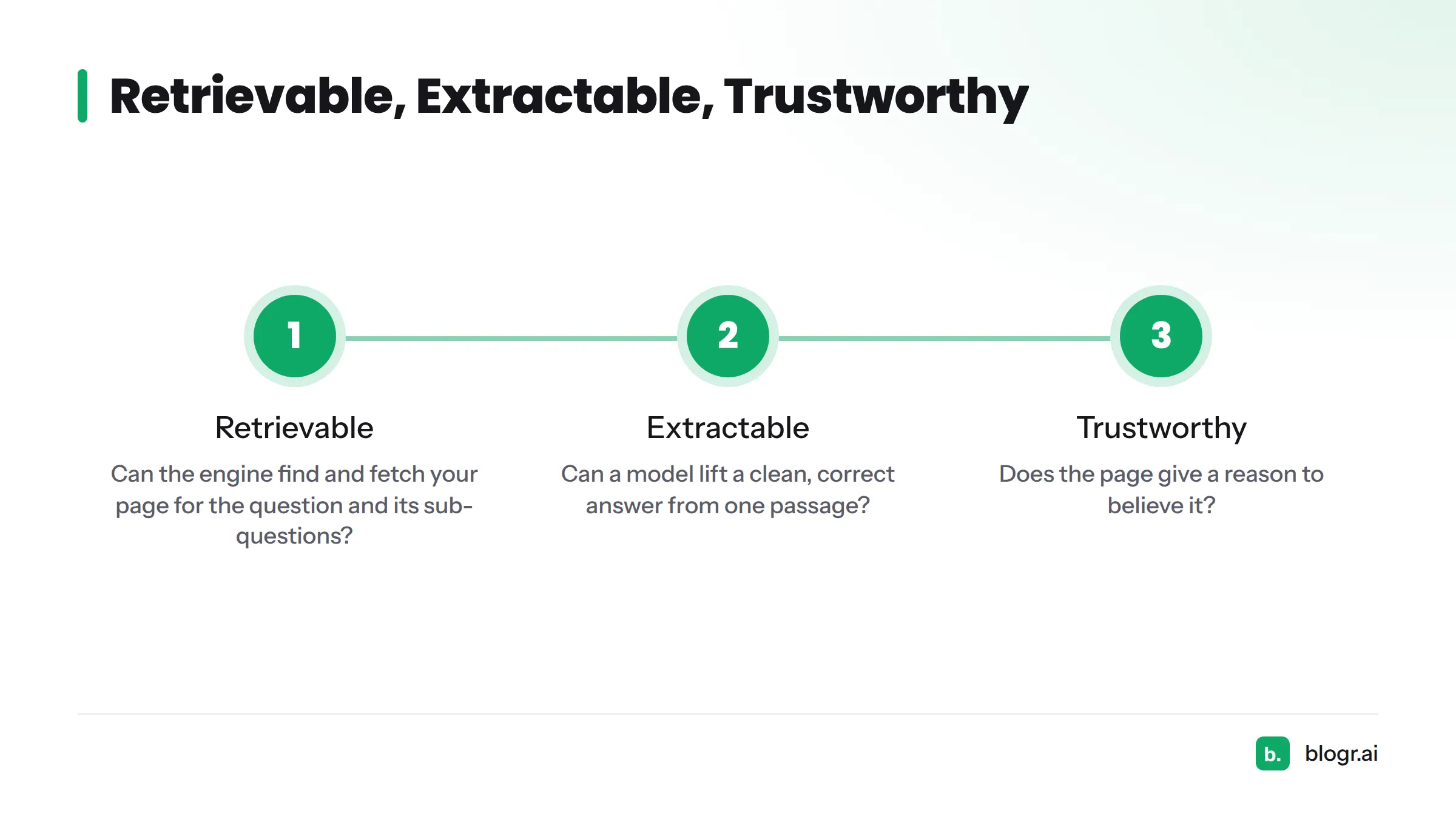
Retrievable
Can the engine find and fetch your page for the question and its sub-questions?
- Allow crawling and keep pages indexable. Bing publishes Webmaster Tools guidance for site owners, including material on AI performance.
- Cover the neighboring questions fan-out will generate, not just the headline query. A topical map makes that coverage systematic.
Extractable
Can a model lift a clean, correct answer from one passage?
- Put the answer first, then the nuance.
- Use headings that mirror real questions.
- State entities and relationships plainly ("Acme is a payroll tool for UK contractors") instead of leaving them implied.
Trustworthy
Does the page give a reason to believe it?
- Show E-E-A-T signals: named authors, first-hand experience, dated updates.
- Cite primary sources for any claim.
- Keep brand facts (pricing, location, product names) consistent everywhere they appear.
Picture three stacked layers: retrieval at the bottom, extraction in the middle, trust on top. A page that fails a lower layer never reaches the one above it.
Generative Engine Optimization Strategies You Can Apply to Any Page
Start with this checklist. Each item carries one line of reasoning.
- Answer the question in the first one or two sentences under each heading. Models lift passages, and short direct answers lift cleanly.
- Write headings as the questions people ask. They match how users and fan-out sub-queries are phrased.
- Cover the sub-questions around your topic. Fan-out rewards breadth within a subject.
- Name entities and define terms once, plainly. A model has less ambiguity to resolve.
- Add specifics: numbers, dates, named sources. The KDD paper's tests favored content with quotations and statistics, and specifics also make a passage worth citing.
- Show who wrote it and why they know. Experience and authorship support trust.
- Refresh pages on a schedule. Stale facts lose to fresh ones. Our guide to updating old blog posts lays out a workable routine.
Here is a before and after:
Before: "Many factors can influence how teams think about handling their invoicing process, and there are a number of approaches worth considering depending on circumstances."
After: "Invoice factoring lets a business sell unpaid invoices to a lender for immediate cash, usually at a fee of 1% to 5% of the invoice value. It suits companies waiting 30 to 90 days on customer payments."
The second version states the answer, names the concept and gives a model something concrete to quote. (The fee range is illustrative, so verify figures for your own market before publishing.)
Step-by-step citation tactics, ChatGPT-specific work and structured data each deserve their own full treatment. I'm pointing at those topics rather than squeezing them in here.
How to Run GEO With a Live-SERP Brief
A list of practices is easy to forget. A repeatable workflow sticks. The method I trust works like this:
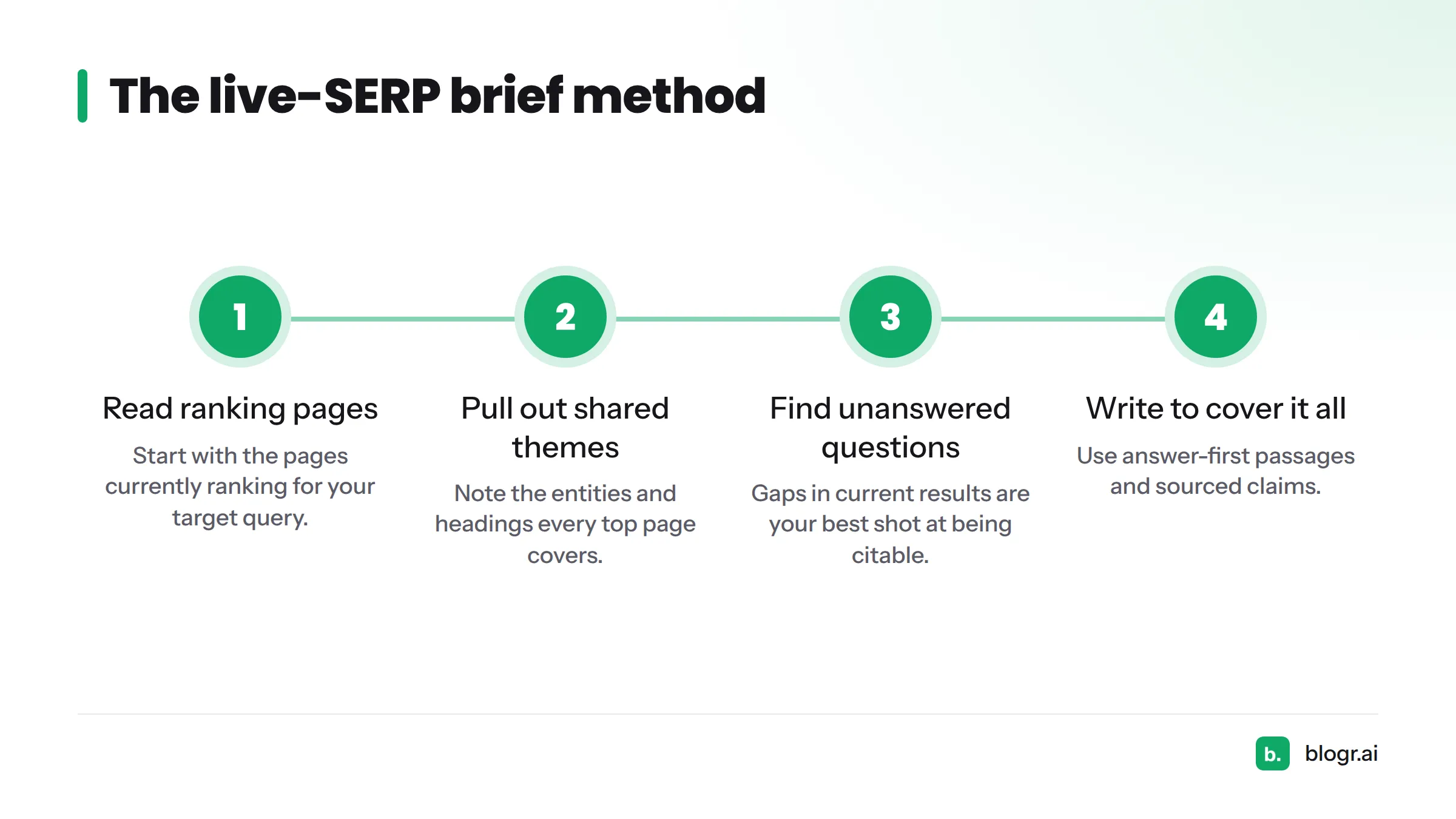
- Read the pages currently ranking for your target query.
- Pull out the shared themes, entities and headings. Whatever every top page covers is the baseline the engine already sees.
- Find the unanswered questions. Gaps in the current results are your best shot at adding something citable.
- Write to cover all of it, with answer-first passages and sourced claims.
This maps straight onto the framework. Shared themes and entities push you toward Retrievable coverage of fan-out sub-queries. Heading structure and answer-first writing make you Extractable. Sourcing the gaps with real evidence builds trust.
That is the job a live-SERP brief does at blogr.ai. It builds the brief from the pages that rank right now, so your outline starts from evidence instead of folklore. It is one way to run the method. You can also do it by hand with a spreadsheet and an afternoon. We built the tool because we got tired of doing that by hand every week.
Generative Engine Optimization Tools and Free Ways to Track Results
Measurement here is messy, so use several signals and trust none alone.
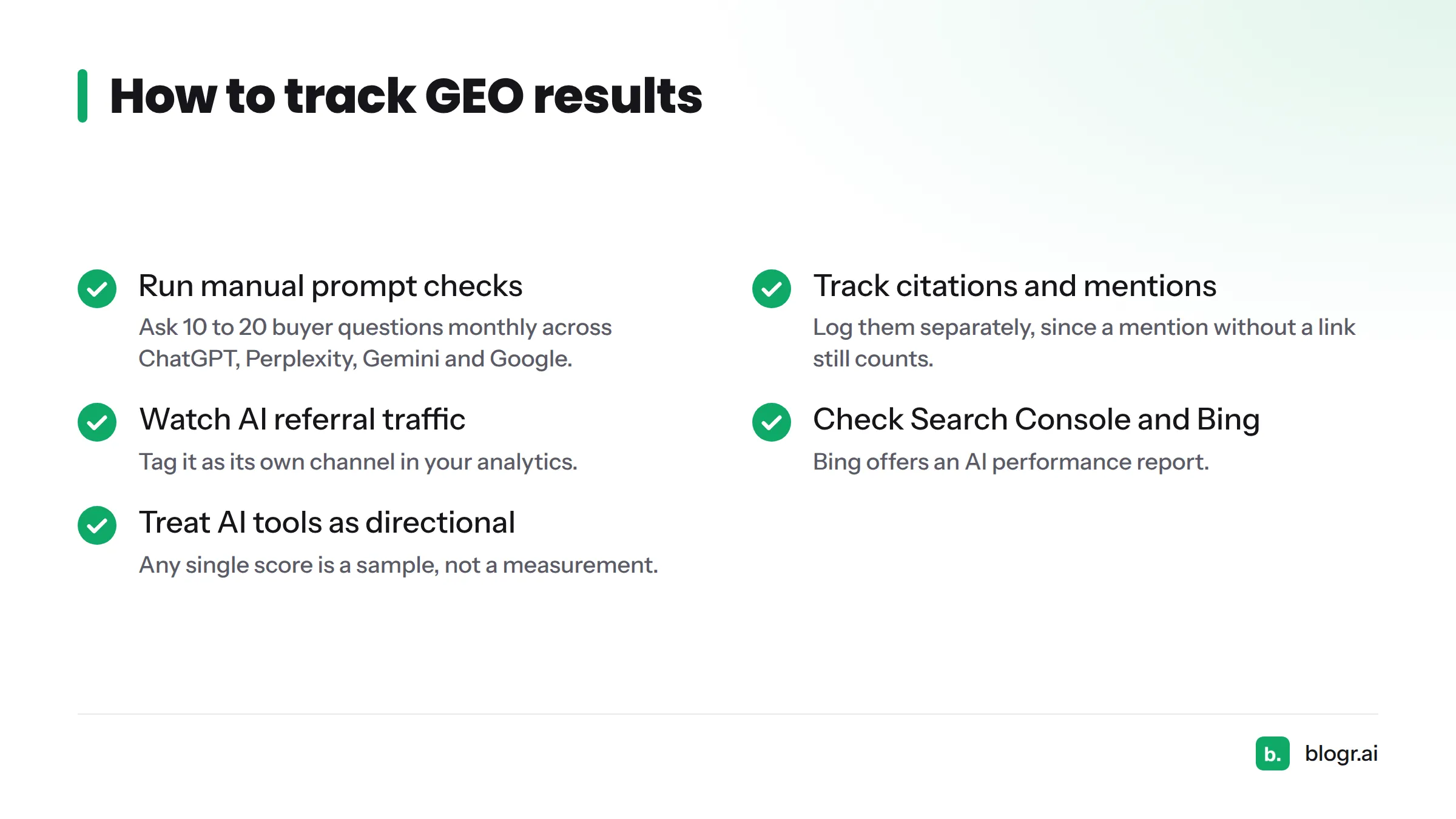
- Run manual prompt checks. Ask the same 10 to 20 buyer questions in ChatGPT, Perplexity, Gemini and Google each month, and log whether you are cited or mentioned.
- Track citations and mentions separately. A mention without a link still counts as visibility.
- Watch referral traffic from AI engines in your analytics, and tag it as its own channel.
- Check Google Search Console and Bing Webmaster Tools. Bing offers an AI performance report, and your Search Console data still shows impressions and clicks for the pages you are working on. Need a refresher? Here is how to read Google Search Console data.
- Treat third-party AI-visibility tools as directional. Answers vary by user, location and day, so any single score is a sample, not a measurement.
Expect slow, noisy results. Re-test on a fixed schedule so you compare like with like.
Where to Go Next
Each of these topics goes deeper than this overview can:
- How GEO compares with traditional SEO
- Tactics for getting cited by AI engines
- Appearing in ChatGPT answers
- Semantic SEO and entities
- Building a topical map to cover fan-out sub-questions
- Refreshing content with a weekly content refresh loop
Generative Engine Optimization FAQ
Is GEO the same as AEO?
Mostly, yes. Both aim to get your content used in direct answers. Answer engine optimization (AEO) leans toward answer formats such as featured snippets and voice, while GEO focuses on citations inside LLM-written responses. Practitioners often use the terms interchangeably, and the tactics overlap heavily.
Is GEO just SEO under a new name?
Partly. Google says optimizing for its AI features is still SEO, and the fundamentals do carry over. GEO adds a different target: being quoted inside a generated answer. That changes how you write passages and how you measure success.
Is SEO dead now with AI?
No. AI engines still retrieve from indexed web pages, so crawlability, quality and authority still matter. What changes is that visibility can happen without a click. Plan for both rankings and AI citations.
What is the best tool for generative engine optimization?
It depends on the job. For tracking, Bing Webmaster Tools and Google Search Console are free starting points. For building content from live search results, blogr.ai's live-SERP briefs give you a repeatable way to plan pages that cover a topic fully. Treat any tool's AI visibility score as directional.
Can anyone guarantee an AI citation?
No. No engine publishes how it selects sources, and answers vary by user and day. You can improve your odds by being retrievable, extractable and trustworthy, but a guarantee would be a red flag.
How do I start GEO as a beginner?
Pick your five most valuable pages. Rewrite the first sentence under each heading as a direct answer, add sourced specifics, show the author, and confirm the pages are indexable. Then run your prompt checks monthly and watch what changes.
Start Building GEO-Ready Pages Today
Run the live-SERP method on your next article and see what your competitors' pages leave unanswered. You can try it with the 7-day free trial at blogr.ai.