


SEO vs GEO: Key Differences and What to Do (2026)

SEO earns rankings and clicks in traditional search results. GEO (generative engine optimization) aims to get your content cited or recommended inside AI-generated answers. The two share foundations, so most sites need both. Start with SEO fundamentals, then add GEO as an extension.
I have spent years watching Google Search Console data for small sites, and the panic around this new acronym feels familiar. Every few years someone declares search dead. Here is the calm version: what differs, what overlaps, and what to do this week.
SEO vs GEO: The Short Answer
SEO is the work of making pages findable, relevant and trustworthy so they rank and earn clicks. GEO is the work of making that same content easy for AI answer engines to understand, quote and name. GEO builds on SEO. It does not replace it.
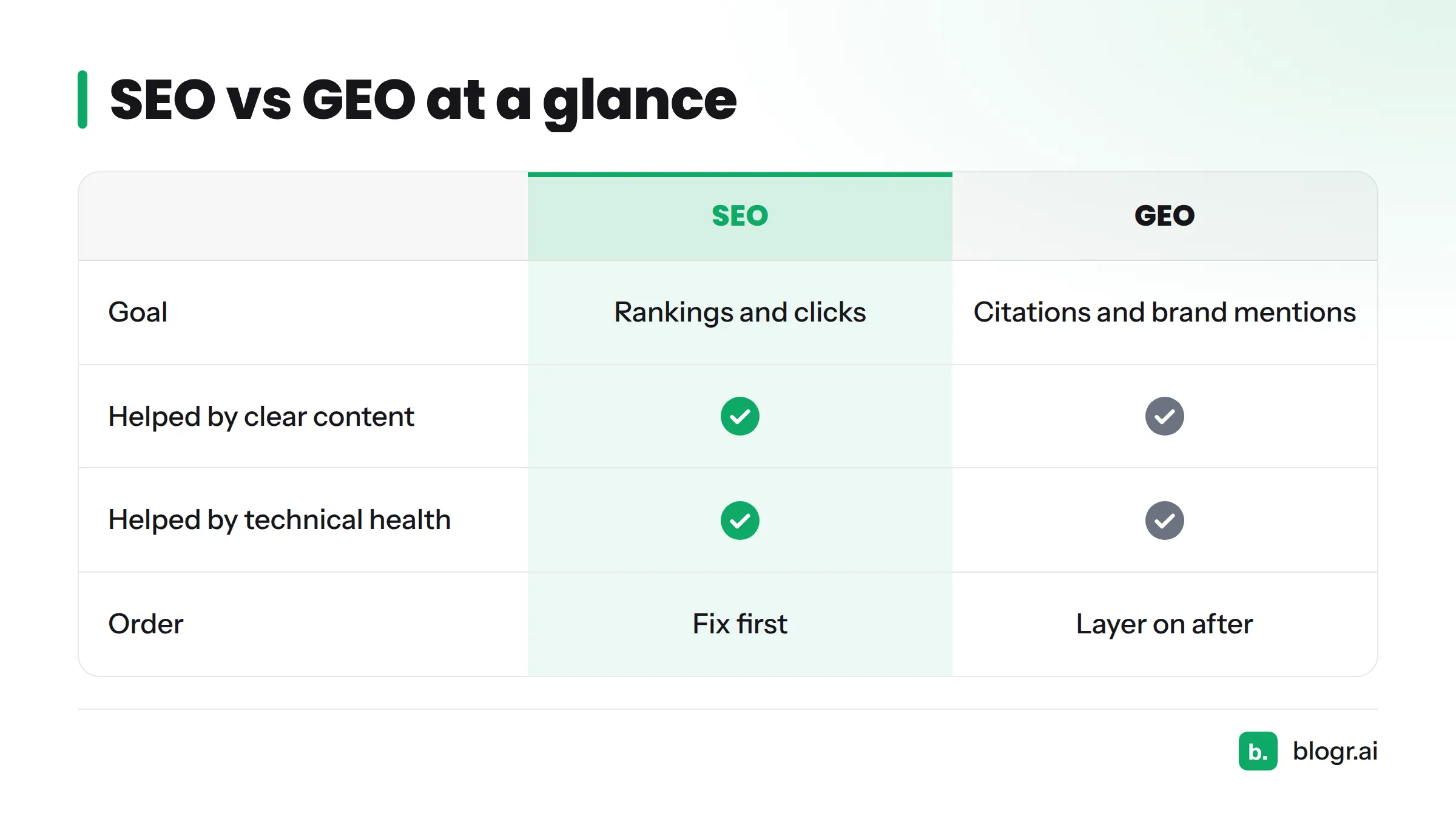
- Goal: SEO targets rankings and clicks. GEO targets citations and brand mentions.
- Overlap: Clear content, real expertise and clean technical health help both.
- Order: Fix fundamentals first, then layer on GEO.
A quick word on labels. AEO (answer engine optimization) is a closely related term, usually about winning direct answers and snippets. When people compare "AEO vs SEO" or "GEO vs SEO", they describe the same shift. For the full definition of the newer discipline, see generative engine optimization explained.
What SEO and GEO Each Aim to Achieve
SEO: rankings, clicks and organic search traffic
SEO (search engine optimization) is judged by where you appear and whether people click. Google's own Search Essentials describe the baseline: technical requirements, spam policies and helpful, people-first content. Meet that baseline and you earn organic search traffic you do not pay for.
GEO: citations and brand mentions in AI answers
GEO is judged by whether an AI answer names your brand or links your page. Success looks like a citation, a mention in a recommendation, or a referral visit from a chat tool. You rarely control the exact wording, so the goal is to be a source worth quoting.
Where AI answers show up
The AI search vs traditional search split is not one place. AI answers appear in several:
- Google's AI features in Search, including AI Overviews and AI Mode
- Chat assistants such as ChatGPT from OpenAI
- Answer engines such as Perplexity
Want the Google side in detail? Read our guides on Google AI Overviews and their SEO impact and Google AI Mode.
Signals and Inputs: What Each Responds To
Nobody outside these companies knows exactly how any engine picks its sources. Treat the table below as a practical map, not a rulebook.
| Input | SEO | GEO |
|---|---|---|
| Content relevance | Matches search intent for a query | Answers a question clearly enough to be quoted |
| Technical health | Crawlable, indexable, fast | Same: content must be accessible to be used |
| Links and authority | Backlinks and internal links shape rankings | Credible brand presence across the web likely matters, though evidence is still thin |
| E-E-A-T and content quality | Experience, expertise, trust signals | Same signals make a source safer to cite |
| Structured data | Helps eligibility for rich results (schema.org) | Helps machines read entities and facts, with no guarantee |
| Extractable passages | Helps featured snippets | Short, self-contained answers are easier to lift |
Google states that no special markup is required to appear in its AI features. Good SEO practice is the entry ticket.
How You Measure SEO and GEO
Most comparisons go quiet here, and this is where the real difference lives.
SEO in Search Console: impressions, clicks, CTR, average position
Search Console's Performance report gives you four numbers per query and page:
- Impressions: how often your page appeared in results.
- Clicks: how often someone clicked through.
- CTR: clicks divided by impressions.
- Average position: your mean ranking for that query.
It is first-party data, free, and tied to real searches. Learn to read it with our walkthrough on reading Google Search Console data, and see how Search Console-driven SEO turns those rows into tasks.
GEO: citations, brand mentions, referral traffic, and honest limits
GEO has no first-party dashboard to match. You can check citations by asking engines your target questions, watch for brand mentions, and look for referral traffic from chat tools in your analytics. Answers vary by user, prompt and day, so any single snapshot is noisy.
| Metric | Source | Reliability |
|---|---|---|
| Impressions, clicks, CTR, position | Search Console | High: first-party and consistent |
| AI citations | Manual prompt checks or third-party trackers | Low to medium: results vary run to run |
| Brand mentions in AI answers | Manual checks or tracking tools | Low to medium |
| Referral traffic from AI tools | Web analytics | Medium: undercounts when no link is clicked |
My advice: treat GEO numbers as directional signals, never as a scoreboard.
Effort and Resourcing: Where the Work Overlaps
Most of the work is shared, which is good news for small teams. If you have wondered whether you need GEO as a separate project, this table is the answer: mostly no.
| Task | Helps SEO | Helps GEO |
|---|---|---|
| Clear, accurate, original content | Yes | Yes |
| Demonstrating E-E-A-T (real authors, sources) | Yes | Yes |
| Structured data | Yes | Yes, as a clarity aid |
| Internal linking and topical coverage | Yes | Likely, by clarifying entities |
| Keyword and intent research | Yes | Yes, as question research |
| Concise answer blocks under question headings | Some | Yes |
| Tracking mentions and citations | No | Yes (GEO-specific) |
| Presence on third-party sources and communities | Some | Yes (GEO-leaning) |
Picture two overlapping circles. The big shared middle holds content quality, trust and technical health. SEO-only work includes link building and CTR tuning. GEO-only work is mostly answer formatting and monitoring mentions. Tactics for the GEO side belong in a guide on how to get cited by AI, and the planning side in building an SEO content strategy.
Why Search Console-Led SEO Fundamentals Still Drive Most Results
Founder's opinion: In our experience growing organic search, the biggest measurable wins still come from reading Search Console, finding queries stuck just off page one, and improving those pages. GEO has been an extension of that work for us, not a separate playbook. This is our view, not a proven rule.
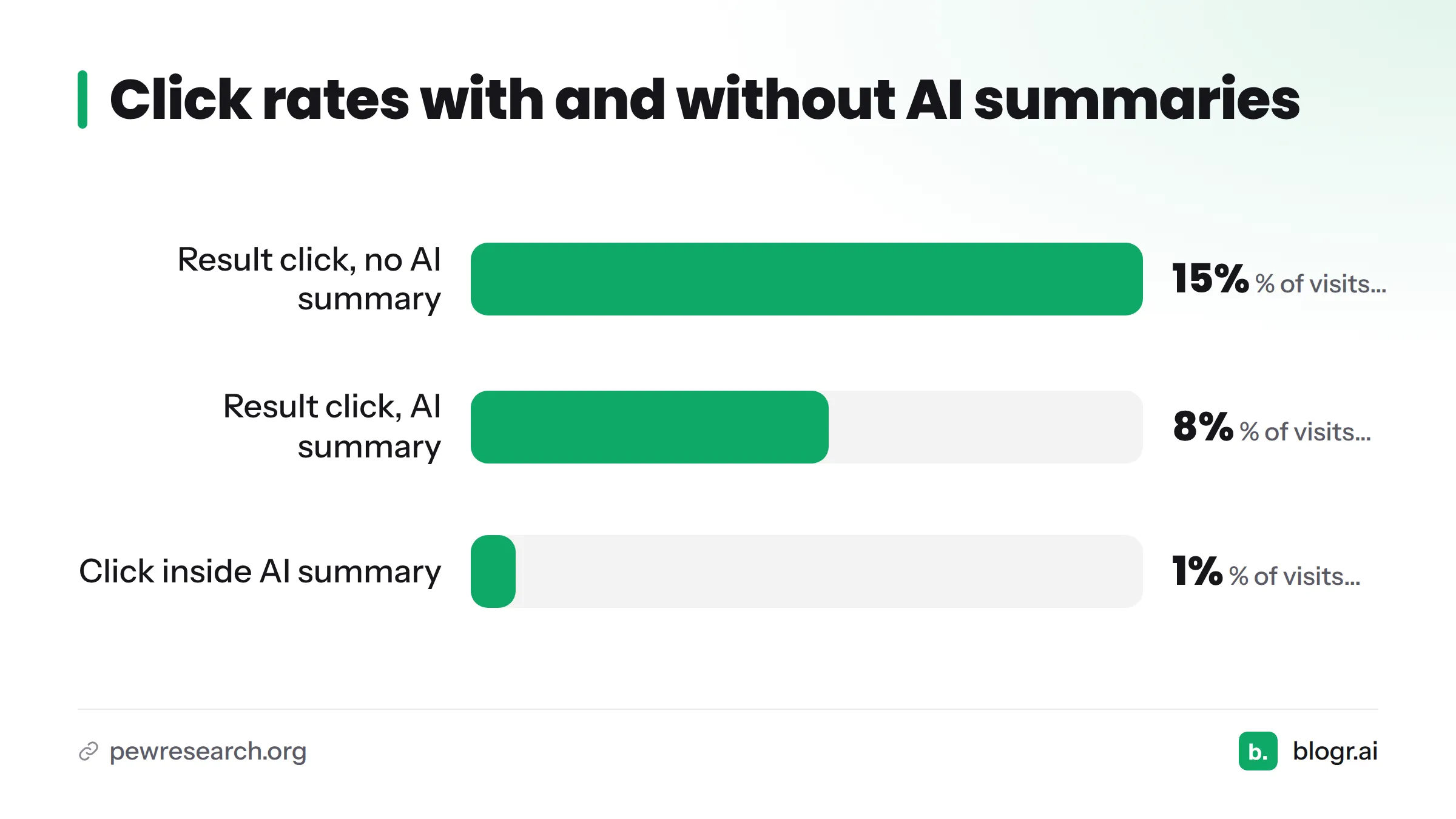
The data supports some caution about clicks. A Pew Research Center analysis of browsing data from March 2025 found users clicked a traditional result on 8% of visits when an AI summary appeared, versus 15% when none did. Only 1% of visits included a click on a link inside the summary. That is one dataset, one month, one panel of US adults, so read it as context rather than a universal rate.
Fewer clicks make strong rankings and sharp titles matter more, not less. Here is a mini-diagnostic:
| Symptom | Likely cause | Work on first |
|---|---|---|
| Ranking but few clicks | Weak title or snippet, or AI summary absorbing the click | SEO: see why you rank but get no clicks |
| Ranking but never cited | Content hard to quote, or thin brand presence | GEO: answer structure, evidence, mentions |
| Not ranking | Relevance, authority or indexing problems | SEO fundamentals |
Verdict: GEO or SEO First, and Why You Need Both
Short version: you need both, in sequence. No tactic guarantees rankings or citations, so spend effort where the evidence is strongest first. That is why the GEO or SEO question has a boring answer. SEO goes first.
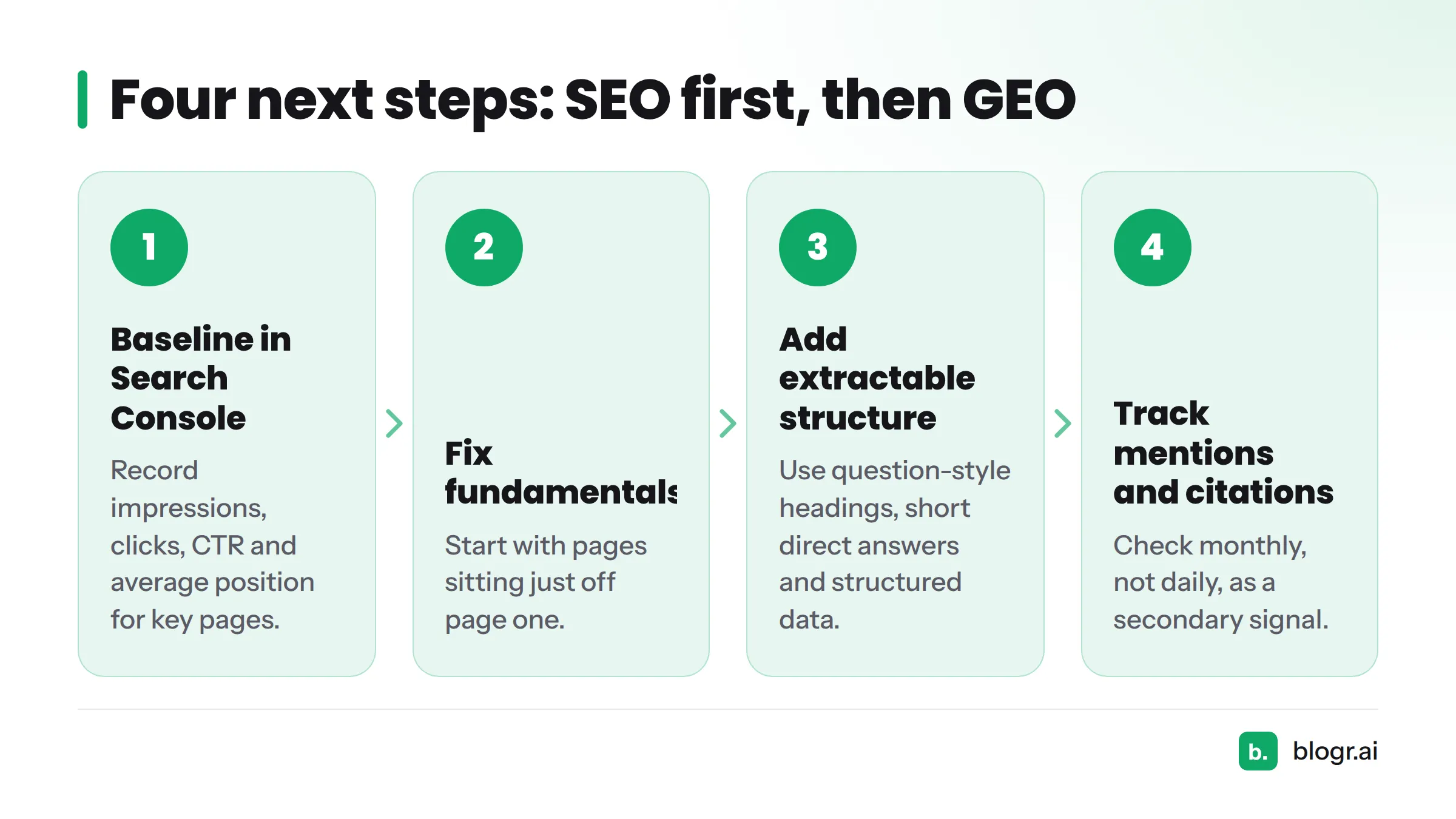
Next steps:
- Baseline in Search Console. Record impressions, clicks, CTR and average position for your key pages.
- Fix content and technical fundamentals. Start with pages sitting just off page one. Our guide to striking distance keywords shows how.
- Add extractable structure. Use question-style headings, short direct answers and accurate structured data.
- Track mentions and citations as a secondary signal. Check monthly, not daily.
Your situation changes the starting point:
- New site: Publish useful content on a clear topic and get indexed. GEO can wait.
- Established site with Search Console data: Refresh your winners, then restructure answers so they are easy to quote.
- Ecommerce or local: Keep product, pricing and business details accurate and consistent everywhere, since AI answers pull from many sources.
Want help doing this without a full SEO team? blogr.ai reads your Search Console data to surface striking-distance queries, and its AI search visibility feature extends that to AI answers. Start the 7-day free trial at blogr.ai and see where your content stands.
SEO vs GEO FAQ
Do I need both SEO and GEO?
Most sites do. SEO brings clicks from traditional results, and GEO adds visibility in AI answers. They share content quality and trust work, so the extra effort is modest. Start with SEO, then add GEO.
Is GEO replacing SEO?
No. AI answers sit on top of the same web content that SEO improves, and Google says its AI features rely on the same Search foundations. GEO extends SEO into a new surface. Anyone claiming SEO is dead is overstating the evidence.
Is SEO still relevant in 2026?
Yes. Traditional results still drive visits, and the content, technical and trust work behind SEO also feeds AI answers. Click patterns shift when AI summaries appear, so measure your own Search Console data rather than trusting headlines.
What is AEO, and how does it differ from SEO and GEO?
AEO, answer engine optimization, means shaping content to be chosen as a direct answer, such as snippets, voice results or AI responses. It overlaps heavily with GEO. In the AEO vs SEO comparison, as with GEO, the newer term extends SEO rather than replacing its fundamentals.
Should I do SEO or GEO first?
SEO first. It gives you measurable data in Search Console and builds the content and technical base GEO relies on. Add GEO once your key pages are indexed, relevant and well structured.
Does ranking well in Google help me get cited in AI answers?
Often, but there is no guarantee. Strong rankings signal relevant, accessible content, which helps. AI engines also draw on other sources, so a ranking page can still go uncited.
How do I measure SEO success versus GEO success?
Measure SEO with Search Console: impressions, clicks, CTR and average position. Measure GEO with citation checks, brand mentions and AI referral traffic. The first is precise. The second is directional.
What if I rank on page one but get few clicks?
Check your title, snippet and the query's intent first, then see whether an AI summary appears for it. Improve the title and answer fit. Our guide on fixing CTR gaps walks through it.
Sources
- Google Search Console, Google
- Google Search Essentials, Google Search Central
- AI features and your website, Google Search Central
- Performance report (Search), Search Console Help, Google
- Google users are less likely to click on links when an AI summary appears in the results, Pew Research Center
- schema.org