
What Is Semantic SEO? Entities, Intent and Examples

Semantic SEO is the practice of optimizing content for meaning (the entities, intent and related subtopics behind a query) rather than for one keyword string. Keyword SEO asks which phrase to repeat. Semantic SEO asks what the searcher needs to understand, then covers it completely.
This guide stays on the practice itself. Topical authority, structured data setup and topic clusters each deserve their own page, so I name them here and move on. Let's break it down.
What Is Semantic SEO? The Short Answer
Here is the version you can lift and reuse.
Semantic SEO in one paragraph
Semantic SEO is an approach to writing and organizing pages around what a query means. You identify the main entity (the person, product, concept or place the query is about), match the intent behind the search, and cover the related subtopics and questions a reader would expect. The goal is a page that fully explains a topic, not one that repeats a phrase. That goal is also the heart of semantic SEO writing: you plan the page around the reader's questions before you draft a single line.
Semantic SEO vs semantic search
The two terms sound alike, and people swap them constantly. They describe different things.
- Semantic search is a search engine capability. The engine interprets meaning, context and intent instead of only matching the literal words typed.
- Semantic SEO is a publisher practice. You shape content so an engine that interprets meaning can see what your page covers.
One is what Google does. The other is what you do in response.
Approach, not a ranking factor. Google has not published "semantic SEO" as a ranking factor, and no tactic here guarantees a position. Google's own guidance asks for helpful, reliable, people-first content. Semantic SEO is a practical way to meet that standard on a topic-by-topic basis.
Keyword SEO vs Semantic SEO: What Changes
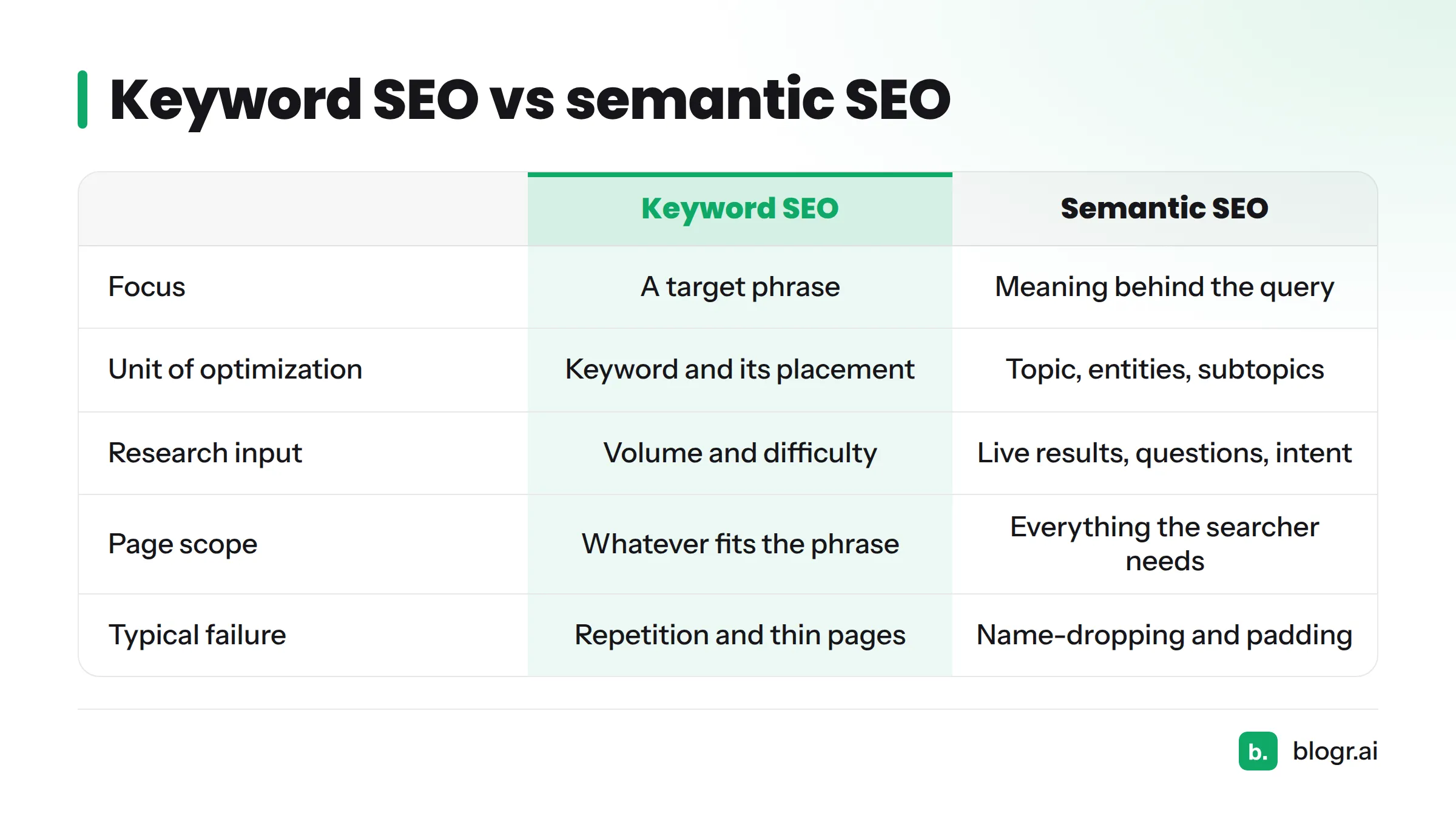
I still do keyword research on every page I plan. What changes is what I do with the result. Here is the side-by-side view of keyword SEO vs semantic SEO.
| Keyword SEO | Semantic SEO | |
|---|---|---|
| Focus | A target phrase | The meaning behind the query |
| Unit of optimization | The keyword and its placement | The topic, its entities and subtopics |
| Research input | Volume and difficulty for a phrase | Live results, related questions, entities, intent |
| Page scope | Whatever fits the phrase | Everything the searcher needs to understand |
| Success measure | Phrase appears in the right spots | The page answers the query and its follow-ups |
| Typical failure mode | Repetition and thin pages | Name-dropping and padded pages |
What stays the same
Keywords still matter. A keyword shows you the language people use and roughly how many of them use it. Semantic SEO builds on that input. It does not replace it.
A short history, from Google's own words
Two announcements explain why this approach exists:
- In 2012, Google introduced its Knowledge Graph and described the shift as moving to understanding "things, not strings".
- In 2013, Google rolled out the Hummingbird algorithm, which Search Engine Land reported was built to handle full conversational queries better than isolated words.
Both are old, and Google has changed Search many times since. The direction they set still explains why meaning matters.
Entities, Search Intent and Context: The Three Building Blocks
Picture a small map with the topic at the center. The topic connects to entities (what the page is about). Entities connect to search intent (what the searcher wants to do). Intent connects to context (who is asking, and what they likely ask next). Context leads to related subtopics (what the page must cover).
Entities
An entity is a distinct thing with attributes and relationships. "Standing desk" is an entity. So are "ergonomics," "height adjustment range" and a specific brand. Google describes its Knowledge Graph as a collection of real-world things and the connections between them. When people say entity SEO, they mean writing so those things and connections are unmistakable on the page. You can also label entities explicitly with structured data, which this site covers in its structured data guide.
Search intent
Intent is the job the searcher wants done. The four common types are informational (learn something), navigational (reach a site), commercial investigation (compare options) and transactional (buy or sign up). Search intent optimization means picking the page type that matches the job. A page that nails the topic but misses the intent still fails. Someone searching "what is semantic SEO" wants a definition, not a pricing page.
Context and natural language processing
Words are ambiguous. "Jaguar" could be a car or a cat. Search systems use natural language processing (NLP) and machine learning to read the surrounding words and the likely follow-up question. Google has described this in general terms in How Search works. I won't claim to know which system does what on a given query, and neither should you. Write clearly and let the surrounding words carry the context.
Semantic SEO Practices That Improve Topical Coverage
This is the workflow I follow when I write a page. Good topical coverage comes from running these steps in order.
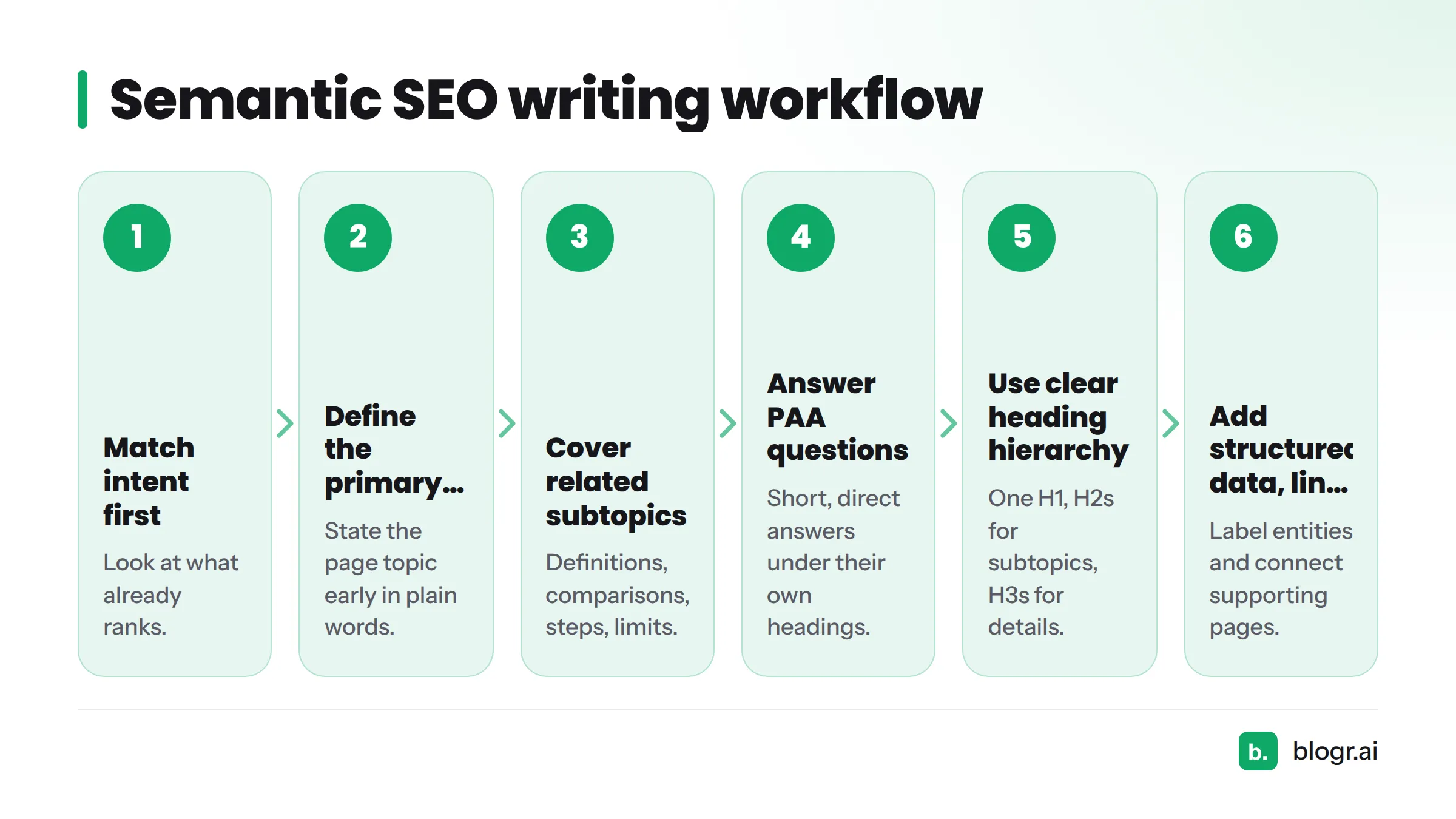
- Match intent first. Look at what already ranks. If every result is a how-to, a sales page will struggle.
- Define the primary entity early. State what the page is about in the opening lines, in plain words.
- Cover related terms and subtopics. List what a reader needs next: definitions, comparisons, steps, limits.
- Answer People Also Ask style questions. Give each question a short, direct answer under its own heading.
- Use a clear heading hierarchy. One H1, H2s for major subtopics, H3s for details. Headings should read like a table of contents.
- Use natural semantic keywords. Pick the related phrases that fit, use each once, and place it where it helps the reader.
- Label entities with structured data where it fits. Link out to a proper guide for the setup, since it is a separate skill.
- Link related pages. Connect pages that support each other. Topic clusters are their own subject, so I leave them for that page.
Semantic keywords are not a synonym list. Sprinkling variations into every paragraph reads badly and adds nothing. "LSI keywords" is a loosely used industry term, not a Google concept, so treat it with caution.
For the wider plan around these steps, see this site's SEO content strategy guide.
Semantic SEO Examples: Keyword-Led vs Meaning-Led Pages
Here is an illustrative example for "standing desks." It is hypothetical and makes no performance claims.
| Keyword-led outline | Meaning-led outline |
|---|---|
| H1: Best Standing Desk | H1: Best Standing Desks: How to Choose One That Fits |
| H2: Best Standing Desk Reviews | H2: What Is a Standing Desk (and Who Benefits) |
| H2: Best Standing Desk for Home | H2: Frame Types, Height Range and Weight Capacity |
| H2: Best Standing Desk Brands | H2: Desktop Size, Materials and Cable Management |
| H2: Buy Standing Desk Online | H2: Setup and Ergonomics: Monitor and Elbow Height |
| H2: Standing Desk FAQ | H2: Questions Buyers Ask Before Purchasing |
What changed between the two outlines
- The entity is explained. The meaning-led page defines the product and the features that set one desk apart from another.
- Intent drives the order. A buyer comparing options needs selection criteria before a list of picks.
- Headings carry information. Each heading names a real subtopic instead of repeating the phrase.
How to Build Semantic Coverage From Live SERP Briefs
The live results page is the best research input you have. It shows what the engine currently treats as relevant to the query.
Read the SERP like a researcher
Scan the top results for shared themes, repeated entities, common headings, the People Also Ask box and related searches. When several pages repeat the same thing, readers probably expect it.
Find the unanswered questions
Note what the top pages skip or answer poorly. That gap is where your page adds something new. Check the PAA questions and ask which ones no result answers directly.
Turn findings into an outline
Group the shared themes into H2s, put the missing questions under H3s, and write the definition first.
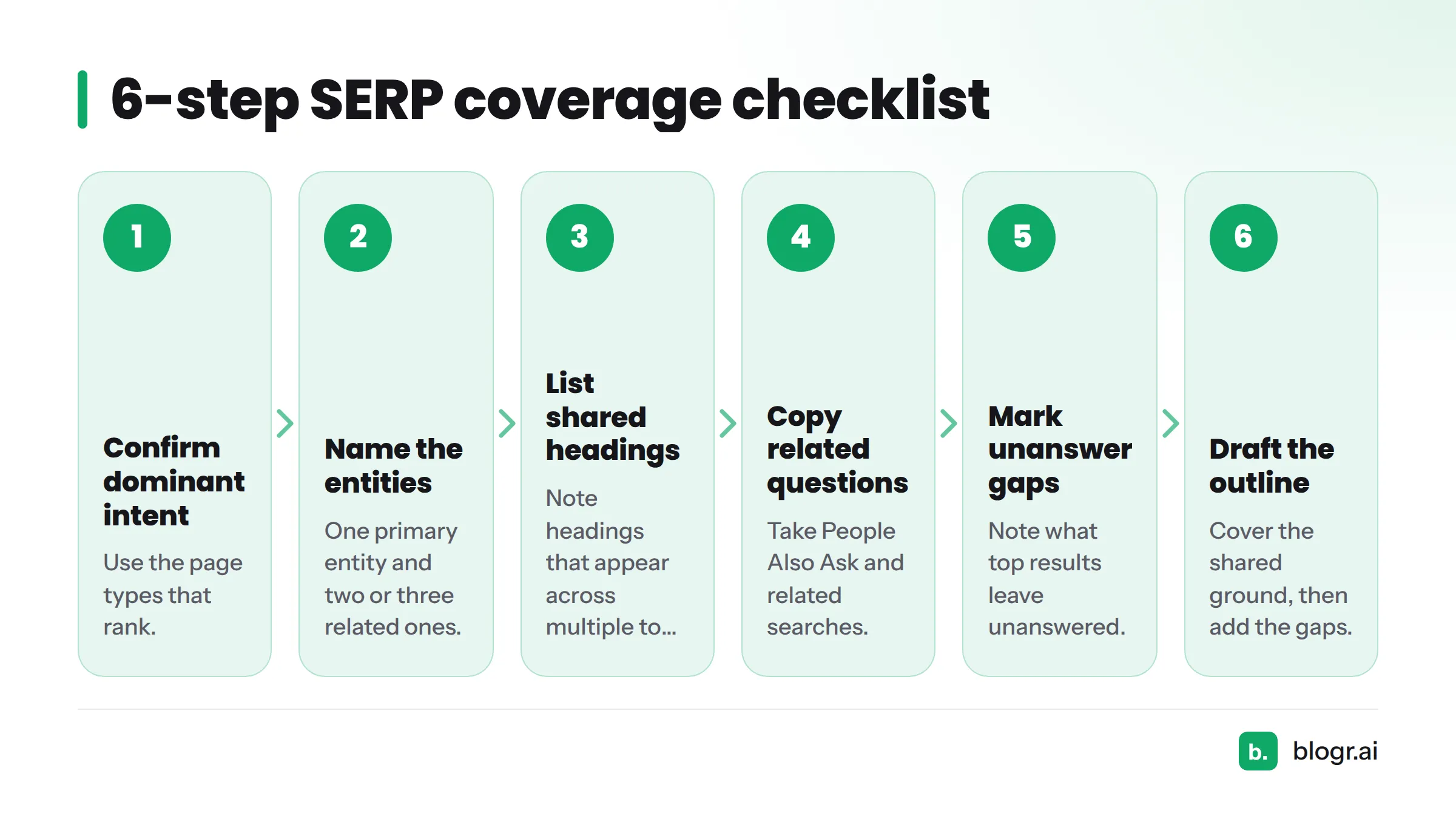
6-step SERP coverage checklist
- Confirm the dominant intent from the page types that rank.
- Name the primary entity and two or three related entities.
- List the headings that appear across multiple top results.
- Copy the People Also Ask and related-search questions.
- Mark what the top results leave unanswered.
- Draft an outline that covers the shared ground, then adds the gaps.
Doing this by hand takes a while. blogr.ai builds the same inputs into briefs built from live SERP entities, surfacing shared themes, entities, headings and unanswered questions from the current results. If you plan whole subject areas, topical map software helps you decide which pages to write. Grouping keywords by intent is a separate method, and I cover it elsewhere.
Next step: See how live-SERP briefs capture entities.
Common Semantic SEO Mistakes to Avoid
- Stuffing synonyms. Rewording the same keyword twenty ways is still stuffing.
- Name-dropping entities. Mentioning a term without explaining it adds nothing.
- Ignoring intent. Perfect coverage of the wrong page type misses the searcher.
- Padding to hit a word count. Long is not the same as complete.
- Copying competitor headings. Borrow the shared themes, then add your own angle.
- Promising rankings. No coverage method guarantees a position.
- Skipping updates. Results shift. Refreshing old posts keeps coverage current, which matters in 2026 with AI Overviews on many results. This site's AI Overview guide covers that context.
FAQ
What is semantic SEO in simple terms?
It is writing for what a query means instead of the exact words typed. You identify the main topic, match the searcher's goal and cover related subtopics and questions so the page fully answers the need.
Is semantic SEO a Google ranking factor?
No. Google has not listed it as one. It is an approach that helps you meet Google's published guidance on helpful, people-first content. It cannot guarantee higher rankings.
What are entities in SEO?
Entities are distinct things, such as people, products, places or concepts, with attributes and relationships. Search systems like Google's Knowledge Graph store and connect them, so clear entity coverage helps a page show what it is about.
Are semantic keywords the same as LSI keywords?
Not exactly. Semantic keywords are related terms and phrases that fit a topic. "LSI keywords" is a loosely used industry label, not a term Google uses, so I avoid building a strategy around it.
Do I still need keyword research?
Yes. Keyword research shows the language people use and the demand for it. Semantic SEO adds a second layer: the intent, entities and questions behind that language.
Is semantic SEO still relevant in 2026 with AI Overviews?
Yes. AI-generated answers still draw on pages that explain a topic clearly and completely. Writing around meaning, intent and complete coverage remains a sound way to produce those pages, though no outcome is guaranteed.
Sources
- Introducing the Knowledge Graph: things, not strings, Google
- Creating helpful, reliable, people-first content, Google Search Central
- How Search works, Google
- FAQ: All About The New Google Hummingbird Algorithm, Search Engine Land
Related: clustering keywords by intent