


Best AI SEO Writers in 2026: Ranked and Compared
The best AI SEO writer for a team that needs content that ranks is the one that runs the whole loop: topic discovery, a brief built from the live results, a draft, a review step, publishing, and refresh. For that job, blogr.ai fits best. If you only need on-page grading, research briefs, brand-voice copy, bulk output, or enterprise planning, one of the specialists below may suit you better. You can start the 7-day free trial and judge for yourself.
Full disclosure: blogr.ai publishes this page. We ranked every tool on the same criteria, placed ourselves by fit, and stated our limits. Let's break it down.
Best AI SEO Writers in 2026: Quick Comparison
Most lists of the best AI SEO writers rank tools by how good the draft reads. We rank them by how much of the publishing loop they run. A great draft that sits in a document, never gets briefed from real search data, never goes live, and never gets refreshed does little for your traffic.
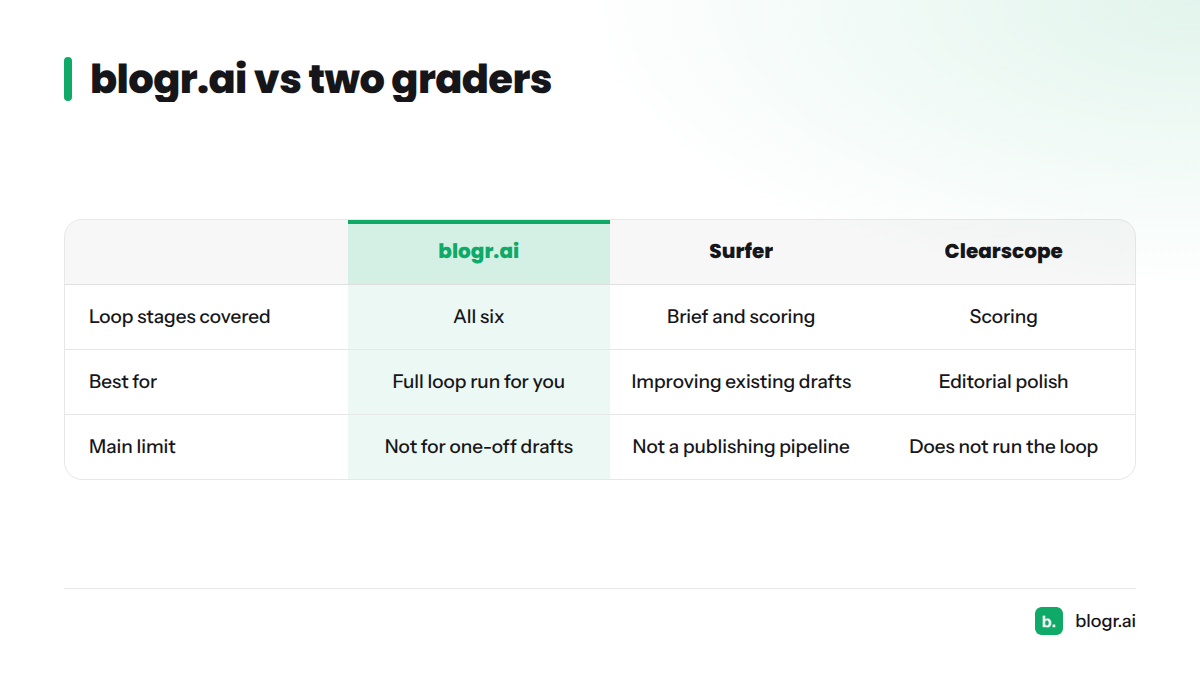
This AI SEO writer comparison covers seven tools:
| # | Tool | Best for | Loop stages covered | Main limit | Verdict |
|---|---|---|---|---|---|
| 1 | blogr.ai | Teams wanting the full loop run for them | All six | Not built for one-off drafts or grading only | Best overall for steady, ranking-ready publishing |
| 2 | Surfer | Improving drafts you already have | Brief and scoring | Not a hands-off publishing pipeline | Best on-page grader |
| 3 | Frase | Research-first briefs and answer targeting | Research, brief, drafting | Less focus on publishing and refresh | Best for research-led writers |
| 4 | Jasper | Brand-voice marketing copy | Drafting | Built around marketing copy, not SERP-led SEO | Best for brand voice |
| 5 | Byword | Bulk programmatic articles | Drafting at volume | Review-at-scale risk | Best for bulk output |
| 6 | MarketMuse | Enterprise topical authority planning | Planning and briefs | Planning-heavy for small teams | Best for enterprise planning |
| 7 | Clearscope | Editorial teams refining content grades | Scoring | Grades content; does not run the loop | Best for editorial polish |
Pricing and feature claims for every competitor change often. Check each vendor's live page before you buy.
Best for a team that needs steady, ranking-ready publishing: blogr.ai, because it covers all six loop stages in one place.
How We Ranked These AI SEO Tools: The Whole Content Loop, Not Just the Draft
We run our own organic growth, and that shaped the criteria. When we shopped for tools, the draft was rarely the bottleneck. The slow parts were everything around it: deciding what to write, briefing it properly, getting it live, and fixing it when rankings slipped.
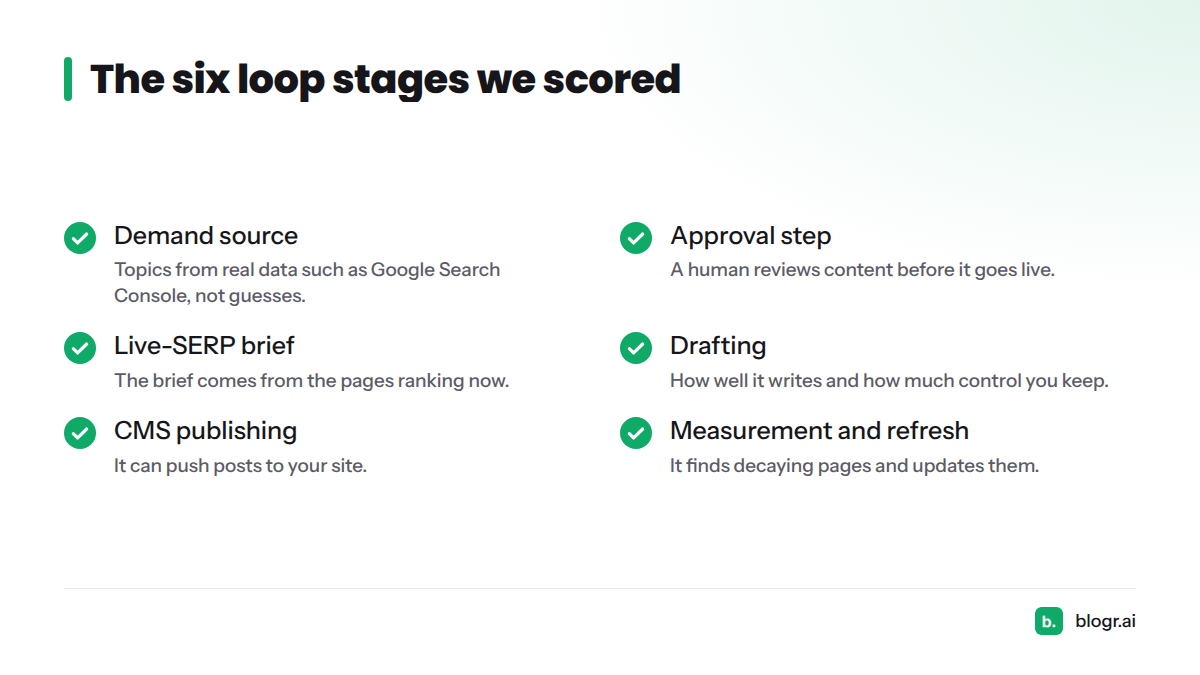
The six loop stages we scored
Each tool earned credit for the stages it covers, using one checklist for every product:
- Demand source: Does it pull topics from real data, such as Google Search Console, instead of guesses?
- Approval step: Can a human review content before it goes live?
- Live-SERP brief: Does the brief come from the pages ranking now?
- Drafting: How well does it write, and how much control do you keep?
- CMS publishing: Can it push posts to your site?
- Measurement and refresh: Does it find decaying pages and update them?
This is our opinion-based framework, not an industry standard. We label it that way on purpose.
What an AI writer for SEO actually is
An AI SEO writer is software that uses large language models to produce search-focused articles, usually guided by keyword research, competitor analysis, or a content brief. It differs from a general AI writer because it works from search intent and ranking pages, not just a prompt.
Three tool types get lumped together under that label:
- Writers draft the article.
- Graders score a draft against ranking pages and suggest terms.
- Planning platforms map topics and measure authority across a site.
A live-SERP content brief is an outline built from the pages currently ranking for a keyword, so the draft matches what searchers and Google already reward. A content refresh means updating an existing page once its rankings or clicks decline.
Sourcing rules and check date
Every competitor claim below comes from the vendor's own live page, checked in October 2026. Where a vendor page does not state something, we say "not stated" instead of guessing. We name no scores we did not measure, and we make no ranking or traffic promises.
1. blogr.ai: Best for Teams That Want the Full Loop Run for Them
Best for: SaaS, ecommerce, and local-business teams, solo founders, and agencies that want consistent publishing without stitching together five tools.
Strengths: blogr.ai works as both an AI blog writer and an SEO content automation platform, and it starts from your own data. It can turn Search Console data into SEO actions, so titles come from queries your site already earns impressions for. Each article begins with a brief built from the live search results, and a human approval step sits before anything goes live. Posts publish to WordPress and other CMS platforms, including Webflow, Shopify, and Ghost. When a page slips, the content refresh tool reads Search Console data and flags what to update. The features page shows the full SEO content automation loop, and a topical map helps you plan coverage before you write.
Limits: blogr.ai is the wrong pick if you want a one-off draft, or only a grader for drafts written elsewhere. It runs a publishing process, so it rewards teams that publish steadily.
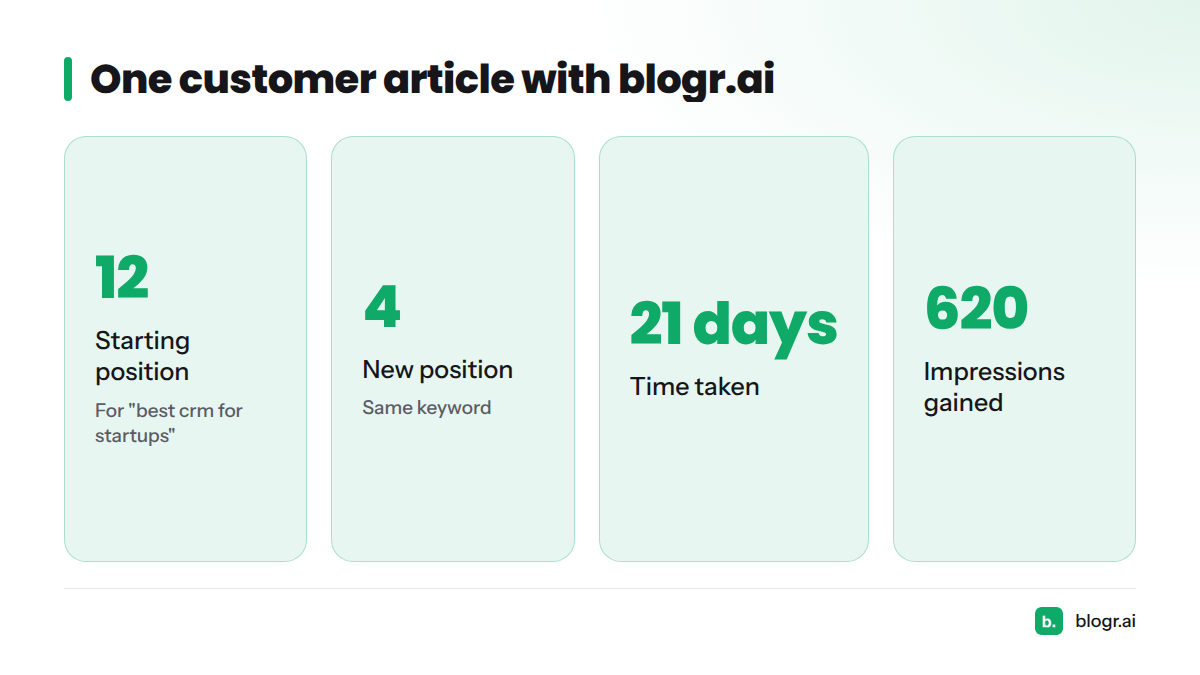
Verdict: For the question this page asks, which tool helps a team publish content that ranks, this is our top pick. We back that with a measured result: one customer article moved from position 12 to position 4 for "best crm for startups" in 21 days and picked up 620 impressions. See blogr.ai pricing and the 7-day trial for plan details.
Ready to test it? Start the 7-day free trial.
2. Surfer: Best for Improving Drafts You Already Have
Best for: Writers and editors who already have drafts and want to match them to the pages ranking today.
Strengths: Surfer is known for its content editor, which scores a draft and suggests terms based on ranking pages. If your workflow is "write, then tune," it fits cleanly. It also pairs well with a separate writer.
Limits: It centers on improving content, not on running topic selection, approval, and publishing as one pipeline. Pricing and AI writing features vary by plan, so confirm them on the vendor page.
Verdict: Choose Surfer when on-page grading is your gap. If you are weighing it against other options, see our rundown of Surfer SEO alternatives.
3. Frase: Best for Research-First Briefs and Answer Targeting
Best for: Writers who start with research and want briefs that reflect the questions searchers ask.
Strengths: Frase focuses on research and briefs. It pulls together what ranking pages cover and the questions around a topic, then helps you write against that. It suits people who like to see the research before they draft.
Limits: Its center of gravity is research and on-page work. Publishing and refresh workflows are not where it leads, so check the vendor page for current connections to your CMS.
Verdict: A strong fit for research-led writers. Pair it with a publishing process of your own.
4. Jasper: Best for Brand-Voice Marketing Copy at Scale
Best for: Marketing teams producing on-brand copy across ads, emails, landing pages, and posts.
Strengths: Jasper is built around marketing content and brand voice. If consistent tone across many assets matters more than SERP-led article structure, it is a natural choice.
Limits: It is a general marketing platform, not a loop built around Search Console topics and live-SERP briefs. That is a difference in focus, not a flaw. Check the vendor's current feature page and compare it against the six loop stages above.
Verdict: Pick Jasper for brand-voice copy. Pick a loop tool when ranking articles are the goal.
5. Byword: Best for Bulk Programmatic Article Generation
Best for: Sites that need large volumes of articles, such as programmatic SEO projects.
Strengths: Byword is positioned around generating articles in bulk. When the job is volume across many similar pages, that focus helps.
Limits: Bulk output creates a review problem. Google's guidance says that using automation to generate many pages without adding value for users can violate its spam policies, as covered in Google Search Central's guidance on AI-generated content. Someone still has to check quality at that scale.
Verdict: Use it when volume is the plan, and budget time for review.
6. MarketMuse: Best for Enterprise Topical Authority Planning
Best for: Large content operations that need to plan topical authority across hundreds of pages.
Strengths: MarketMuse is known for content planning and topic modeling. It helps big teams decide what to cover and where the gaps sit.
Limits: It leans toward planning. A small team that wants to publish this week may find a lighter tool faster. If you want planning without the enterprise weight, our free topical map generator is a starting point.
Verdict: Best when strategy across a large site is your constraint.
7. Clearscope: Best for Editorial Teams Refining Content Grades
Best for: Editorial teams who want a clear grade and term guidance for each draft.
Strengths: Clearscope is built around content grading and term recommendations. Editors use it to polish drafts to a consistent standard.
Limits: It grades and guides. It does not run topic discovery, publishing, or refresh for you.
Verdict: A good second tool beside a writer. A weak fit if you want the whole process handled.
How to Choose the Right AI SEO Tool for Your Team
Pick by team type
- Solo founder: You lack time, not ideas. Choose a loop tool. Our guide to on-page SEO for founders without an SEO team shows what you still have to do by hand.
- SaaS team publishing around 10 posts a month: Choose a loop tool, then add a grader only if editors want scores. See SEO content for SaaS.
- Agency with many client sites: You need publishing control across sites. See software for agencies.
- Ecommerce: Look for Shopify publishing and refresh of category-adjacent content.
- Publisher or affiliate site: Bulk tools fit, but build in review.
- Enterprise: Planning platforms fit when strategy across hundreds of pages is the constraint.
| If your main need is... | Choose this type | Example |
|---|---|---|
| Topics, briefs, publishing, refresh | Full-loop platform | blogr.ai |
| Grading existing drafts | Grader | Surfer, Clearscope |
| Research before drafting | Research and brief tool | Frase |
| On-brand marketing copy | Copy writer | Jasper |
| Many pages fast | Bulk generator | Byword |
| Site-wide strategy | Planning suite | MarketMuse |
Combining tools
A writer plus a grader is the most common pair. A loop platform handles topics, briefs, drafts, and publishing, while a grader gives editors a second opinion. Skip any purchase that duplicates a job you already cover.
The one-keyword trial protocol
Run this on any tool before you commit:
- Pick one real keyword, ideally a striking-distance keyword you already almost rank for.
- Generate the brief and check whether it reflects the current top results.
- Produce the draft and edit it as you would any other.
- Check whether you can approve it before it goes live.
- Publish to your real site, or a staging copy, and note the steps.
- Set a date to check performance and see whether the tool helps you refresh.
Need keywords to test? Our guide on finding keywords in Search Console walks through it.
Safety: approval steps and review before publishing
Google says it rewards helpful, people-first content however it is produced, and that using automation mainly to manipulate rankings breaks its policies. Read Google Search Central's guidance on AI-generated content before you scale anything. My opinion: keep a human approval step, check facts, and add real experience. Tools with review gates make that habit easier. For editing help, our free AI text humanizer can smooth stiff phrasing.
Which Tool to Pick, and What to Do Next
Here is the short version by scenario:
- Want the loop run for you: blogr.ai.
- Have drafts to improve: Surfer or Clearscope.
- Research first: Frase.
- Brand-voice copy: Jasper.
- Bulk pages: Byword, with a review plan.
- Enterprise planning: MarketMuse.
Next steps: pick one keyword, run the trial protocol on two tools, and compare how much work each left on your plate. When you are ready to see the full loop, check blogr.ai pricing and the 7-day trial and start the 7-day free trial.
FAQ
What is the best AI SEO writer?
For teams that need content that ranks, blogr.ai is our pick because it covers the whole loop from Search Console topics to refresh. Specialists win narrower jobs: Surfer and Clearscope for grading, Frase for research, Jasper for brand voice, Byword for bulk, MarketMuse for enterprise planning.
Can AI SEO writers publish directly to my site?
Some can. blogr.ai publishes to WordPress, Webflow, Shopify, Ghost, and others through its CMS connections. For other tools, check the vendor's live page before you buy.
Are AI SEO writers safe for Google rankings?
Google states that AI-generated content is not against its guidelines by itself, but content made mainly to manipulate rankings is. See Google's guidance. Review before publishing, and remember that no tool can guarantee rankings.
How should I compare AI SEO writers?
Score each one on the same six stages: demand source, approval step, live-SERP brief, drafting, CMS publishing, and measurement with refresh. Then run the one-keyword trial on your own site and compare the work left over.