


What Is an Automatic Blog? How It Works and Risks
An automatic blog publishes posts on a schedule with little manual work. A source supplies content, a template or prompt shapes it, a scheduler sets the timing, and a connection to your CMS pushes the post live. Whether that setup helps or hurts comes down to one question: does a human approve what goes out?
I have watched both versions run. Some setups scrape other sites and fire posts off with no oversight. Others draft posts automatically and wait for a person to say yes. They share a name and almost nothing else. Let's break it down.
What Is an Automatic Blog? (Short Definition)
Definition: An automatic blog is a blog whose posts are sourced, formatted, scheduled and published by software instead of by hand. The automation covers the mechanics of publishing. Quality depends on whether a person reviews each post before it goes live.
The word "automatic" describes how posts reach your site. It says nothing about whether those posts are any good.
Automatic blog, autoblog and automated blog: same idea, different habits
People use these terms loosely, and search results blur them together. Here is how I separate them:
- Autoblog (or auto blog): the old-school term. It usually means a site fed by RSS feeds or scraped pages, publishing whatever arrives.
- Automated blog: a broader label for any blog where software handles part of the workflow, from drafting to posting.
- Automatic blog posting / blog on autopilot: the pipeline itself, where posts are created and published on a timer.
- Auto post blog articles: the same action, described from the publisher's side.
The mechanics overlap. The habits differ. An autoblog tends to run unattended, while a modern automated blog can include a review step.
Mini-glossary
| Term | Plain-English meaning |
|---|---|
| RSS feed | A machine-readable list of a site's latest posts, defined in the RSS 2.0 specification |
| Scraped content | Text copied automatically from another site |
| Spun content / content spinning | Copied text rewritten by software, often by swapping words, to disguise the source |
| CMS | The system that stores and publishes your posts, such as WordPress |
| Scheduled publishing | Setting a post to go live at a chosen date and time |
| Drip publishing | Releasing posts at a steady pace instead of all at once |
How Automatic Blog Posting Works
Every automatic setup follows the same four stages. Some add a fifth, a human checkpoint, and that one matters most.
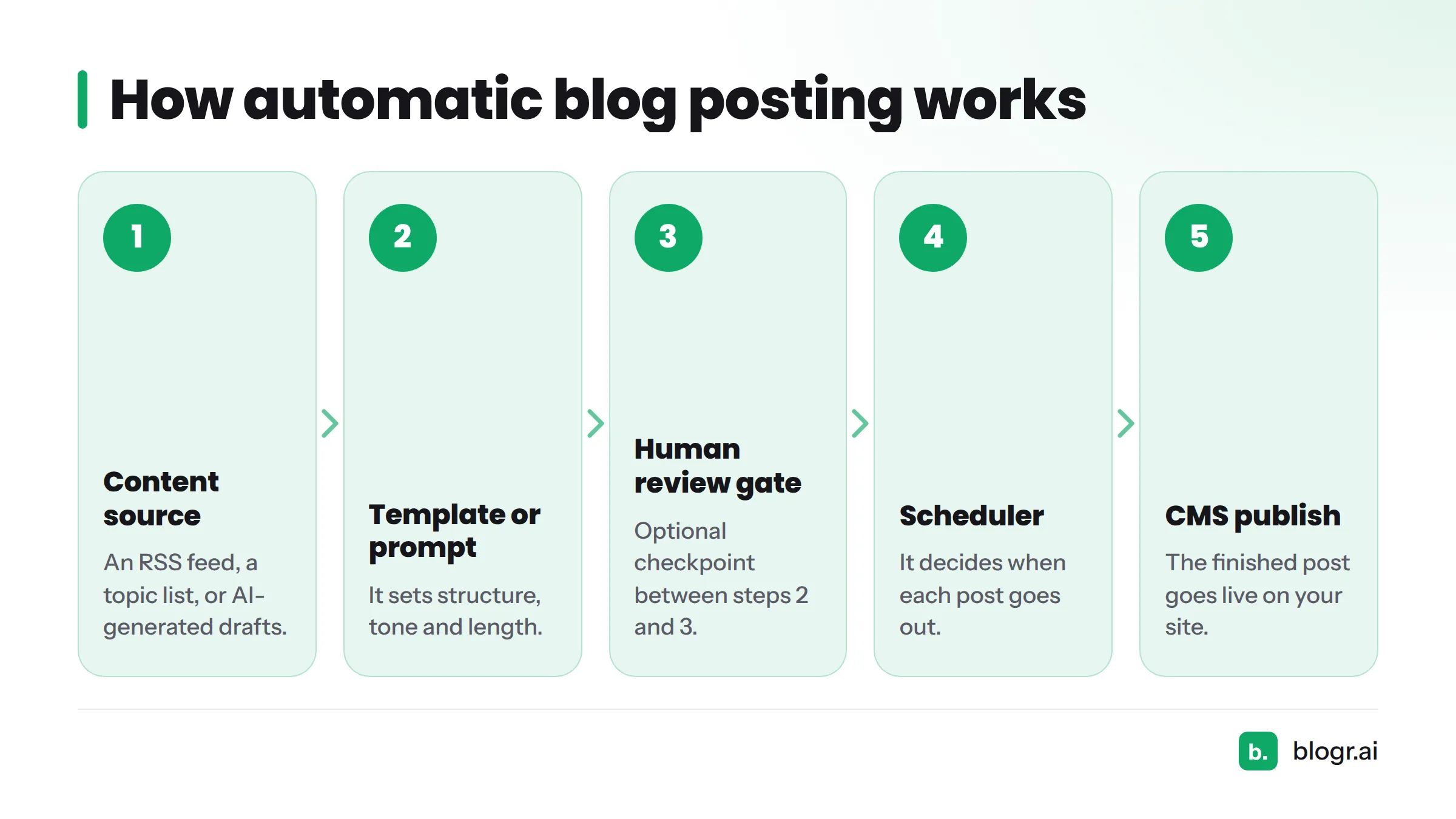
- A content source. An RSS feed, a topic list, or AI-generated drafts.
- A template or prompt. It sets structure, tone and length.
- A scheduler. It decides when each post goes out.
- A CMS connection. It publishes the finished post to your site.
Picture a conveyor belt: source → template or prompt → [optional human review gate] → scheduler → CMS publish. The review gate sits between steps 2 and 3. Skip it and the belt runs on its own.
Step 1: A content source
The source is where raw material comes from. In an RSS autoblog, it is other people's feeds. In a topic-list setup, it is a queue of keywords or titles. In a modern AI setup, it is drafts produced by a large language model.
Step 2: A template or prompt that shapes the post
The template turns raw input into a post: headline, headings, length, internal links, voice. A weak template produces the same hollow structure every time. A good one encodes your brand voice and your editorial rules.
Step 3: A scheduler that sets the publishing schedule
The scheduler works like a cron-style queue. It releases one post per day, three per week, or whatever pace you set. Pacing matters. Fifty posts dumped in an afternoon look very different from a steady drip.
Step 4: A CMS connection that publishes the post
The last link is a webhook or API call into your CMS. The post lands on your site, formatted and live. Setup details for one platform deserve their own page: auto-posting to WordPress.
For the broader picture of how this fits into a content program, see this overview of SEO content automation. For how AI-written drafts fit in, read What Is an AI Blogger? How It Works and Its Limits.
Old-Style Autoblogs vs Approval-Gated Publishing
Here is where the real split happens. This comparison reflects our experience and reasoning as SEO operators, not measured data.
How an RSS autoblog, scraped site or spun site works
An RSS autoblog subscribes to feeds and republishes the items on its own site. A scraped version skips the feed and copies the page. A spun version runs the copy through software to reword it. Nobody reads the output, because the site exists to publish volume.
The trouble is structural. The content is not yours, it adds nothing new, and nobody checks it.
How approval-gated publishing works
Approval-gated publishing automates everything except the decision. The software generates drafts, formats them and queues them. Then a person reads each one and approves, edits or declines it. Only approved posts reach the scheduler. This is the model behind automated blogging done with approval.
Side-by-side comparison
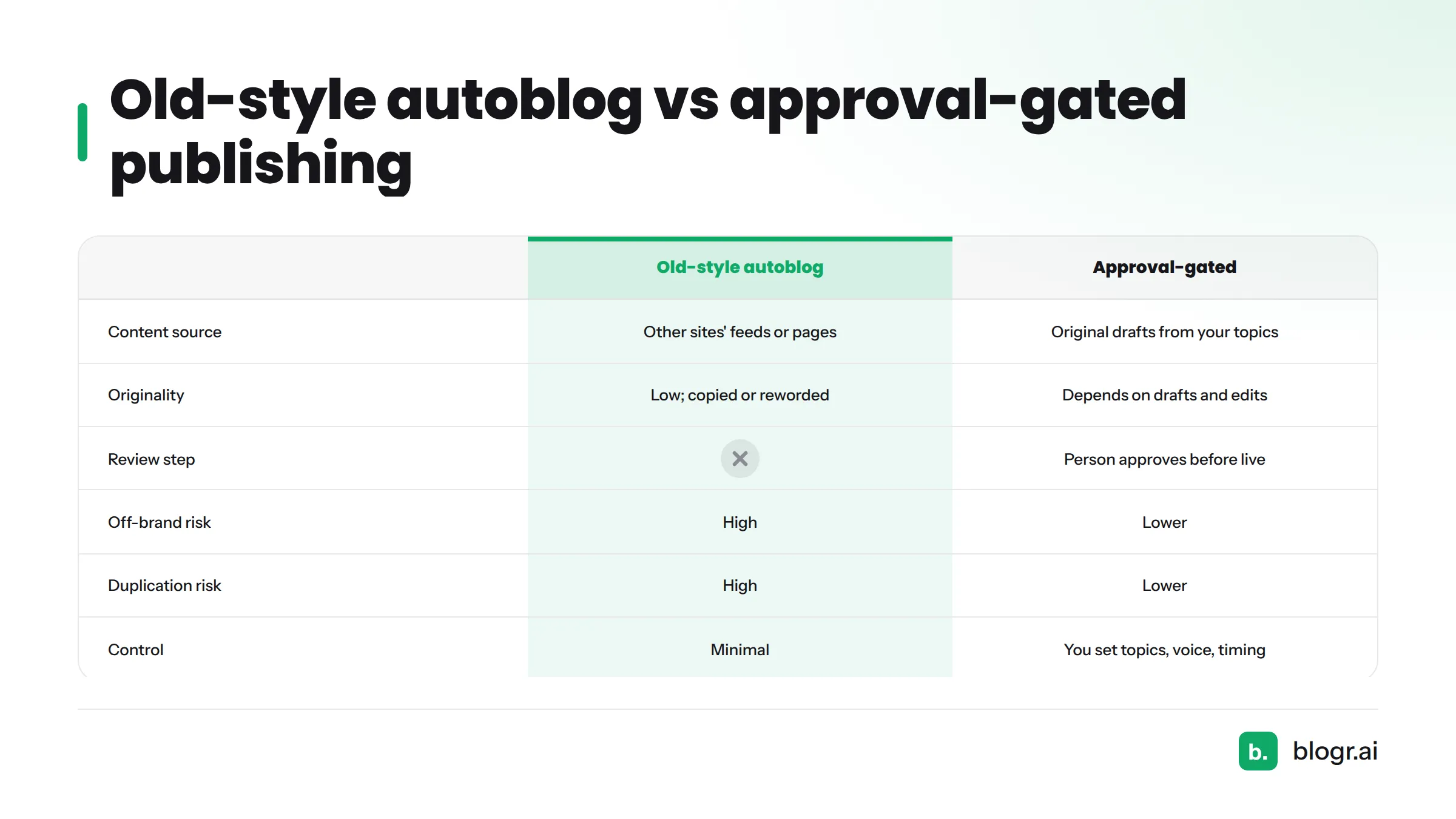
| Factor | Old-style autoblog (RSS, scraped, spun) | Approval-gated publishing |
|---|---|---|
| Content source | Other sites' feeds or pages | Original drafts from your topics and prompts |
| Originality | Low; copied or reworded | Depends on the drafts and your edits |
| Review step | None | A person approves before anything goes live |
| Off-brand risk | High | Lower, because you can decline posts |
| Duplication risk | High | Lower |
| Control | Minimal | You set topics, voice and timing |
| Ability to pause or decline | Often none | Built into the workflow |
Approval-gated publishing does not guarantee rankings or protect you from penalties. It puts judgment back where it belongs.
When an Automatic Blog Helps
Automation earns its keep when the work is repetitive and the standards are clear. From what I have seen, it pays off in four situations:
- Consistency. A blog that publishes every week beats one that publishes in bursts and then goes silent.
- Time saved. Formatting, scheduling and uploading are chores. A machine can do them.
- A reusable process. Once your template works, you can reuse it across several sites.
- Drip publishing. A steady cadence is easier on readers and on your editorial calendar than bulk dumps.
Small teams and solo founders tend to feel this most. If you are still working out what to write, a solid SEO content strategy keeps the automation pointed at the right topics.
When an Automatic Blog Fails
Automating the schedule is fine. Automating judgment is where blogs fail. Here is how that looks.
Scraped or spun content and duplication
Copied text is the fastest route to a worthless site. Readers can find the original, and spun versions often read awkwardly. Google's spam policies address scraping and automatically generated content produced without adding value, so this is not a gray area worth testing.
Thin, generic or off-brand posts
Even original drafts can be bland. Without a review step, generic intros, filler paragraphs and the wrong tone slip through. If you need a fast fix, these edits that make AI content read as human are a good place to start.
Factual errors nobody catches
A model can state something wrong with total confidence. When no one reads the post before it publishes, the error goes live and stays there.
Search risk
Google says that using automation, including AI, to generate content whose main purpose is manipulating rankings violates its spam policies. Its guidance on generative AI adds that AI-generated content is not banned by default, and that what matters is whether the content is helpful and original. I will not parse the policy line by line here. What counts as scaled content abuse belongs on a separate page.
Troubleshooting mini-table
| Symptom | Likely cause | Fix |
|---|---|---|
| Posts read like other sites | Scraped or spun source | Switch to original drafts; remove copied posts |
| Every post sounds the same | Weak template or prompt | Rewrite the prompt with voice rules and examples |
| Wrong facts appear | No human review | Add an approval step and check claims against sources |
| Fifty posts appear overnight | Bulk publishing | Set a drip schedule |
| Posts you dislike go live | No way to decline | Use a workflow where you approve first |
How to Tell a Safe Automatic Blog Setup From a Risky One
Run this two-minute check on any setup, yours or someone else's.
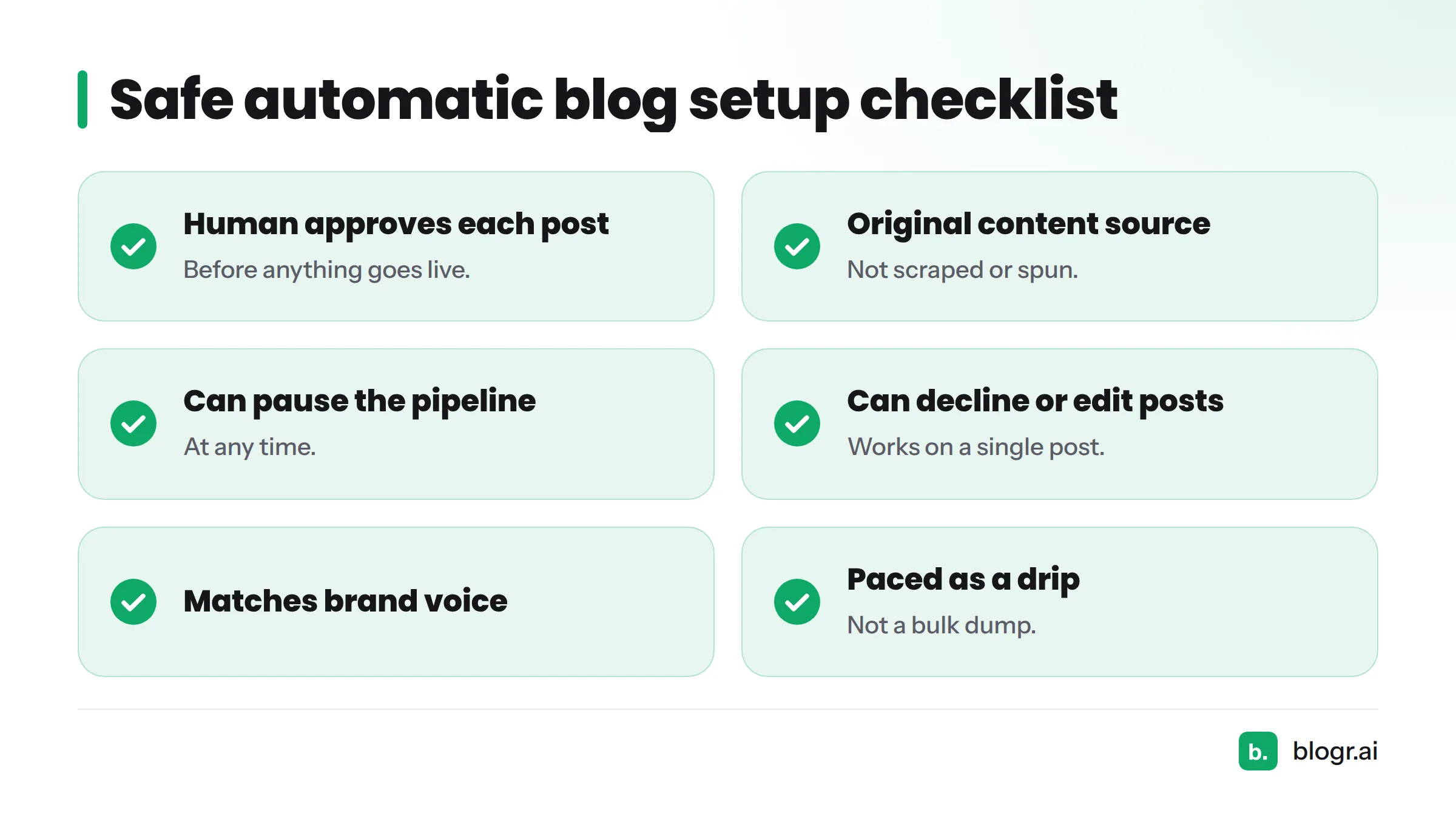
Safe-setup checklist
- A human approves each post before it goes live.
- The content source is original, not scraped or spun.
- You can pause the whole pipeline at any time.
- You can decline or edit a single post.
- Posts match your brand voice.
- Claims are fact-checked and sources are cited.
- Publishing is paced as a drip, not a bulk dump.
- Each post has a clear purpose for a real reader.
- You review performance afterwards and adjust.
- The setup is documented so someone else could take over.
Quick decision tree
- What is the source? Scraped or spun: stop, this is risky. Original: continue.
- Does a person approve each post? No: add a review gate before continuing. Yes: continue.
- Can you pause or roll back? No: risky. Yes: your setup is on the safer side.
Three yeses will not make a blog rank. They do mean you are automating the right parts. For tooling context, this guide to combining auto SEO tools shows how the pieces fit.
Next Steps
Four topics each get their own page: what an auto blogger is, what counts as scaled content abuse, auto-posting to WordPress, and how to automate SEO content properly. For the bigger picture, see how SEO content automation works from research to refresh.
Want a blog on autopilot with a human in charge? Try automated blogging done with approval and start the 7-day free trial at blogr.ai. You approve every post. The schedule runs itself.
FAQ
What is an automatic blog?
An automatic blog is a blog where software sources, formats, schedules and publishes posts with little manual effort. The automation handles publishing mechanics. Whether the content is good depends on the source and on whether a person reviews each post.
Is an automatic blog the same as an autoblog?
Mostly, but not always. "Autoblog" usually means a feed-driven or scraped site that publishes unattended. "Automatic blog" is broader and can include original, AI-assisted drafts with a human approval step.
How does automatic blog posting work?
It follows four stages: a content source, a template or prompt, a scheduler, and a CMS connection that publishes the post. A careful setup adds a human review gate between the template and the scheduler.
Can an automatic blog run with no human involved?
Technically, yes. Practically, that is where most failures start. Without review, errors, off-brand posts and duplicated material go live unchecked. Keeping a person on the approval step is the safer design.
Do automatic blogs hurt SEO?
They can. Google's spam policies target automation used to manipulate rankings, and low-value copied content is a common cause. Original, reviewed content is a different case, though nothing guarantees results.
What is the difference between a scraped autoblog and approval-gated publishing?
A scraped autoblog copies other sites and publishes without review. Approval-gated publishing creates original drafts and holds each one until a person approves it. The first automates judgment. The second automates only the mechanics.
Does an automatic blog need a CMS?
Yes, in most cases. The CMS stores and publishes your posts, and the automation connects to it through an API or webhook. WordPress is the most common example.
Can AI-generated content be published automatically?
It can be, and Google's guidance on generative AI content says AI use alone is not the issue. Quality and originality are. I recommend a human review step before anything goes live.