


What Is an Auto Blogger? Types, Uses and Limits

An auto blogger is software that writes and posts blog content with little manual work. It comes in five main types: RSS and scraper autoblogs, article spinners, AI article writers, scheduling or auto-publish plugins, and full-loop systems that also plan topics, publish, and measure results. Here is how they differ, and how to pick one.
I have spent years watching teams buy "autoblogging" tools that promised a finished blog and delivered a pile of drafts. The label is loose. It covers a 2008 posting script and a 2026 publishing system in the same breath. Let's break it down so you know what you are buying.
What Is an Auto Blogger?
An auto blogger automates part or all of the blog workflow: finding topics, writing posts, and publishing them to a site. "Autoblogging," "auto blogging," and "automated blogging" all mean the same thing. For the broader idea of a blog that posts itself, read how an automatic blog works.
What matters is how much of the workflow the tool covers. Some tools only paste text into a post. Others run the whole loop.
The old meaning: copy and repost
Early autoblog scripts and plugins pulled items from an RSS feed and republished them on a schedule, often on Blogger or WordPress. They wrote nothing. They copied.
The modern meaning: AI drafting plus automation
Today a large language model drafts the post, and a connected system may choose the topic, schedule it, and push it to your CMS. Many searches for an "auto blogger website" or "auto blogger app" are really looking for this second kind.
One distinction helps here. An AI blogger is the writing engine. An auto blogger is the engine plus the automation around it. For the writing side, see the AI blogger guide.
Five Types of Autoblogging Tools
Here are the five types you will meet:
- RSS feed autoblogs and scrapers
- Content spinners
- AI article writers (drafting only)
- Scheduled publishing and CMS auto-publish plugins
- End-to-end automated publishing loop tools
RSS feed autoblogs and scrapers
These pull other sites' content through feeds or scraping and repost it. They are fast and cheap. They also reuse text someone else wrote, which is the core problem.
Content spinners
A spinner rewrites existing text by swapping words and phrases. The output is a near-duplicate of the source and often reads awkwardly. A spinner is not an auto blogger, but spinners often ship inside one.
AI article writers
These generate a draft from a prompt or keyword. They are good at first drafts, and they stop there: no topic strategy, no publishing, no measurement.
Scheduling tools and CMS auto-publish plugins
These take finished text and post it on a schedule. A WordPress plugin that drips posts out is the classic case. They automate the last step only. If you run WordPress, see how CMS auto-publish for WordPress fits in.
End-to-end publishing loop tools
These connect topic sourcing, briefing, drafting, approval, publishing, and measurement. This is where SEO content automation sits.
| Type | What it does | Strength | Main risk |
|---|---|---|---|
| RSS and scraper autoblogs | Reposts content from feeds or scraped pages | Zero writing effort | Duplicate content, copyright trouble |
| Article spinners | Rewrites existing text with swaps | Cheap volume | Near-duplicates, poor readability |
| AI article writers | Drafts new text from a prompt | Fast first drafts | No strategy, accuracy needs checking |
| Scheduling and auto-publish plugins | Posts finished content on a timer | Consistency | Automates only the last step |
| Full-loop systems | Plans, drafts, publishes, measures | One connected workflow | Needs a real approval step and clear inputs |
What Automated Blogging Does Well and Where It Fails
Automation is good at three things:
- Volume and consistency. A tool does not skip a Tuesday.
- Scheduling. Posts go live when you planned, without you logging in.
- First drafts. A usable draft in minutes beats a blank page.
It is weak in four places:
- Original experience. A tool cannot tell your customer story or share a test it never ran.
- Accuracy. Language models can state wrong facts with confidence. Someone has to check.
- Voice. Without your input, posts sound like everyone else's.
- Strategy. A tool will not decide which topics build authority for your site.
Thin and duplicate content can cost you
Google Search Central's spam policies describe "scaled content abuse" as producing many pages mainly to manipulate rankings, however they are made. Google's guidance on AI-generated content says automation is not banned, but content made without adding value for people can break policy. Scraped and spun posts sit squarely in the danger zone. Careful AI drafts with human review do not.
| An auto blogger can | An auto blogger can't |
|---|---|
| Draft and schedule on a steady cadence | Supply your first-hand experience |
| Push posts to your CMS | Verify every fact for you |
| Repeat a format reliably | Choose your business strategy |
| Save hours on routine steps | Guarantee rankings or traffic |
A Five-Stage Framework for Judging Any Auto Blogger
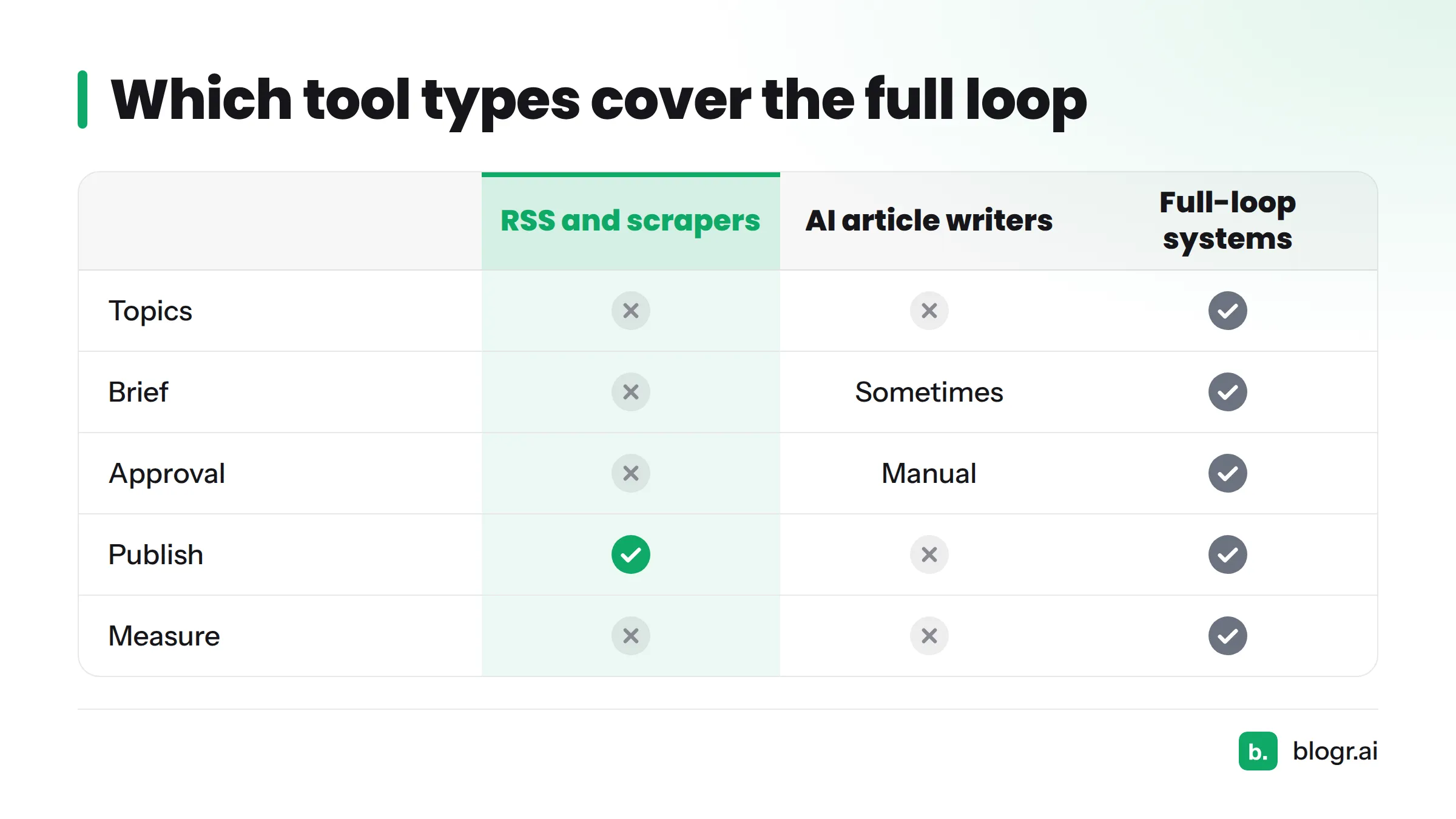
After building an end-to-end loop myself, my view is simple: an auto blogger is only as good as the loop around it. Judge any tool on these five stages, in order: topic sourcing, briefing, approval, publishing, and measurement.
1. Topic sourcing
Where do topics come from? Good tools use your keyword data and a topical map. Bad ones guess with a random generator.
2. Briefing
A content brief tells the writer what the page must cover. The strongest briefs come from the live search results, like AI content briefs built from the live SERP. Without one, a draft is a guess at what ranks.
3. Approval
A human approval step lets you read, edit, or reject a post before it goes live. I treat it as a feature, not a delay. It is the cheapest protection you have against errors and off-brand text.
4. Publishing
Can the tool post to your CMS, set categories and metadata, and schedule? Look for real integrations, not copy and paste.
5. Measurement
Does the tool read Google Search Console data to see what worked? Without measurement, you automate output but never learn. For what to watch, see how to read Search Console data.
| Tool type | Topics | Brief | Approval | Publish | Measure |
|---|---|---|---|---|---|
| RSS and scrapers | No | No | No | Yes | No |
| Spinners | No | No | No | Sometimes | No |
| AI article writers | No | Sometimes | Manual | No | No |
| Scheduling plugins | No | No | Manual | Yes | No |
| Full-loop systems | Yes | Yes | Yes | Yes | Yes |
Drafting-Only Tools vs Tools That Run the Whole Loop
Picture a founder who buys a drafting tool. On Monday she pastes in a keyword and gets 1,500 words. Then the real work starts. She picks the next topic by hand, checks the facts, formats the post, uploads it, and weeks later wonders whether anything ranked. The tool wrote. She ran the blog.
A full-loop tool takes over the stages before and after the draft. That is the real difference, and the matrix above shows it. For a roundup of the wider category, see automated SEO tools worth considering.
How to Judge an Auto Blogger Before You Commit
Run this checklist:
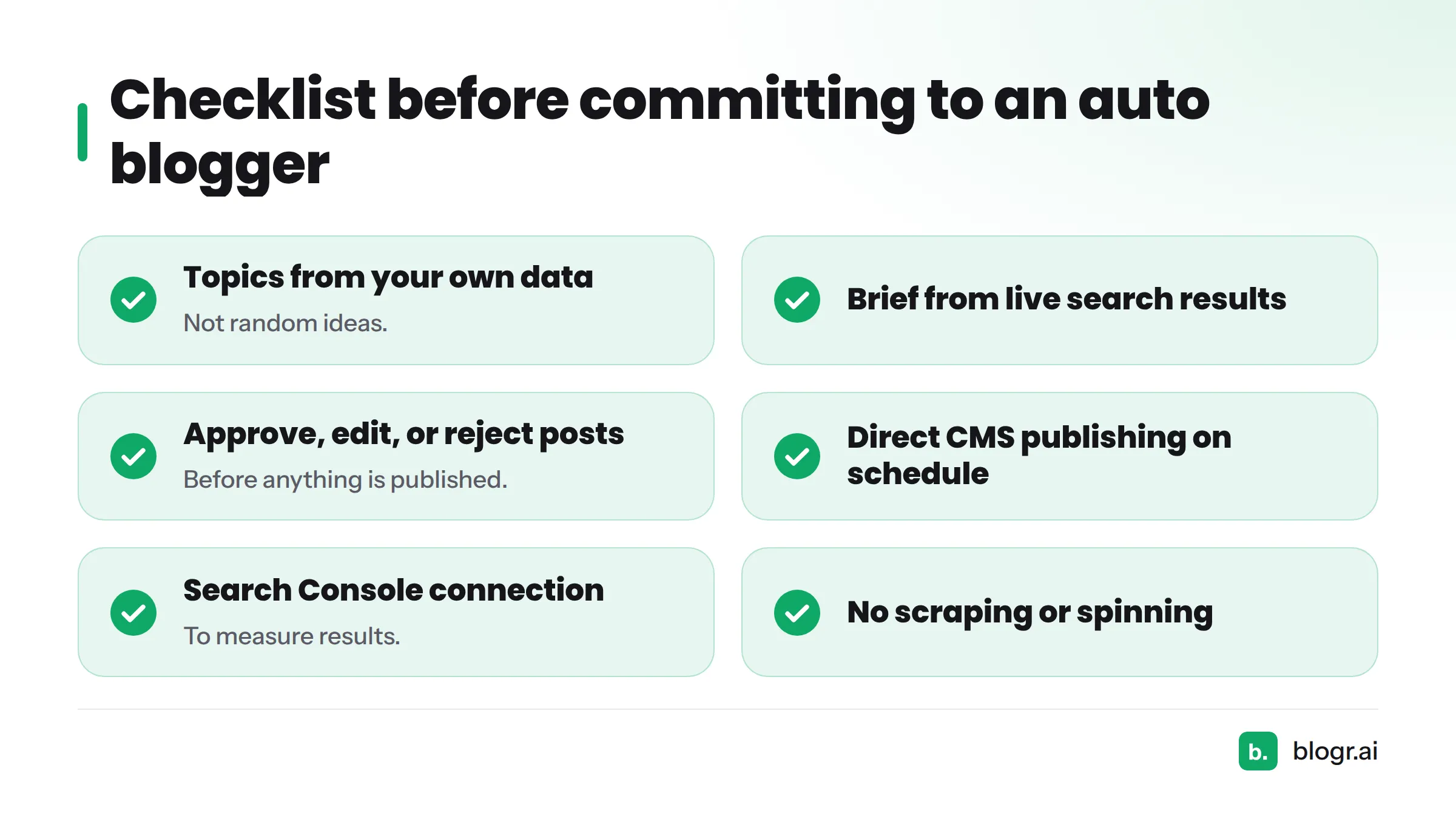
- Does it source topics from your own data, not random ideas?
- Does it build a brief from live search results?
- Can you approve, edit, or reject every post before publishing?
- Does it publish to your CMS directly and on a schedule?
- Does it connect to Search Console to measure results?
- Can you set brand voice and add your own facts?
- Does it avoid scraping or spinning other sites' text?
- Can you export your content if you leave?
Red flags: promises of "no human intervention," guaranteed rankings, hundreds of posts a day, or no way to see a post before it goes live.
If approval matters to you, look for an auto blogger that waits for your approval. Disclosure: blogr.ai publishes this guide and builds that kind of tool.
Who Should Use an Auto Blogger and Who Should Wait
Good fits:
- Founders and small teams who cannot publish weekly by hand
- Agencies running content across several sites
- Sites with a clear topic plan and someone to approve posts
Wait if:
- You have no keyword research or topic plan yet
- Your content depends on original reporting or expert opinion
- You cannot spend even a few minutes reviewing each post
- You want a shortcut to traffic with no oversight
FAQ
What is auto-blogging?
Auto-blogging is the use of software to create and publish blog posts with little manual effort. The software may pull feeds, rewrite text, or generate new posts with AI, then post on a schedule.
What is an AI auto blogger?
An AI auto blogger uses a language model to write posts and automation to publish them. Better ones also pick topics, build briefs, and track results.
Is auto blogging safe for SEO?
It depends on the type. Scraped and spun content risks breaking Google's spam policies. Original, reviewed content is treated like any other. Quality and value to readers decide the outcome, not the tool.
What is the best autoblogging plugin for WordPress?
Choose by criteria, not by name. Look for direct publishing, scheduling, an approval queue, original text rather than scraped feeds, and metadata control. The CMS integrations page shows what a proper connection includes.
How do I use AI to make a blog?
Pick a topic from keyword data, build a brief, generate a draft, edit it with your own facts and voice, then publish and check Search Console. An auto blogger automates several of those steps.
Can an auto blogger post without approval?
Yes, many can. That is a setting, not a requirement. I recommend keeping approval on until you trust the output.
Next Steps
Ready to compare your options? See the best AI SEO writers compared, or start the 7-day free trial at blogr.ai and watch the full loop run with your approval.