


What Is an AI Blogger? How It Works and Its Limits

An AI blogger is software that uses a large language model to plan, draft, and sometimes publish blog posts for a website. It takes a topic, studies what already ranks, writes a draft in a set voice, and then hands it to a person for review or sends it to your CMS. The quality of the result depends on the topic data going in and the approval coming out.
That is the short version. Here is the longer one, written from the operator's side of the desk. My co-founders and I have run organic growth for our own products, so I have seen both the wins and the messy failures. Let's break it down.
What Is an AI Blogger?
A plain definition
An AI blogger turns a topic into a blog post, with a large language model (LLM) doing the writing. You will also hear it called an AI blog writer, an AI blogging tool, or an AI blog generator. People use the names loosely, and most of the time they mean the same thing: software that drafts posts so you do not start from a blank page.
Quick definition: an AI blogger is a pipeline, not a prompt. The model writes the words, but topic selection, a content brief, human approval, and publishing decide whether those words are any good.
A large language model predicts text one piece at a time, based on patterns learned from huge amounts of writing. That is why it writes fluently. It is also why it can sound sure of itself while being wrong.
AI blogger vs a chatbot vs a human blogger using AI
People mix these three up constantly. Here is how they differ.
| General chatbot (like ChatGPT) | AI blogger | Human blogger using AI | |
|---|---|---|---|
| Starts from | Your prompt | A topic list, keyword data, or a plan | The writer's own idea |
| Research | Whatever you paste in | Keyword research and SERP analysis built in | Done by the writer |
| Output | A single reply | A structured draft, often with a brief | A draft the writer shapes |
| Review step | You decide | Should be built in | The writer is the review |
| Publishing | Copy and paste | Can connect to your CMS | Manual |
A chatbot is a flexible assistant. An AI blogger is a workflow built around one job: getting posts onto a site. If you are comparing tools, this guide on how to choose an AI writing tool covers the selection criteria in more depth.
How an AI Blogger Produces a Blog Post
The pipeline runs in a fixed order: topic, brief, draft, review, publish, measure. Picture a left-to-right line with a person standing at the review gate.
- Choose the topic. Pick a subject with real search demand.
- Build the brief. Analyze the live results and outline the post.
- Generate the draft. The LLM writes against the brief.
- Review and approve. A human checks facts, voice, and intent.
- Publish and measure. Send it to the CMS, then watch the data.
Step 1: Topic selection and keyword research
Good automated blogging starts before any writing. Keyword research shows what people type into Google, and search demand data tells you whether a topic deserves a post at all.
The best demand data is your own. Search Console data lists the queries where you already earn impressions, and striking distance keywords point to pages sitting just off page one. For a bigger plan, a topical map groups topics so posts support each other.
Step 2: SERP analysis and the content brief
A content brief tells the model what to write and for whom, and SERP analysis feeds it. You look at the pages that already rank, spot the search intent, note what they cover, and find what they miss. Some tools build content briefs from the live SERP, so the draft targets a real gap instead of repeating the top results.
Step 3: Draft generation by a large language model
Now the LLM writes. Given a good brief, it produces a structured draft with headings, an intro, and sections in the voice you set. Given a vague prompt, it produces filler. Drafting is the cheapest step in the pipeline, which is exactly why the steps around it matter.
Step 4: Human approval and editorial review
A person reads the draft before it goes live. They check claims, fix anything off-brand, and add what only a human has: a real example, a first-hand story, a number from your own data. A few edits make AI drafts read human, and they take minutes, not hours.
Step 5: Publishing workflow and measurement
Once approved, the post goes to your CMS, such as WordPress, Webflow, Shopify, or Ghost. Then you track impressions, clicks, and position in Google Search Console and refresh whatever underperforms. The mechanics of automatic blog posting deserve their own guide, so I will leave them there.
What an AI Blogger Does Well
Used properly, an AI blogger removes the slow, repetitive parts of publishing. It works fast, keeps a consistent format, and handles structure well. It can summarize what top pages cover, apply a voice when you give it samples, and repurpose material you already own.
| Task | AI does well | Human still needed |
|---|---|---|
| Topic ideas | Generates many options quickly | Chooses based on business goals and demand data |
| Outline and brief | Structures sections from SERP patterns | Confirms the angle fits your reader |
| First draft | Writes fast, in a consistent format | Adds original experience and data |
| Brand voice | Mimics tone from examples | Judges if it sounds like you |
| Fact accuracy | Recalls common knowledge | Verifies every claim, name, and number |
| Publishing | Pushes to CMS on schedule | Approves what goes live |
| Measurement | Reports on queries and clicks | Decides what to change |
Where AI Blogging Fails Without Demand Data and Approval
Most tool pages skip this part. Google's own guidance says automation is not against its rules by default, but using it mainly to manipulate rankings is spam. Quality, not the method, is the test. Here is where things break.
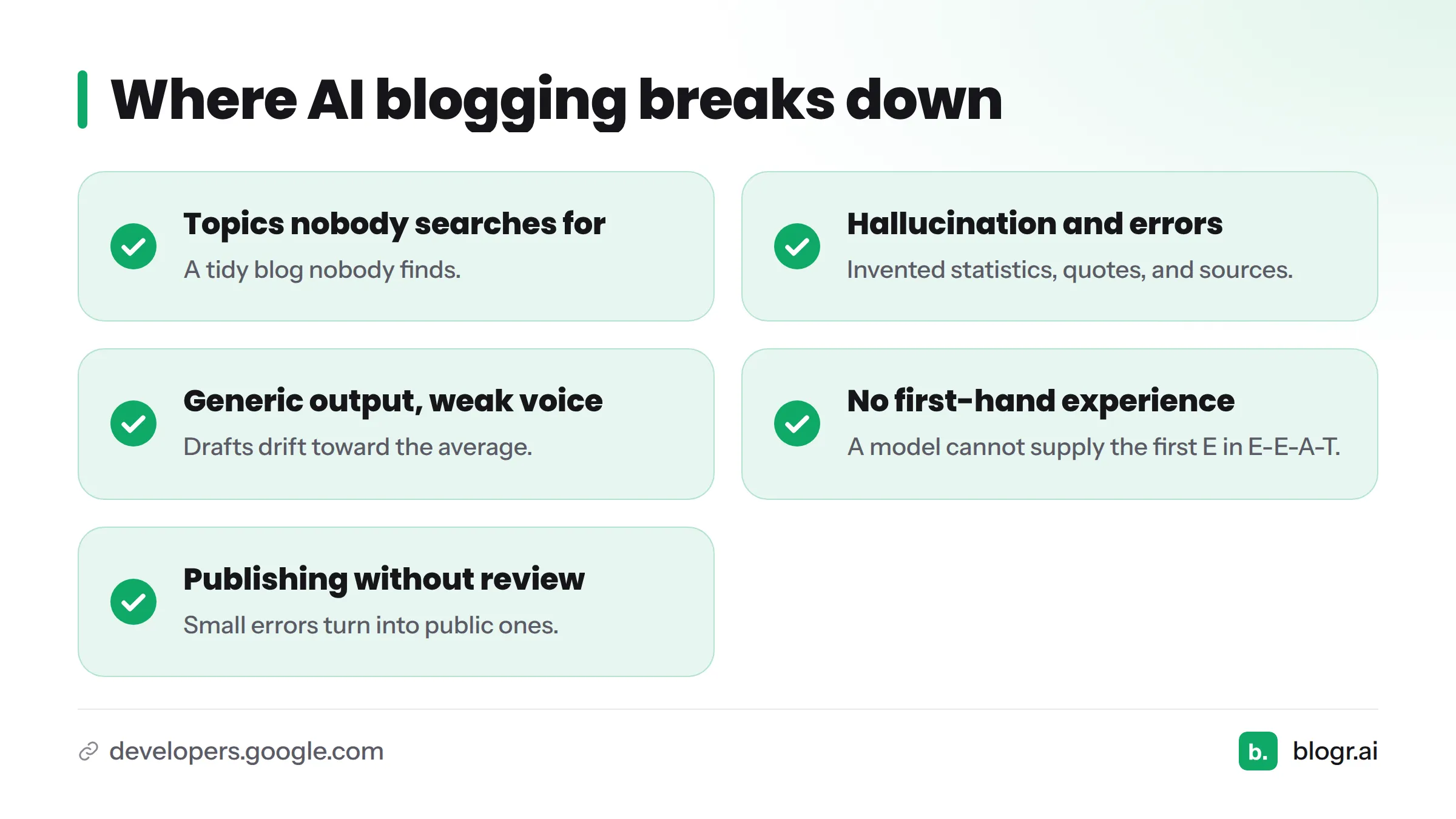
Writing about topics nobody searches for
A model will happily write 1,500 words on a subject with no audience. Without demand data, you end up with a tidy blog nobody finds.
Hallucination and factual errors
LLMs can invent statistics, quotes, and sources that sound real. This is called hallucination. It shows up as a made-up study, a wrong date, or a feature a product does not have.
Generic output and weak brand voice
Left alone, drafts drift toward the average of everything the model has read. They sound competent and forgettable.
No first-hand experience or original data
An LLM has not run your campaign, shipped your product, or talked to your customers. Google's guidance on creating helpful content points to experience, expertise, authoritativeness, and trust (E-E-A-T), and a model cannot supply the first E on its own.
Publishing without review
Autopilot sounds appealing. In my experience, it is where small errors turn into public ones.
Operator's note: when we ran organic growth for our own products, the worst posts were never the ones with clumsy sentences. They were the ones on topics we picked by gut feel, with no demand data, and the ones we let through without a read. Fixing the inputs (what to write) and the output gate (what ships) did more for quality than any change to the writing itself. I am describing what we saw, not promising results. Nobody can guarantee rankings, and I will not either. If you want the evidence question, look for a dedicated guide on whether AI content ranks in Google.
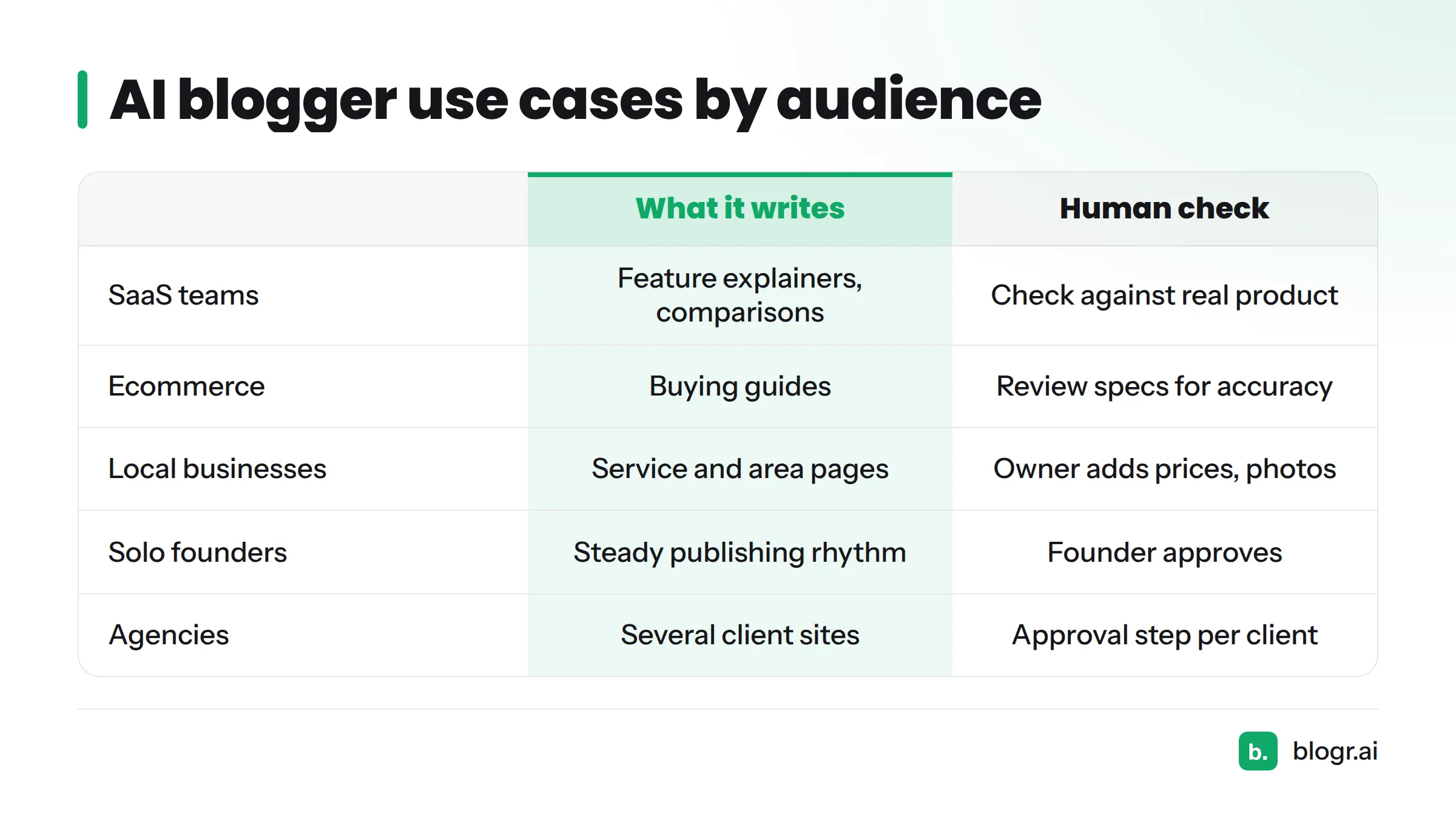
Practical Use Cases for an AI Blogger
- SaaS teams: feature explainers and comparison posts. A product marketer feeds in the feature list and approves the draft after checking it against the real product. See how this works for SaaS.
- Ecommerce: buying guides for categories with steady search interest, such as "how to choose a standing desk," reviewed for accuracy on specs.
- Local businesses: service and area pages, like "emergency plumber in a specific town," where the owner adds real prices and photos.
- Solo founders and small teams: a steady publishing rhythm without a hired writer, with the founder as the approver. Our guide to on-page SEO for founders covers the groundwork.
- Agencies: several client sites run from one workflow, with an approval step per client. Details are on the agency page.
Six Questions to Ask Before You Pick an AI Blogger Tool
Run this vendor-neutral checklist on any tool, ours included.
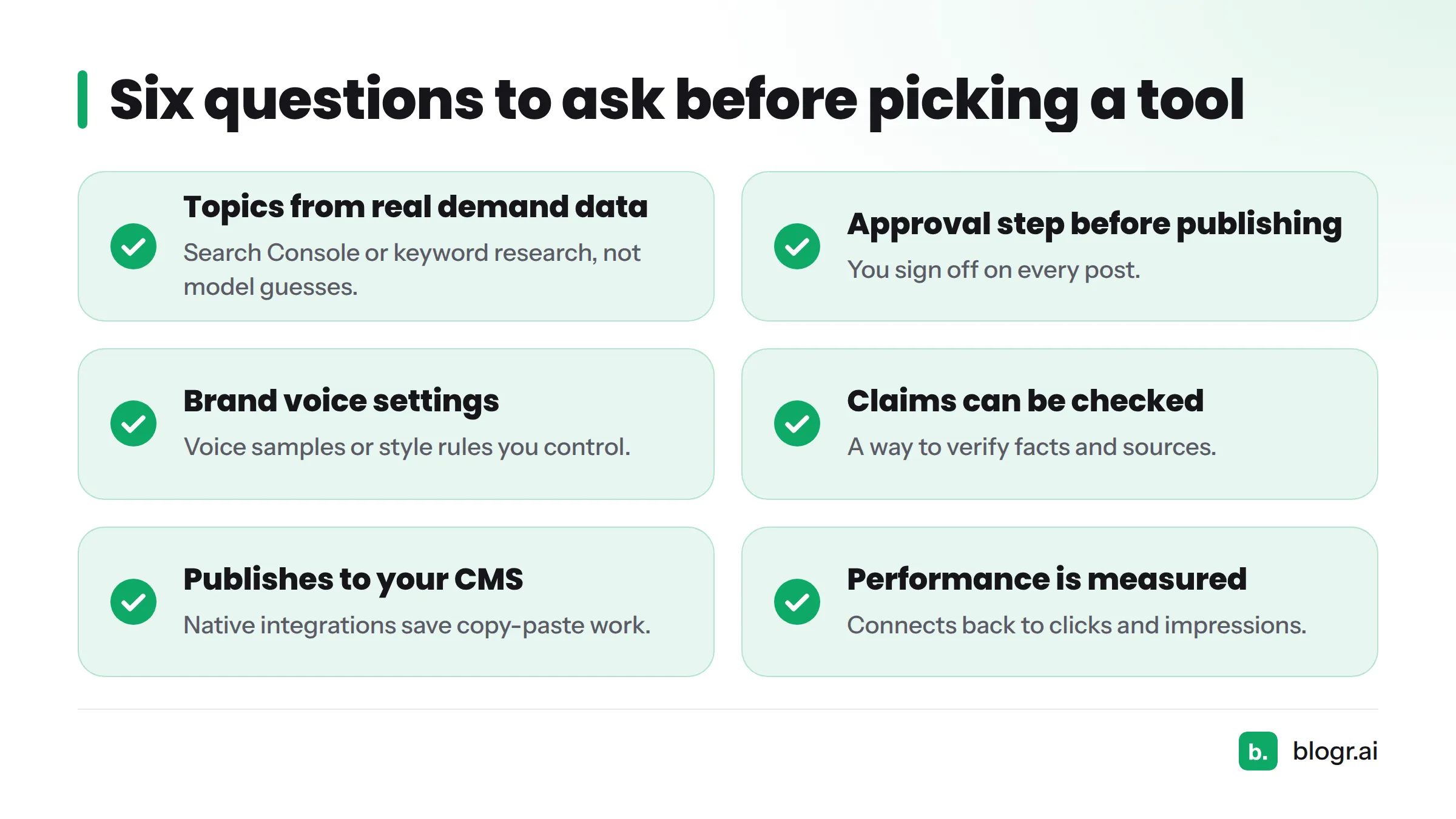
- Where do topics come from? Real demand data, such as Search Console or keyword research, not just model guesses.
- Is there an approval step? You should see and sign off on every post before it publishes.
- Can you set brand voice? Look for voice samples or style rules you control.
- Are claims checked? You need a way to verify facts and sources.
- Does it publish to your CMS? Native CMS publishing integrations save copy-paste work.
- Is performance measured? The tool should connect back to clicks and impressions.
Here is how to read your score:
| Result | What it means |
|---|---|
| 5 to 6 checks | Good fit. Start small and review every post. |
| 3 to 4 checks | Needs more control. Add your own demand data and approval process first. |
| 0 to 2 checks | Not a fit. You would be automating guesswork. |
Full disclosure: blogr.ai is our product. It is built around this exact loop of demand data, live SERP briefs, human approval, and CMS publishing. If you want to see an AI blog writer built that way, start the 7-day free trial and judge it against the checklist above. You can also read the blogr.ai homepage for the overview.
Frequently Asked Questions
Can AI write a blog on its own?
Yes, technically. A large language model can produce a full post from a prompt. Whether it should publish without a human is a different question, and the answer is usually no, because facts, voice, and topic choice still need a person.
What is an AI blogging tool?
An AI blogging tool is software that uses an LLM to help plan, draft, and publish blog posts. The better ones wrap keyword research, SERP analysis, and an approval step around the writing.
Is an AI blog generator the same as an AI blogger?
Close, but not identical. A generator usually just produces text from a prompt. An AI blogger covers the wider workflow: topic choice, brief, draft, review, and publishing.
Do I need to edit AI-written posts?
Yes. Check facts, fix voice, and add something original, like an example or your own data. Google's guidance focuses on whether content is helpful and reliable, not on how it was made.
Will an AI blogger improve my rankings?
No tool can promise that. Rankings depend on topic demand, content quality, and your site's authority. An AI blogger can help you publish more consistently, but results vary.
Can an AI blogger match my brand voice?
It can get close if you provide samples and clear style rules. Expect to edit, especially in the first few posts. Our guide to AI Overviews and SEO shows how voice and clarity affect visibility in answer engines.