


Surfer SEO Alternatives in 2026: 7 Tools Compared
The best Surfer SEO alternative depends on the job you need done. Editor-style optimizers like Clearscope and NeuronWriter grade a draft you already wrote. Automation platforms plan, write, publish and refresh for you. If you want the full loop, blogr.ai is my pick. Below are seven tools, compared the same way. I checked features and pricing models against vendor pages in October 2026.
A disclosure first: blogr.ai publishes this page, so it is our own product. I ranked it first because it covers the most workflow stages, and I give every other tool credit for what it does best. Verify current terms on each vendor's site before you buy.
Surfer SEO Competitors at a Glance
Here is the shortlist. Prices change often, so the table shows pricing models, not dollar figures. Check each vendor's pricing page for current numbers.
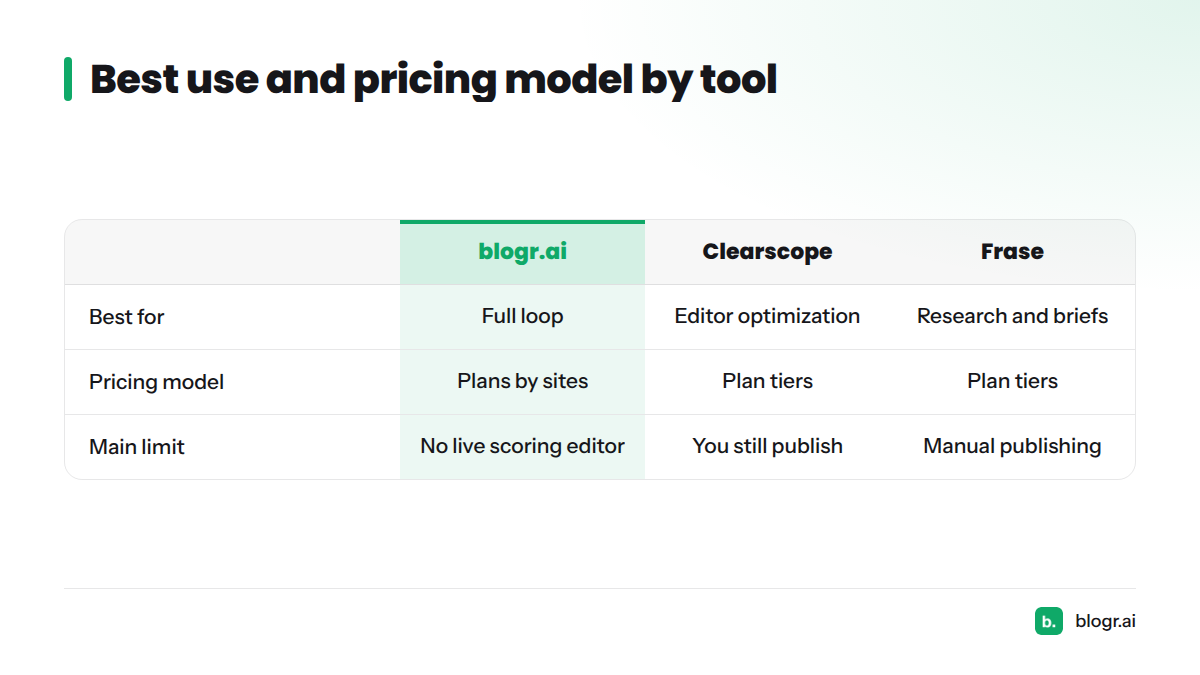
| # | Tool | Best for | Key difference | Main limit | Pricing model |
|---|---|---|---|---|---|
| 1 | blogr.ai | Full loop, Search Console to auto-publish and refresh | Picks titles from your own Search Console data, publishes to your CMS | No live as-you-type scoring editor | Plans by number of sites |
| 2 | Clearscope | Editor-based optimization | Focused content grading and term guidance | Optimizes drafts; you still plan and publish | Plan tiers (check vendor) |
| 3 | Frase | Research and brief-led work | SERP research feeding briefs and drafts | Manual publishing steps | Plan tiers (check vendor) |
| 4 | MarketMuse | Topical authority planning | Topic modeling and content planning | Heavier setup for small teams | Plan tiers (check vendor) |
| 5 | Scalenut | Fast AI drafting | Keyword planning plus AI writer in one app | Drafts still need editing | Plan tiers (check vendor) |
| 6 | Semrush SEO Writing Assistant | Lightweight optimization | Sits inside a broader SEO suite | Best value only if you already use Semrush | Part of Semrush subscription |
| 7 | Rankability | Agencies | Agency workflow and reporting | Agency-first framing | Plan tiers (check vendor) |
The split that matters most: an optimizer helps you improve one draft at a time. A full-loop platform decides what to write, writes it, publishes it and watches how it performs. Most of these content optimization tools sit on the optimizer side.
Why People Look for a Surfer SEO Replacement
Surfer is a respected tool, and I will say so up front. Its Content Editor scores a draft against top-ranking pages and suggests NLP terms and keywords, which many writers find useful. People who leave rarely say the tool is broken. Their complaints are about workflow and cost. Let's break it down.
Cost per seat and plan limits
Surfer's plans are tiered, with limits on what you can do under each one. Surfer's pricing page lists current tiers and what each includes. Per-seat pricing means every writer or editor adds cost, while per-article pricing means cost tracks output. Neither model wins in the abstract. The better fit depends on whether many writers publish a little or a few people publish a lot. If you are hunting for something cheaper than Surfer SEO, work out which of those two teams you are before you compare price tags.
Manual work on every article
The typical editor workflow goes like this: choose a keyword, write a draft, paste it into the editor, chase the score, then publish by hand. I have run this workflow on real sites, and the pile-up is predictable. Drafts wait for optimization. Optimized posts wait for publishing. Refreshes never happen.
Wanting planning, publishing and measurement in one place
An editor does not choose your topics, push posts to your CMS or tell you which old posts are decaying. Teams that want those jobs handled tend to look at automation platforms.
Ownership and packaging changes
Rankability's comparison page references a 2025 acquisition of Surfer by Positive Group. I cannot verify how that affects plans, so treat it as context and watch Surfer's own announcements.
How I Ranked These Tools Like Surfer SEO
I applied the same six criteria to every tool:
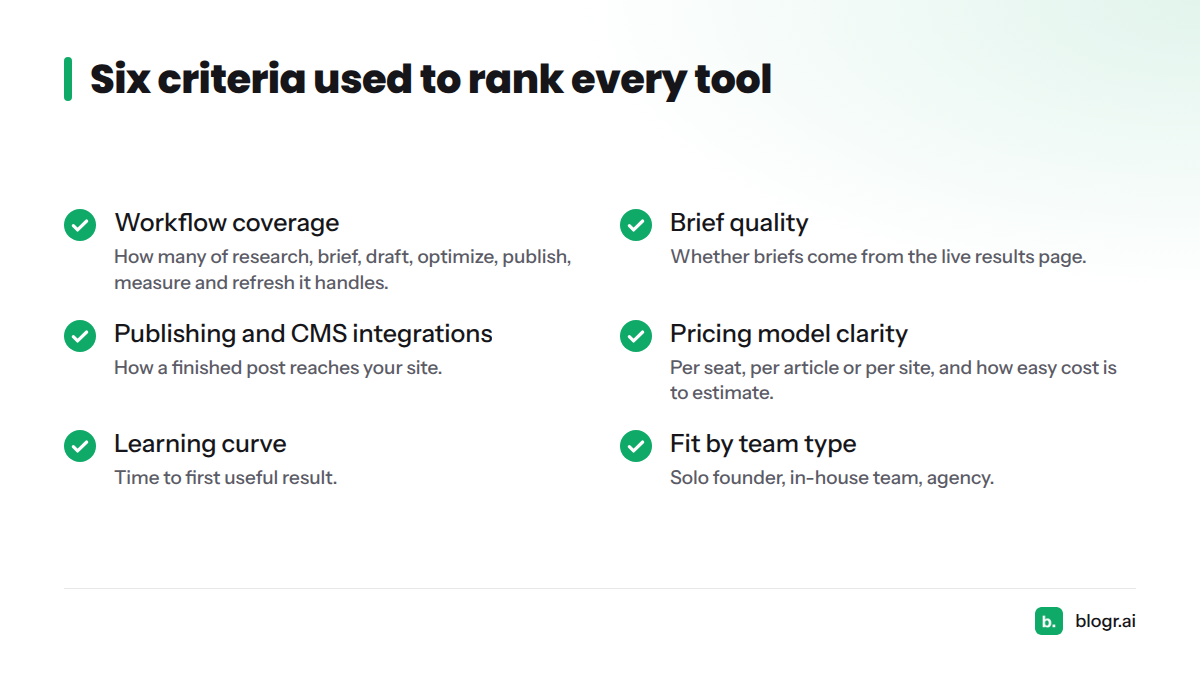
- Workflow coverage: how many of research, brief, draft, optimize, publish, measure and refresh it handles.
- Brief quality: whether briefs come from the live results page.
- Publishing and CMS integrations: how a finished post reaches your site.
- Pricing model clarity: per seat, per article or per site, and how easy it is to estimate cost.
- Learning curve: time to first useful result.
- Fit by team type: solo founder, in-house team, agency.
No tool guarantees rankings, and I do not claim any does. Google's own guidance says its systems reward helpful, people-first content, not tool scores.
A few terms used below:
- Content editor: a writing screen that grades your draft against competing pages.
- Content score: a number summarizing how closely a draft matches the terms and structure of top results.
- AI content brief: an outline with headings, questions and terms built before writing.
- Auto-publish: sending a finished post to your CMS without copy and paste.
- Content refresh: updating an existing post when its rankings or clicks slip.
1. blogr.ai: Best for the Full Loop From Search Console to Auto-Publish and Refresh
Best for: founders, SaaS teams, ecommerce and local sites that want less manual work.
It starts from your own data
Most tools begin with a keyword you typed in. blogr.ai begins with what your site already earns. It connects to Google Search Console and proposes titles from queries where you already sit near page one, the so-called striking distance keywords. You approve or decline each title, so nothing gets written without a yes. Teams that want less control can switch on full autopilot.
Each approved title gets a brief built from the live results page rather than a template. Planning starts with a topical map, so posts support each other instead of competing. Want a taste first? Try the free topical map generator.
As an AI SEO writer, it also produces the surrounding pieces: a brand-voice article, internal links, an SEO title and meta description, an FAQ section, schema markup and a cover image. That makes it an AI blog writer built for the whole job, not a draft generator.
Publishing and refresh
Posts go out through CMS integrations including WordPress, Webflow, Shopify, Ghost, Lovable, Directify, plus webhooks and a REST API. After each publish it resubmits your sitemap, then tracks positions and recommends a content refresh when a post slips.
One real example: an article for "best crm for startups" moved from position 12 to 4 in 21 days and picked up 620 impressions. That is one result, not a promise.
Limits
blogr.ai is not a line-by-line editor with live scoring as you type. If you want to tune a human-written draft sentence by sentence, an editor-style tool fits better.
Pricing model: plans by number of sites, each with a 7-day free trial. See the pricing page. Pick it if: you want the whole SEO content automation loop handled for you.
2. Clearscope: Best for Editor-Based Content Optimization
Best for: in-house writers who already produce drafts and want clear term guidance.
Key difference: Clearscope concentrates on grading and improving content rather than planning or publishing.
Limits: you still choose topics, publish and track refreshes yourself.
Pricing model: plan tiers; confirm on the vendor's pricing page.
Pick it if: your writers are strong and you want a focused editor. If you are leaving Clearscope instead, look for a dedicated Clearscope alternatives guide.
3. Frase: Best for Research and Brief-Led Workflows
Best for: teams that start with SERP research and briefs.
Key difference: Frase pairs research with brief creation and drafting in one workspace.
Limits: publishing and ongoing measurement remain mostly manual.
Pricing model: plan tiers; check the vendor site.
Pick it if: the brief is where your process stalls. Content Harmony is another brief-focused option worth a look.
4. MarketMuse: Best for Topical Authority and Content Planning
Best for: larger content programs that need to plan coverage of a subject.
Key difference: MarketMuse leans on topic modeling to show gaps in your coverage. WriterZen is a lighter option with topic discovery features.
Limits: more setup than a simple editor, which may be overkill for a small site.
Pricing model: plan tiers; check the vendor.
Pick it if: topical authority is your main goal and you have a team to act on the plan.
5. Scalenut: Best for Fast AI Drafting at Scale
Best for: teams that want keyword planning and an AI writer in one app.
Key difference: Scalenut combines planning and drafting, so first drafts arrive quickly.
Limits: AI drafts need human review for accuracy and voice.
Pricing model: plan tiers; check the vendor.
Pick it if: speed to first draft matters more than polish.
6. Semrush SEO Writing Assistant: Best for Budget or Lightweight Optimization
Best for: people who already pay for Semrush.
Key difference: the writing assistant lives inside a broader SEO suite, so you get optimization without another subscription. SE Ranking also offers a content editor within its suite. Its own comparison of Surfer alternatives is here, though that page is dated August 2025.
Limits: it is a lighter editor than a dedicated tool.
Pricing model: bundled into the suite subscription.
Pick it if: you want a cheaper way to score drafts and already use the suite.
7. Rankability: Best for Agencies
Best for: agencies managing content for clients.
Key difference: Rankability frames its product around agency workflow and reporting.
Limits: the framing is agency-first, so a solo founder may use little of it. If you run client sites and want automation, see blogr.ai for agencies too.
Pricing model: plan tiers; check the vendor.
Pick it if: reporting and client handoff matter as much as the content itself.
How to Choose Between Optimizing a Draft and Running the Whole Loop
Answer these in order:
- Do you already write strong drafts in-house? If yes, an editor (Clearscope, NeuronWriter, Semrush) fits. If no, lean toward a platform.
- Do you need publishing handled? If yes, pick a tool with CMS integrations.
- Is Search Console connected? If so, you can pick topics from real queries. Here is how to find keywords in Search Console.
- How many people need seats? Many seats favor per-site or per-article pricing.
- What is your budget model? A fixed monthly cost per site, or a cost that scales with output?
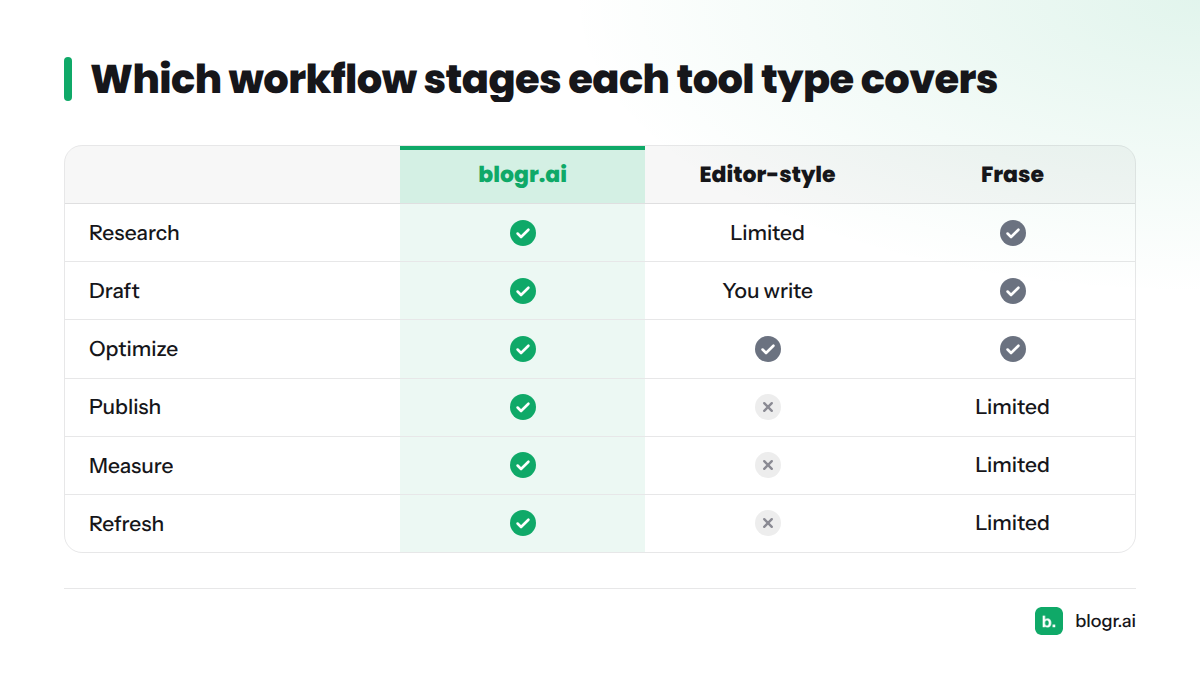
This table shows which workflow stages each group covers, based on each vendor's positioning. Verify on vendor pages.
| Stage | blogr.ai | Editor-style (Clearscope, NeuronWriter) | Brief/research (Frase) | Planning (MarketMuse) |
|---|---|---|---|---|
| Research | Yes | Limited | Yes | Yes |
| Brief | Yes | Limited | Yes | Yes |
| Draft | Yes | You write | Yes | Limited |
| Optimize | Yes | Yes | Yes | Yes |
| Publish | Yes | No | Limited | No |
| Measure | Yes | No | Limited | Limited |
| Refresh | Yes | No | Limited | Limited |
Signs you have outgrown an editor-only workflow
- You rank but get no clicks.
- Drafts pile up waiting for optimization.
- Old posts decay and no one has time to update them.
How to switch from Surfer SEO in five steps
Next steps, in order:
- Export your briefs and notes, and check your contract end date.
- Keep the posts that already perform. Do not rewrite winners.
- Trial the new tool on one site first.
- Compare clicks and positions in Search Console after a few weeks.
- Decide whether to switch fully or pair tools.
Pairing works. Some teams keep an editor for hand-written pillar posts and let a platform run the routine ones. For rankings beyond Surfer, see our wider comparison of AI SEO writers on the blog.
Try the Full Loop Before You Commit
Connect Search Console and start the 7-day free trial of blogr.ai. Plans are based on the number of sites; the pricing page has the details.
Frequently Asked Questions
What is the best Surfer SEO alternative?
It depends on your workflow. For the full loop of planning, publishing and refreshing, choose blogr.ai. For editing drafts, choose Clearscope or NeuronWriter. For research-led briefs, choose Frase.
Why do people switch from Surfer SEO?
Common reasons are cost per seat and plan limits, manual work on every article, and wanting planning, publishing and measurement in one place. Surfer's pricing page will help you judge cost for your team.
Is there a free Surfer SEO alternative?
Some vendors offer free trials, and blogr.ai has a 7-day free trial. Free tools exist for pieces of the job, such as a free Search Console audit and a keyword clustering tool. Fully free replacements for a paid editor are rare, so check each vendor's current free options.
Can I use Surfer SEO and blogr.ai together?
Yes. Use Surfer's Content Editor to polish hand-written posts and blogr.ai to plan, publish and refresh the rest. Test on one site first.
Is there a free version of Surfer SEO?
Check Surfer's official site for current trial or free options, since offers change.
Is Surfer SEO the best?
It is a strong editor-style tool. Whether it is best for you depends on whether you need a better editor or less manual work.